Birds · Psittaciformes · Psittacidae
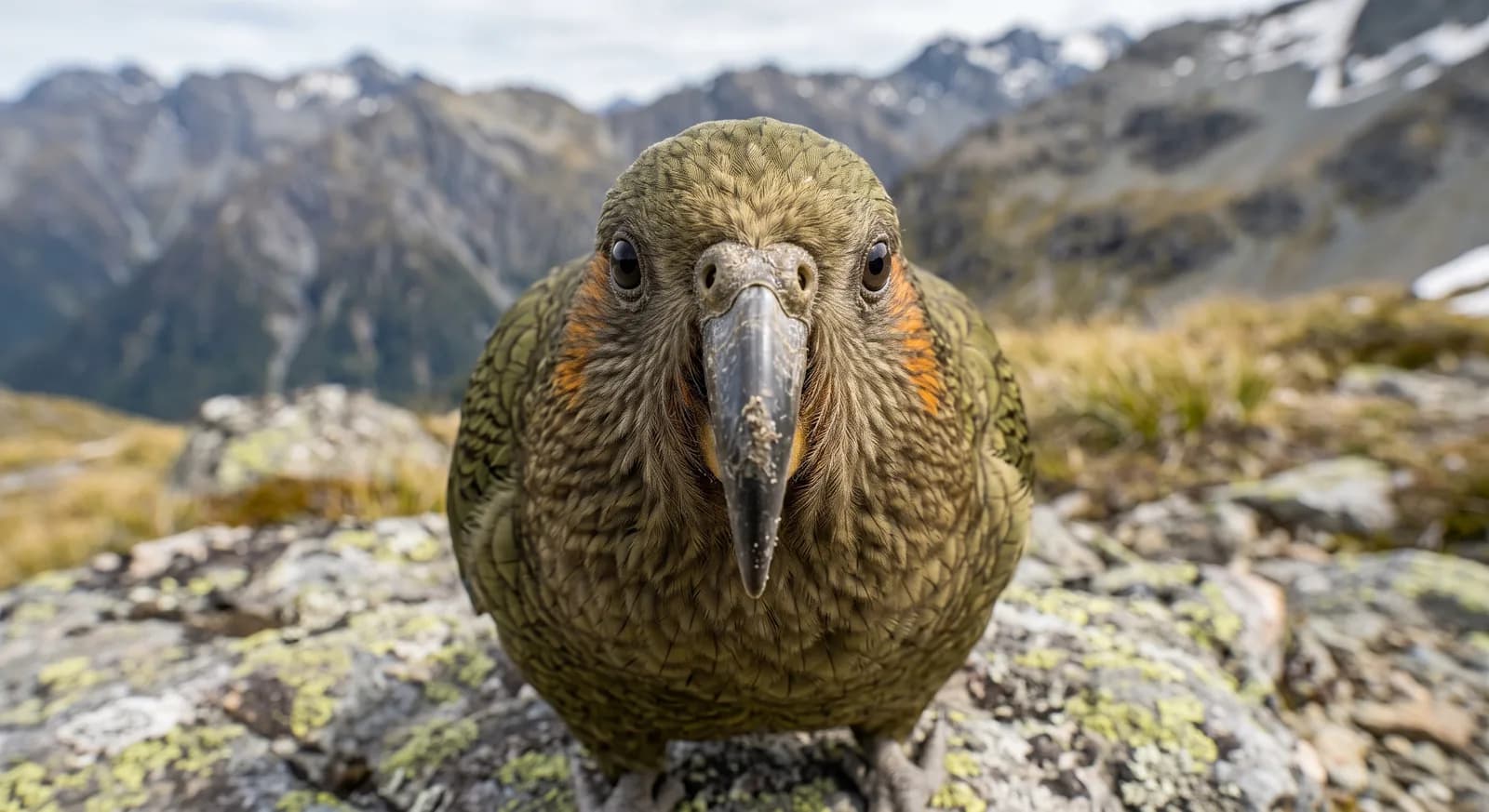
Kea
Nestor notabilis
It faces a very high risk of extinction in the wild in the near future. See full glossary
The kea is the only alpine parrot in the world and probably the most intelligent and inquisitive bird there is. It lives in the mountains of southern New Zealand, where it endures snow and sub-zero temperatures. It is omnivorous and extraordinarily destructive out of sheer curiosity: it dismantles windscreen wipers, rucksacks and hut roofs. It was subjected to an extermination campaign lasting almost a century because of its reputation for attacking sheep.
Weight
779 g – 956 g
Size
46 cm – 50 cm
Lifespan
30 years
Diet
Omnivore
Combines animal and plant food depending on availability.
Activity
Diurnal
Active mainly during the day.
Sighting difficulty
Hard
Estimated population
Between 3,000 and 7,000 individuals
Fun facts
- inteligenciaIt is one of the most intelligent parrots known, able to solve complex problems as a group, and has learned to strip rubber and plastic parts off parked cars out of sheer exploratory curiosity.
- It solves multi-step problems, uses tools and learns by watching other keas: in laboratory tests it has matched or beaten primates on tasks of causal and statistical reasoning.
- Between 1860 and 1970 the New Zealand government paid bounties for keas shot, and more than 150,000 birds were killed, because of their habit of attacking the backs of sheep to eat the fat.
- It has a call that works as contagious laughter: when it is played back, other keas spontaneously start to play, the first described case of contagious positive emotion in a bird.
Life cycle & biology
- Skeleton type
- Vertebrate - internal bony skeleton (bird)
- Habitat & environment
- Alpine grassland, subalpine scrub and beech forest of the south of New Zealand's South Island
- Sexual maturity
- 4 years
- Gestation / incubation
- 22 days of incubation
- Litter / clutch size
- 3 eggs
Sources consulted: https://es.wikipedia.org/wiki/Nestor_notabilis
Where to watch it
Parks and dive sites where this species has been documented.
Related species
Other species in the catalogue with the most in common with Kea — same habitat, park, country, tags or family.
New Zealand Kaka
Nestor meridionalis
Southern Brown Kiwi
Apteryx australis
Australian Magpie
Cracticus tibicen
Great Spotted Kiwi
Apteryx haastii
Kelp Gull
Larus dominicanus
Fiordland Penguin
Eudyptes pachyrhynchus
How to help
The kea is classified as endangered. Organizations such as UICN, WWF y Wildlife Conservation Society work specifically on its conservation and that of its habitat; looking into their programs is a good starting point if you want to get involved.
It's documented in 7 real protected areas — part of why protecting these places matters for its conservation.
Keep exploring
Based on what we already know about kea.
Comments
Share an experience, a fun fact or a tip for seeing the kea.
Be the first to comment.