National Park
Chiquibul
Belize
 Belize
Jaguar · Baird's Tapir
November to April
See parkA circular marine sinkhole three hundred metres across, formed as a dry cave during the last glaciation.
Area
4 km²
Designated in
1996
Region
Central America
A flooded marine doline with submerged speleothems
The Great Blue Hole is a natural monument declared in 1996 in the centre of Lighthouse Reef atoll, some seventy kilometres off the coast of Belize, and is one of the seven components of the Belize Barrier Reef Reserve System inscribed that same year on the World Heritage List.
It is an almost perfectly circular marine sinkhole some three hundred metres across and more than a hundred deep, whose dark blue contrasts spectacularly with the turquoise of the shallows around it, to the point that it is recognisable from the air and from space.
Its origin is karstic and terrestrial: during the Quaternary glaciations, when sea level was far lower, the area was dry land and rainwater dissolved the limestone to form a cave system. The roof of the main chamber eventually collapsed and created a doline, and as sea level rose with the melting ice it was flooded. Underwater expeditions have documented stalactites several metres long on its walls, tilted from the vertical, which can only have formed in the dry and which also record later tectonic movements. Jacques Cousteau explored and popularised it in 1971, and today it is one of the best-known dive sites in the world.
4 dive sites within 300 km are also shown.
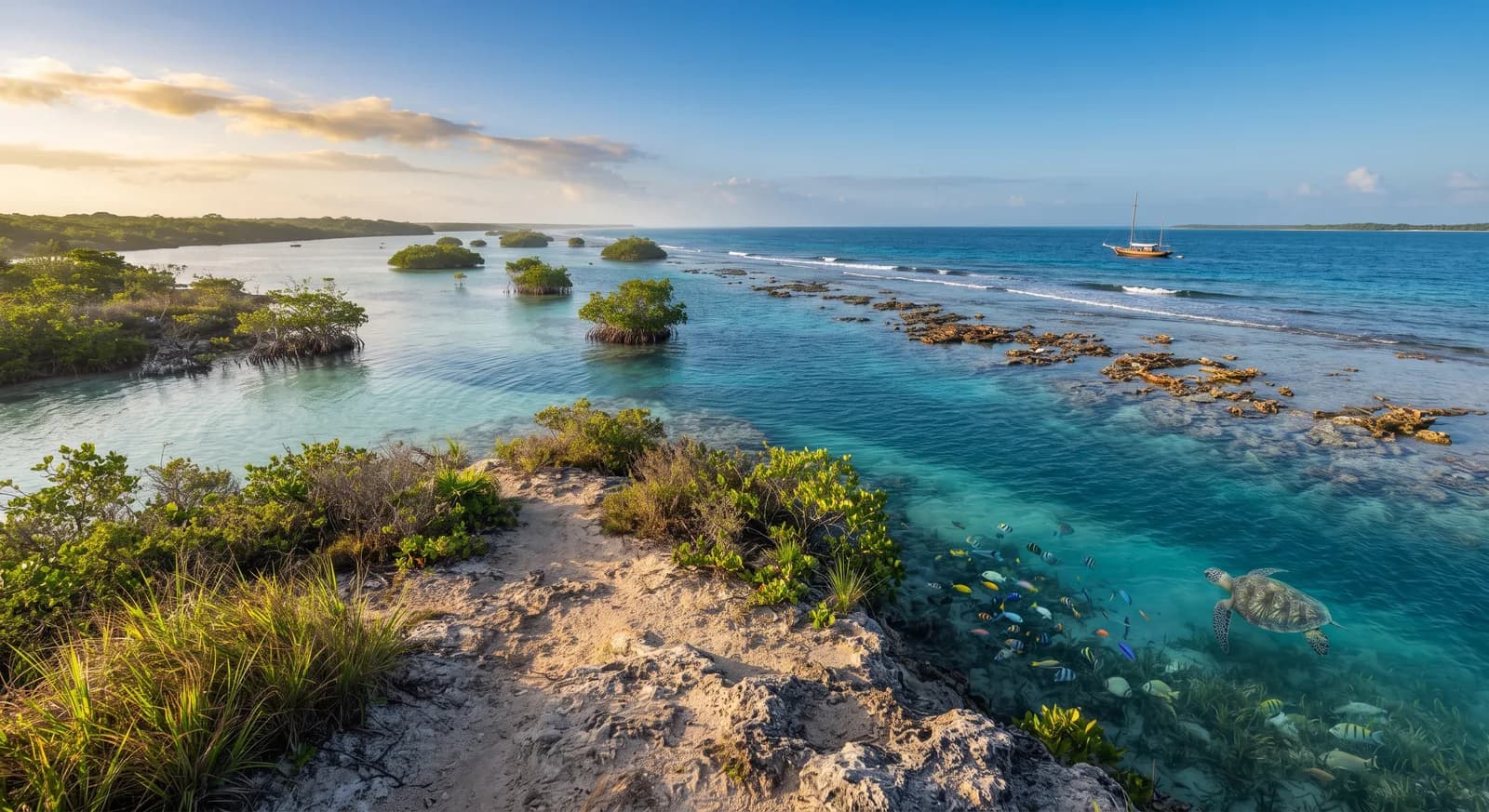
Ecosystems found in Belize, where Great Blue Hole lies.
Where can I dive near here?
1 km away
13 km away
31 km away
33 km away
Which other parks are like this one?
Same country: Belize
Same country: Belize
Same country: Belize
Same country: Belize
Based on what we already know about this park.
Share your experience visiting Great Blue Hole, or a tip for other travellers.
Be the first to comment.
Climate
Tropical
Best season
November to April