Skip to content
WAnimals
  • Map
  • Species
  • Parks
  • Diving
Log inCreate account
WAnimals

The guide for travellers and animal lovers: discover, plan and share your wild adventures around the world.

Discover wildlife

  • Species
  • Ecosystems
  • Glossary
  • Tags

Explore places

  • Map
  • Countries
  • Parks
  • Diving

Plan experiences

  • Guides

Learn

  • Blog

Resources

  • About us
  • How we build our profiles
  • Help centre
  • Contact
  • Install the app

Follow us

Account

  • Log in
  • Create account

© 2026 WAnimals. All rights reserved.

Terms of servicePrivacyCookiesLegal notice
MapSpeciesParksDiving
  1. Home
  2. Species
  3. American Horseshoe Crab
American Horseshoe Crab (Limulus polyphemus)

Horseshoe crabs · Xiphosura · Limulidae

American Horseshoe Crab

Limulus polyphemus

Vulnerable

At high risk of extinction in the wild over the medium term.

Spotted something wrong?

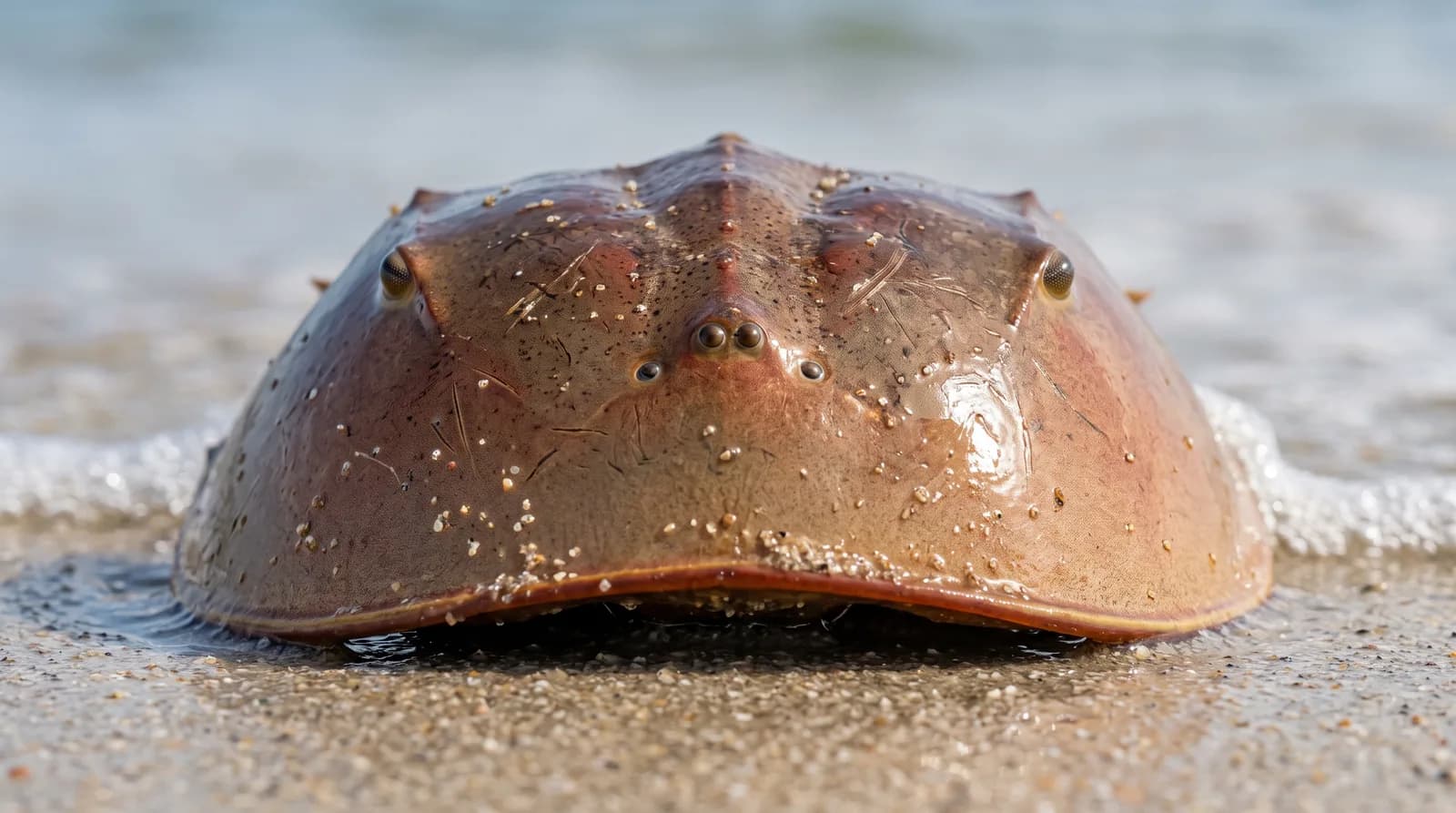
The Atlantic horseshoe crab is a species of xiphosuran chelicerate of the family Limulidae. It reaches 60 cm long and 30 cm wide. Despite its name, this species is more closely related to the spiders and scorpions (arachnids) than to the crabs (crustaceans), to which it is only distantly related. It lives in coastal areas and river estuaries.

Size

up to 60 cm

Life expectancy

20 years

Diet

Omnivore

Combines animal and plant food depending on availability.
Social structure

Colony

Lives in large concentrations, often for breeding reasons.

Ocean
2countries5parks6dive sites1natural phenomena

AI-generated images: illustrations, not photographs.

Fun facts

  • fisiologíaIts blood is blue and contains a compound (amoebocyte lysate) the pharmaceutical industry uses to detect bacterial contamination in vaccines.
  • It is not a crab: it is a chelicerate, more closely related to spiders and scorpions than to crustaceans, and its lineage has gone some 450 million years almost unchanged.
  • Its blood is blue because it carries oxygen with haemocyanin, which is copper-based, instead of haemoglobin.
  • That blood underpins pharmaceutical safety worldwide. In the 1950s it was found to clot on contact with bacterial endotoxins, and from that came the LAL test, used since the 1970s to check that vaccines, injectable medicines and medical equipment are free of contamination.
  • Some 500,000 individuals are caught and bled every year on the east coast of the United States alone. Although they are returned to the sea, there is mortality, and that pressure is one of the causes of the species' decline.
  • A synthetic alternative already exists, recombinant factor C, which avoids using animals.
  • Its eggs are a key resource in wader migration: the red knot depends on them to rebuild fat halfway through its journey to the Arctic.

Life cycle and biology

Habitat and environment
Soft bottoms and shallow bays of the North American Atlantic and the Gulf of Mexico; in spring it comes ashore en masse on sandy beaches to spawn on the spring tides
Sexual maturity
Matures at around 9 or 10 years old

Sources consulted: Wikipedia (es): Limulus polyphemus

Where to find it

Loading map…

The pins mark the parks and dive sites where its presence is documented.

Where to see it

Parks and dive sites where this species has been documented.

Related species

Other species in the catalogue with the most in common with American Horseshoe Crab — same habitat, park, country, tags or family.

Shares a park
Shares a park
Shares a park
Shares a park
Shares a park
Shares a park

How to help

The american horseshoe crab is classified as vulnerable. Organisations such as the IUCN, WWF and the Wildlife Conservation Society work specifically on its conservation and that of its habitat; looking into their programmes is a good starting point if you want to get involved.

It's documented in 5 protected areas — one reason why protecting these places matters for its conservation.

Keep exploring

Based on what we already know about american horseshoe crab.

Share an experience, a fun fact or a tip for seeing the american horseshoe crab.
See full glossary
This page in other languages: Español · Deutsch · Français · Português · Italiano
See its range on the interactive map→
EvergladesUnited States
AcadiaUnited States
BiscayneUnited States
Assateague IslandUnited States
Cape CodUnited States
Blue Heron BridgeUnited States
Block Island (Mohawk wreck)United States
Veracruz (Veracruz Reef System)Mexico
USS Monitor (Graveyard of the Atlantic)United States
Gray's ReefUnited States
Neptune Memorial Reef (Miami)United States
Lemon SharkVulnerable

Lemon Shark

Negaprion brevirostris

Vulnerable

Diamondback Terrapin

Malaclemys terrapin

Vulnerable

Porbeagle

Lamna nasus

SpurdogVulnerable

Spurdog

Squalus acanthias

Atlantic CodVulnerable

Atlantic Cod

Gadus morhua

Vulnerable

Haddock

Melanogrammus aeglefinus

CountriesUnited States
ParksEvergladesUnited States
TagsOmnivore
Omnivore
Colonial
Vulnerable
Ocean
Arthropod
United States
Mexico