Skip to content
WAnimals
  • Map
  • Species
  • Parks
  • Diving
Log inCreate account
WAnimals

The guide for travellers and animal lovers: discover, plan and share your wild adventures around the world.

Discover wildlife

  • Species
  • Ecosystems
  • Glossary
  • Tags

Explore places

  • Map
  • Countries
  • Parks
  • Diving

Plan experiences

  • Guides

Learn

  • Blog

Resources

  • Help centre
  • Contact
  • Install the app

Follow us

Account

  • Log in
  • Create account

© 2026 WAnimals. All rights reserved.

About usHow we build our profilesTerms of servicePrivacyLegal notice
MapSpeciesParksDiving
  1. Home
  2. Species
  3. Collared Lizard

One of the 15 lizards on WAnimals
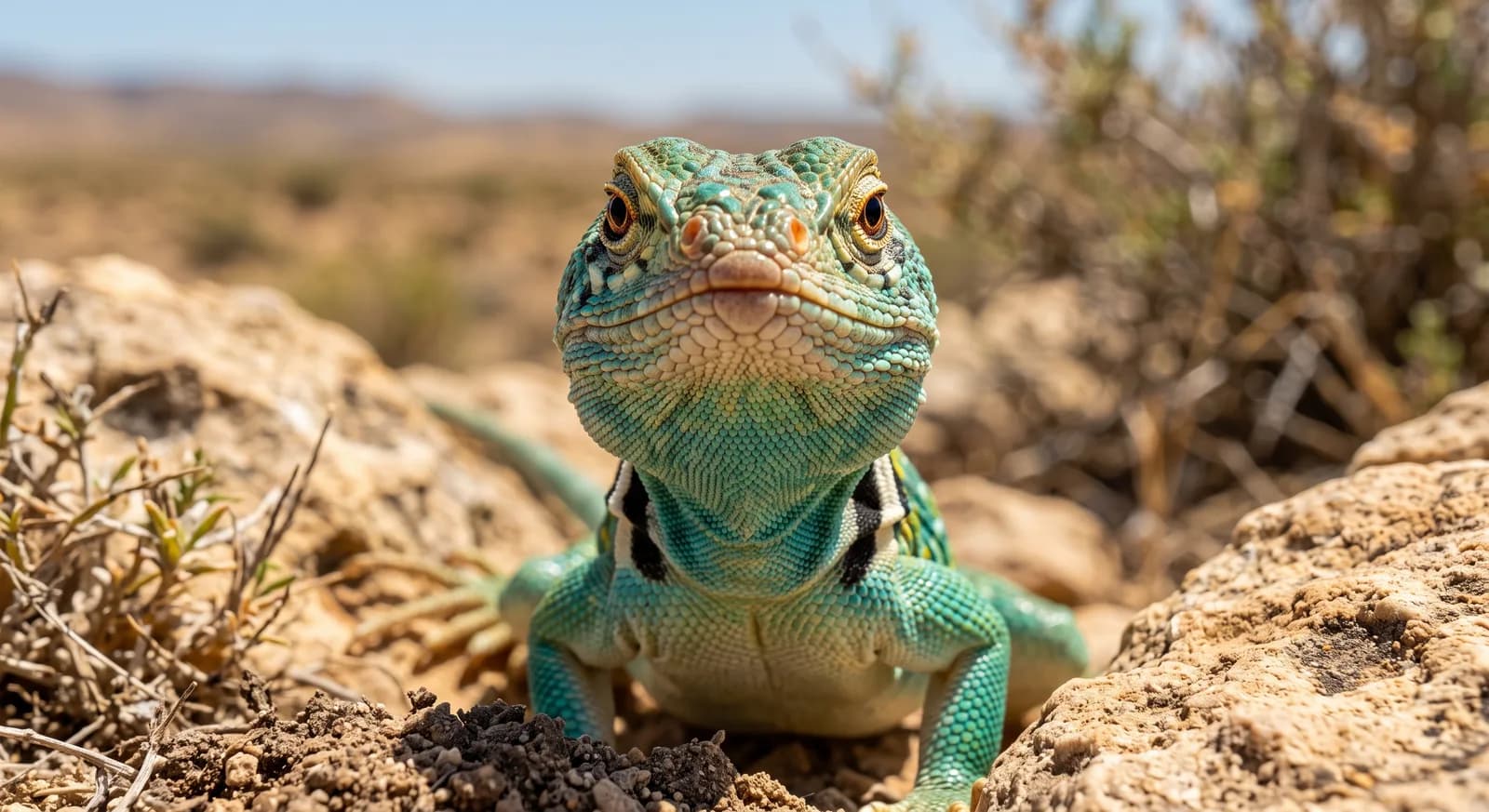
Collared Lizard (Crotaphytus collaris)

Reptiles · Squamata · Crotaphytidae

Collared Lizard

Crotaphytus collaris

Least Concern

The species is abundant and widely distributed; it faces no significant short-term risk.

Spotted something wrong?

The common collared lizard is a robust, colourful lizard of the arid rocky country of North America, with two black collars on the nape and the male a brilliant green and yellow. It is an active predator that hunts other lizards, and is famous for running on its hind legs with its body upright when chasing prey or fleeing.

Weight

3 kg – 9 kg

Size

20 cm – 38 cm

Life expectancy

8 years
Diet

Carnivore

Feeds mainly on other animals.

Activity

Diurnal

Active mainly during the day.

Social structure

Solitary

Lives and hunts alone, joining others only to breed.

Sighting difficulty

Easy

DesertMountainGrassland
2countries4parks

AI-generated images: illustrations, not photographs.

Fun facts

  • GeneralIt runs upright on its hind legs, like a dinosaur in miniature.
  • It runs on two legs: when chasing prey or fleeing it lifts its trunk and runs upright on its hind legs with its tail as a counterweight, reaching notable speeds over rock.
  • That gait has been studied in biomechanics as a model for the first bipedal dinosaurs, and high-speed footage of it appears in textbooks of vertebrate locomotion.
  • It preys on other lizards, including juveniles of its own species, which is uncommon among lizards of its size.

Life cycle and biology

Skeleton type
Vertebrate - internal bony skeleton (reptile)
Habitat and environment
Rocky slopes, canyons and arid stony plains of the central and south-western United States
Size at birth
About 7 cm on hatching
Sexual maturity
2 years
Gestation / incubation
70 days of incubation
Litter / clutch size
6 eggs

Sources consulted: https://www.iucnredlist.org/ | https://animaldiversity.org/ | https://es.wikipedia.org/

Where to find it

Best time: From April to July, in the warm hours, on rocky ground and screes of the central and southern United States; in the breeding season the males take on intense colours.

Loading map…

The pins mark the parks where its presence is documented.

Where to see it

Parks and dive sites where this species has been documented.

Related species

Other species in the catalogue with the most in common with Collared Lizard — same habitat, park, country, tags or family.

Shares a park
Shares a park
Shares a park
Shares a park
Shares a park
Shares a park

Keep exploring

Based on what we already know about collared lizard.

Comments

Share an experience, a fun fact or a tip for seeing the collared lizard.

Be the first to comment.

See full glossary
This page in other languages: Español · Deutsch · Français · Português · Italiano
See its range on the interactive map→
ZionUnited States
Capitol ReefUnited States
CanyonlandsUnited States
ArchesUnited States
PumaLeast Concern

Puma

Puma concolor

Turkey VultureLeast Concern

Turkey Vulture

Cathartes aura

Least Concern

Common Garter Snake

Thamnophis sirtalis

Texas Horned LizardLeast Concern

Texas Horned Lizard

Phrynosoma cornutum

Least Concern

California Kingsnake

Lampropeltis californiae

Common ChuckwallaLeast Concern

Common Chuckwalla

Sauromalus ater

CountriesUnited States
ParksZionUnited States
TagsCarnivore
Carnivore
Diurnal
Solitary
Reptile
Desert
Mountain
Grassland
United States
Mexico