Skip to content
WAnimals
  • Map
  • Species
  • Parks
  • Diving
Log inCreate account
WAnimals

The guide for travellers and animal lovers: discover, plan and share your wild adventures around the world.

Discover wildlife

  • Species
  • Ecosystems
  • Glossary
  • Tags

Explore places

  • Map
  • Countries
  • Parks
  • Diving

Plan experiences

  • Guides

Learn

  • Blog

Resources

  • About us
  • How we build our profiles
  • Help centre
  • Contact
  • Install the app

Follow us

Account

  • Log in
  • Create account

© 2026 WAnimals. All rights reserved.

Terms of servicePrivacyCookiesLegal notice
MapSpeciesParksDiving
  1. Home
  2. Species
  3. Common Chuckwalla
Common Chuckwalla (Sauromalus ater)

Reptiles · Squamata · Iguanidae

Common Chuckwalla

Sauromalus ater

Least Concern

The species is abundant and widely distributed; it faces no significant short-term risk.

Spotted something wrong?

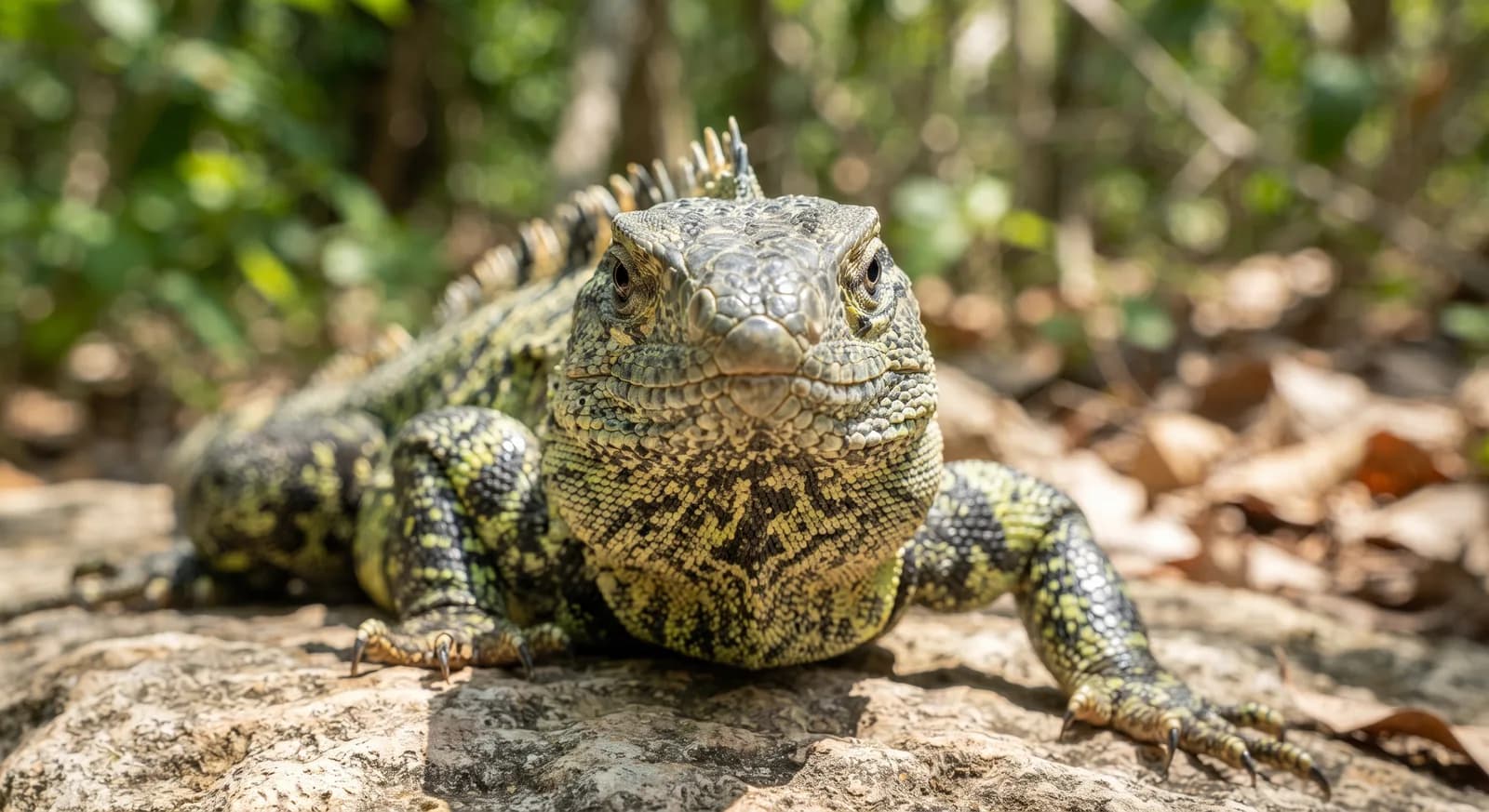
The chuckwalla is a robust, herbivorous iguanid of the deserts of the North American south-west, living among the crevices of rock outcrops. Its defence is purely mechanical: it wedges into a crack and inflates its lungs until it is jammed against the rock, so that it is impossible to pull out without breaking the stone.

Weight

400 g – 900 g

Size

30 cm – 45 cm

Life expectancy

25 years
Diet

Herbivore

Feeds mainly on plants.

Activity

Diurnal

Active mainly during the day.

Social structure

Solitary

Lives and hunts alone, joining others only to breed.

DesertMountain
3countries17parks9same family

AI-generated images: illustrations, not photographs.

Fun facts

  • GeneralIt wedges itself into a crack and inflates with air so it cannot be pulled out.
  • It jams itself into the crack: on detecting a predator it slips into a fissure in the rock and inflates its lungs until it doubles in volume, wedging itself so tightly that no animal can pull it out. The indigenous peoples of the desert extracted it by pricking it with a sharpened stick to deflate it.
  • It is a strict herbivore and gets all its water from the flowers and leaves it eats, with nasal glands that excrete the excess salt as a white crust around the nostrils.
  • It can live more than twenty-five years, a notable lifespan for a lizard weighing under a kilo.

Life cycle and biology

Skeleton type
Vertebrate - internal bony skeleton (reptile)
Habitat and environment
Rocky outcrops and lava fields of the Mojave and Sonoran deserts
Sexual maturity
2.5 years
Gestation / incubation
35 days
Litter / clutch size
8 eggs

Sources consulted: Wikipedia (es): Sauromalus ater

Where to find it

Loading map…

The pins mark the parks where its presence is documented.

Where to see it

Parks and dive sites where this species has been documented — showing 10 of 17.

Related species

Other species in the catalogue with the most in common with Common Chuckwalla — same habitat, park, country, tags or family.

Same taxonomic family
Shares a park
Shares a park
Shares a park
Shares a park

Keep exploring

Based on what we already know about common chuckwalla.

Share an experience, a fun fact or a tip for seeing the common chuckwalla.
See full glossary
This page in other languages: Español · Deutsch · Français · Português · Italiano
See its range on the interactive map→
Grand CanyonUnited States
Death ValleyUnited States
ZionUnited States
El VizcaínoMexico
El Pinacate and Gran Desierto de AltarMexico
Great BasinUnited States
Capitol ReefUnited States
CanyonlandsUnited States
ArchesUnited States
Bryce CanyonUnited States
See all 17 parks
Least Concern

Common Desert Iguana

Dipsosaurus dorsalis

Common Spiny-tailed IguanaLeast Concern

Common Spiny-tailed Iguana

Ctenosaura similis

Least Concern

Bushy-tailed Woodrat

Neotoma cinerea

Least Concern

American Pika

Ochotona princeps

Texas Horned LizardLeast Concern

Texas Horned Lizard

Phrynosoma cornutum

Bighorn SheepLeast Concern

Bighorn Sheep

Ovis canadensis

CountriesUnited States
ParksGrand CanyonUnited States
TagsHerbivore
Herbivore
Diurnal
Solitary
Reptile
Desert
Mountain
United States
Mexico
Canada