One of the 5 armadillos on WAnimals
Mammals · Cingulata · Dasypodidae
Greater Long-Nosed Armadillo
Dasypus kappleri
The species is abundant and widely distributed; it faces no significant short-term risk. See full glossary
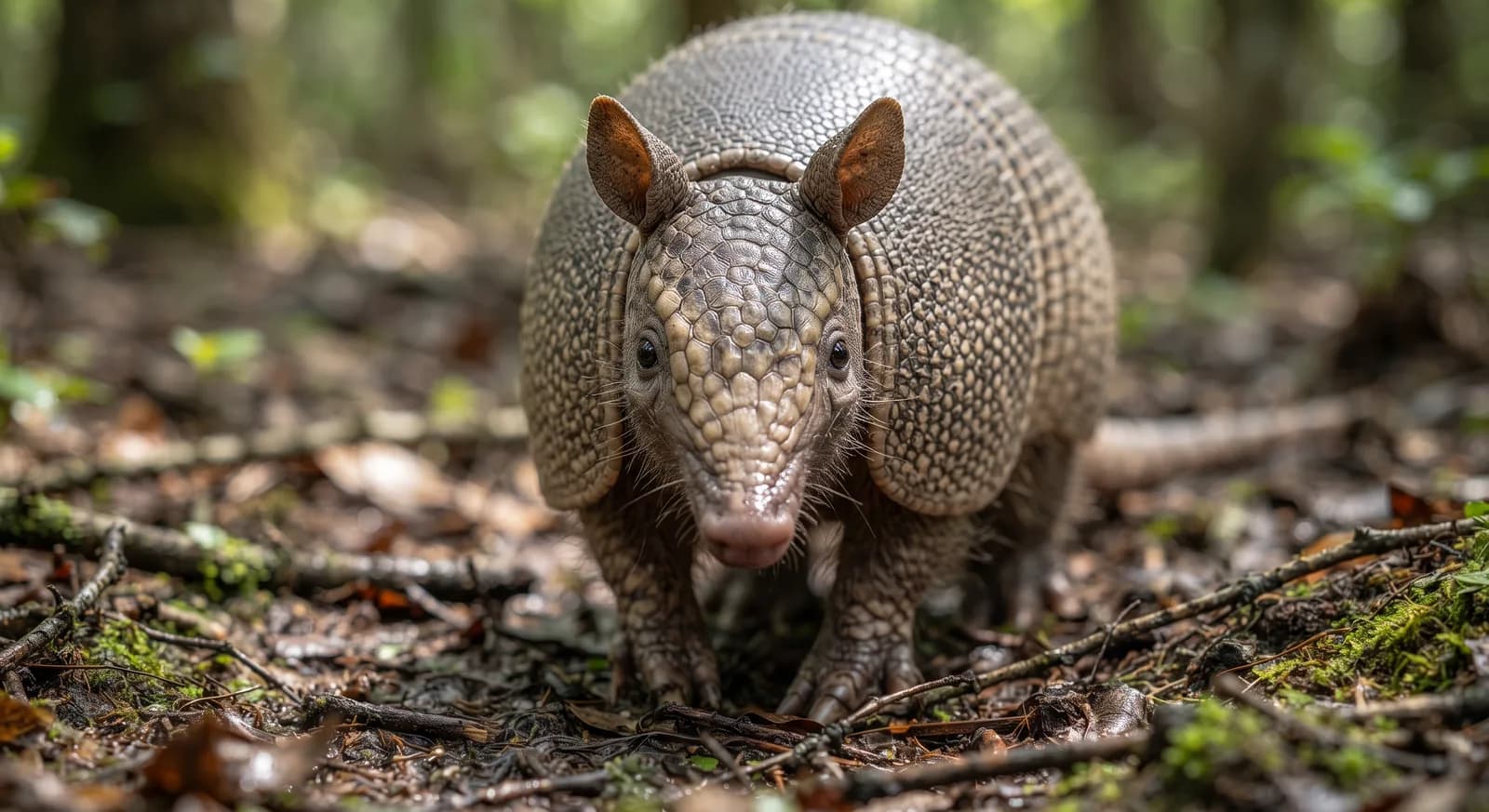
The greater long-nosed armadillo — also called in Spanish armadillo de nueve bandas mayor — is the largest species of the genus Dasypus. It lives in the Amazon and the Guianas, almost always associated with rainforest close to rivers and streams. It is nocturnal and solitary, digs burrows with its powerful front claws and feeds on ants, termites and other invertebrates that it locates by smell while turning over the leaf litter. Its shell is made up of dermal bony plates covered in horny scales.
Weight
8.5 kg – 10.5 kg
Size
51 cm – 57 cm
Diet
Insectivore
Feeds mainly on insects and other invertebrates.
Activity
Nocturnal
Active mainly at night.
Social structure
Solitary
Lives and hunts alone, joining others only to breed.
Sighting difficulty
Easy
Fun facts
- It is told apart from the other nine-banded armadillos by large spur-shaped scales above the knees, which let it drag itself along narrow tunnels.
- It swims well and can cross rivers, either floating after swallowing air to increase its buoyancy or walking along the bottom holding its breath for several minutes.
Life cycle & biology
- Skeleton type
- Vertebrate - internal bony skeleton with a carapace of dermal plates (mammal)
- Habitat & environment
- Lowland rainforest of the Amazon and the Guianas, close to watercourses
- Size at birth
- Born with its eyes open and a soft shell, which hardens within a few weeks
- Litter / clutch size
- 1
Sources consulted: https://es.wikipedia.org/wiki/Dasypus_kappleri
Where to find it
See its range on the interactive mapBest time: All year round in Amazonia, at night and near watercourses; it leaves very distinctive burrows in earth banks.
Related species
Other species in the catalogue with the most in common with Greater Long-Nosed Armadillo — same habitat, park, country, tags or family.
 Least Concern
Nine-banded Armadillo
Dasypus novemcinctus
Large Hairy Armadillo
Chaetophractus villosus
Common Opossum
Didelphis marsupialis
Water Opossum
Chironectes minimus
Mexican Mouse Opossum
Marmosa mexicana
Keep exploring
Based on what we already know about greater long-nosed armadillo.
Comments
Share an experience, a fun fact or a tip for seeing the greater long-nosed armadillo.
Be the first to comment.