One of the 5 armadillos on WAnimals
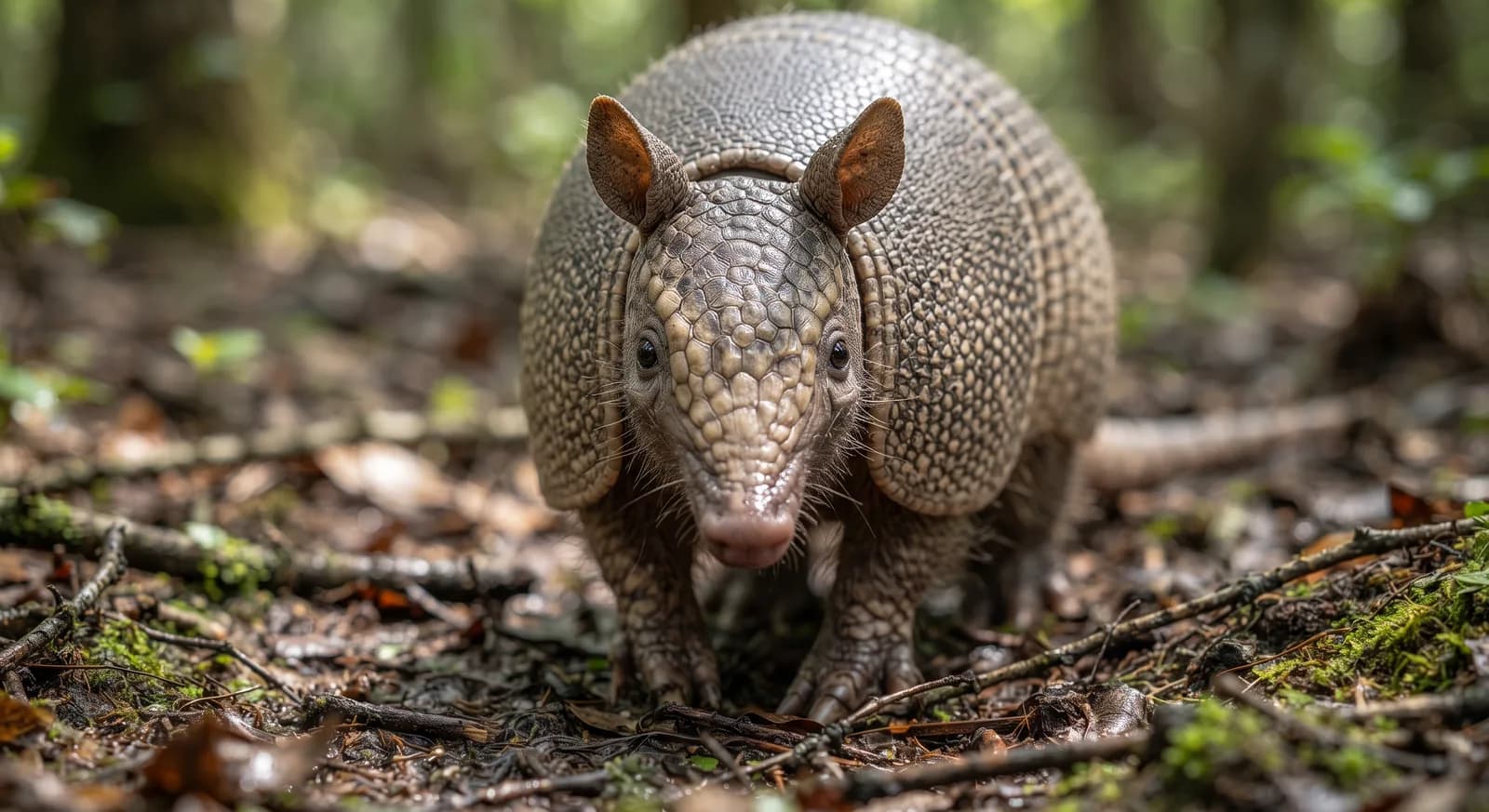
Mammals · Cingulata · Dasypodidae
Nine-banded Armadillo
Dasypus novemcinctus
The species is abundant and widely distributed; it faces no significant short-term risk. See full glossary
It is the only mammal apart from humans known to catch leprosy naturally, which makes it an important model in biomedical research.
Weight
2.5 kg – 6.5 kg
Size
38 cm – 58 cm
Lifespan
7 years
Diet
Insectivore
Feeds mainly on insects and other invertebrates.
Activity
Nocturnal
Active mainly at night.
Social structure
Solitary
Lives and hunts alone, joining others only to breed.
Sighting difficulty
Easy
Fun facts
- It always gives birth to four genetically identical young of the same sex, developed from a single fertilised egg.
- It eats insects, grubs, small invertebrates and occasionally plant matter.
- It lives in forest, grassland and semi-desert across the Americas, from the southern United States to Uruguay.
- reproducciónIt almost always gives birth to genetically identical quadruplets from a single fertilised egg, a case of polyembryony very rare among mammals.
- fisiologíaIt can be a natural carrier of the bacterium that causes leprosy, one of the few non-human animals known to harbour and pass on the disease.
Life cycle & biology
- Skeleton type
- Vertebrate - internal bony skeleton with a dermal carapace of bony plates (mammal)
- Habitat & environment
- Forest, grassland and semi-desert across the Americas, from the southern United States to Uruguay and northern Argentina
- Birth weight
- ~66 grams at birth
- Size at birth
- Born with a soft leathery shell that hardens over time
- Sexual maturity
- 1 year
- Gestation / incubation
- 133-150 days (delayed implantation can stretch the process by up to 4 months more)
- Litter / clutch size
- 4 identical young per litter (genetically identical quadruplets, unique among mammals)
- Lifespan in captivity
- Documented record of up to 22-23 years in captivity
Sources consulted: AnAge (genomics.senescence.info); Animal Diversity Web (D. septemcinctus); Armadillo-Online; Animalia.bio; AnimalHub; Animal Diversity Web (D. novemcinctus); National Wildlife Federation; UF/IFAS Extension
Where to find it
See its range on the interactive mapWhere to watch it
Parques y spots de buceo donde se ha documentado esta especie — se muestran 10 de 14 documentados.
Related species
Other species in the catalogue with the most in common with Nine-banded Armadillo — same habitat, park, country, tags or family.
Virginia Opossum
Didelphis virginiana
Mexican Mouse Opossum
Marmosa mexicana
Northern Tamandua
Tamandua mexicana
Southern Tamandua
Tamandua tetradactyla
Big Brown Bat
Eptesicus fuscus
Keep exploring
Based on what we already know about nine-banded armadillo.
Comments
Share an experience, a fun fact or a tip for seeing the nine-banded armadillo.
Be the first to comment.