One of the 6 kangaroos on WAnimals
Mammals · Diprotodontia · Macropodidae
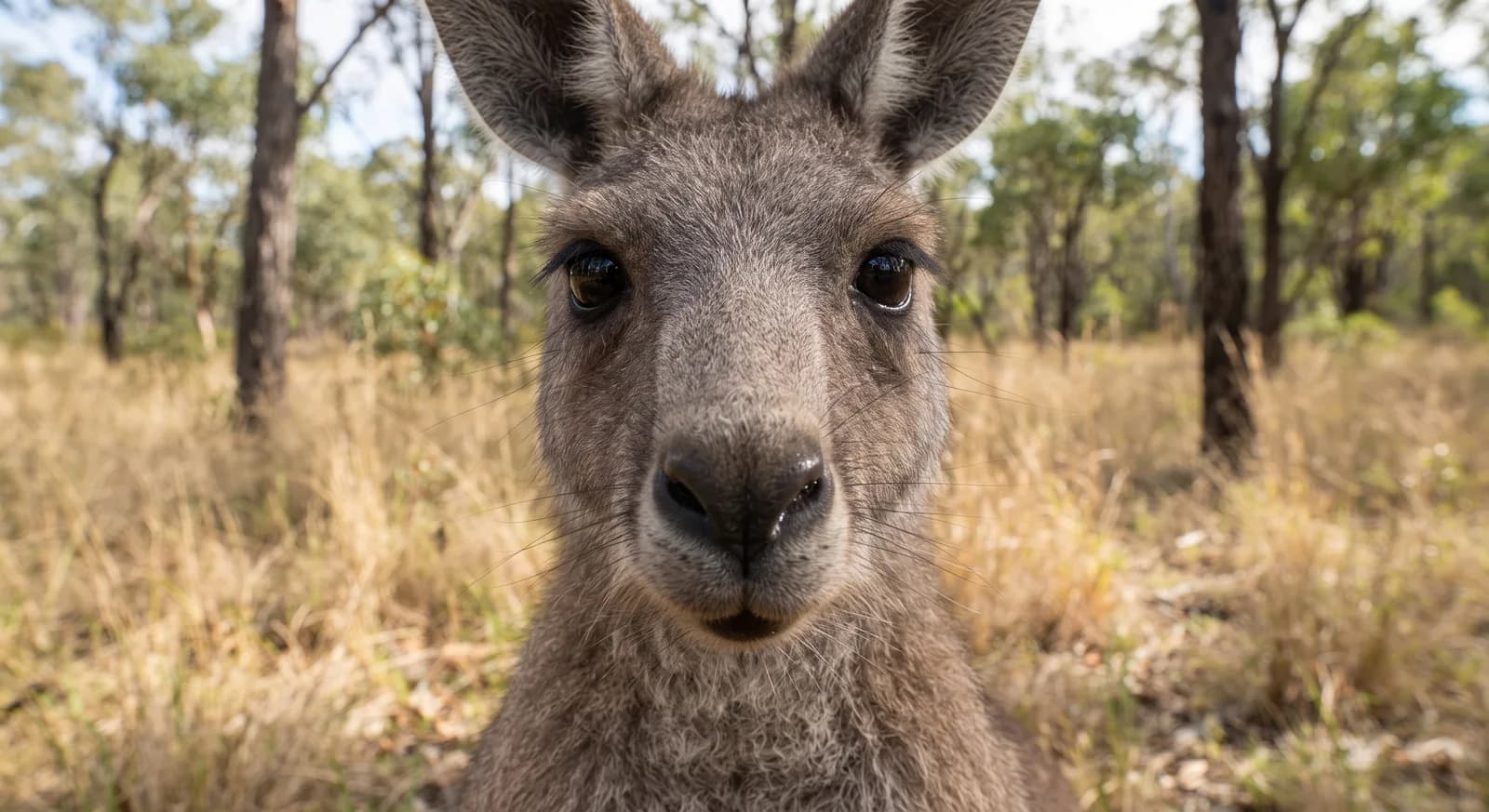
Red Kangaroo
Osphranter rufus
The species is abundant and widely distributed; it faces no significant short-term risk. See full glossary
The largest marsupial in the world, able to bound as far as nine metres on its powerful hind legs.
Weight
18 kg – 90 kg
Size
85 cm – 1.4 m
Lifespan
8 years
Diet
Herbivore
Feeds mainly on plants.
Activity
Crepuscular
Active above all at dawn and dusk.
Social structure
Herd
Lives in large groups as a strategy against predators.
Sighting difficulty
Easy
Estimated population
Some 11.5 million animals according to official estimates from the Australian Department of the Environment; the figures swing widely from year to year depending on the preceding rainfall
Fun facts
- Its mammary glands produce milk of a different composition for each stage of a joey's development.
- It can reach 70 km/h over a short sprint.
- It eats grasses and herbs, favouring soft green shoots.
- It lives on open plains, desert and arid scrub of inland Australia.
- The joey stays in the pouch for about eight months.
- reproducciónFemales can pause an embryo's development (embryonic diapause) until conditions are right for the birth.
- It almost never needs to drink.
Life cycle & biology
- Skeleton type
- Vertebrate - internal bony skeleton (marsupial mammal)
- Habitat & environment
- Open plains, desert and arid scrub of inland Australia
- Birth weight
- ~0.75-0.8 grams (the size of a grain of rice)
- Size at birth
- 2.5 cm long at birth, wholly helpless and blind
- Sexual maturity
- Female: 15-24 months | Male: ~26 months (though he cannot breed effectively until he gains dominance)
- Gestation / incubation
- 30-34 days
- Litter / clutch size
- 1 young, with embryonic diapause able to hold a second embryo back
- Lifespan in captivity
- Documented record of up to 25-30 years in captivity
Sources consulted: Pueblo Zoo; Bright's Zoo; AnAge (genomics.senescence.info); Animal Corner; Animal Diversity Web; Australian Museum; Caversham Wildlife; PMC (juvenile feeding biology study); IUCN Red List (Preocupación menor): especie ampliamente distribuida y abundante en la Australia árida y semiárida, con números que fluctúan con las lluvias || Departamento de Medio Ambiente de Australia, estimaciones de abundancia de macropódidos; IUCN Red List
Where to watch it
Parques y spots de buceo donde se ha documentado esta especie — se muestran 10 de 14 documentados.
Related species
Other species in the catalogue with the most in common with Red Kangaroo — same habitat, park, country, tags or family.
Antilopine Kangaroo
Osphranter antilopinus
Western Gray Kangaroo
Macropus fuliginosus
 Least Concern
Eastern Grey Kangaroo
Macropus giganteus
Yellow-footed Rock Wallaby
Petrogale xanthopus
Red-necked Wallaby
Notamacropus rufogriseus
Agile Wallaby
Notamacropus agilis
Keep exploring
Based on what we already know about red kangaroo.
Comments
Share an experience, a fun fact or a tip for seeing the red kangaroo.
Be the first to comment.