One of the 6 kangaroos on WAnimals
Mammals · Diprotodontia · Macropodidae
Western Gray Kangaroo
Macropus fuliginosus
The species is abundant and widely distributed; it faces no significant short-term risk. See full glossary
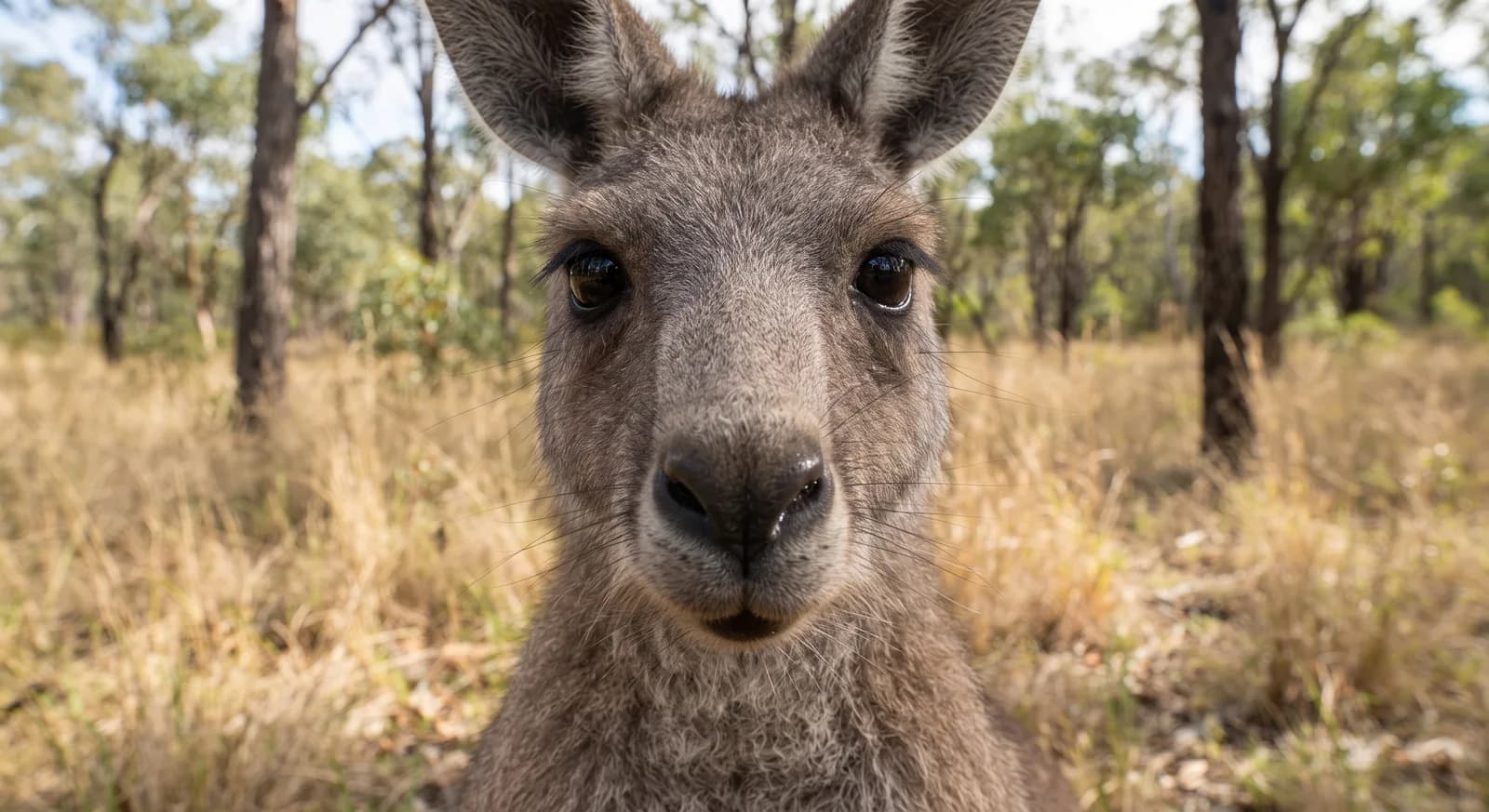
The western grey kangaroo is a diprotodont marsupial of the family Macropodidae. It is one of the largest and most abundant kangaroos in its genus. Its coat is coarse and thick and varies from pale greyish brown to chocolate brown; the chest and belly are paler. When moving slowly it takes long strides like a rabbit, using all four limbs with the tail as support, but when running at speed it bounds on its hind legs. Males grow to twice the size of females and can cover 10 metres in a single bound. This species feeds mainly at night, chiefly on grasses, but it also browses the leaves of shrubs and low trees. It lives in stable groups of up to 15 animals. The dominant male is generally the only one to breed. Gestation lasts 30 to 31 days.
Weight
17 kg – 72 kg
Size
85 cm – 1.4 m
Lifespan
20 years
Diet
Herbivore
Feeds mainly on plants.
Activity
Nocturnal
Active mainly at night.
Sighting difficulty
Easy
Fun facts
- It is the only one of the large kangaroos unable to hold an embryo in diapause: while the red and the eastern grey always have a spare embryo in reserve, this one has to mate again after each joey.
- Adult males give off a strong, characteristic smell, likened to curry, which has earned them the local nickname of stinker among Australian graziers.
Life cycle & biology
- Skeleton type
- Vertebrate - internal bony skeleton (mammal)
- Habitat & environment
- Open eucalypt woodland, mallee scrub and grassland of southern and western Australia
- Sexual maturity
- 22 months
- Gestation / incubation
- 30 days
- Litter / clutch size
- 1
Sources consulted: https://es.wikipedia.org/wiki/Macropus_fuliginosus
Where to watch it
Parks and dive sites where this species has been documented.
Related species
Other species in the catalogue with the most in common with Western Gray Kangaroo — same habitat, park, country, tags or family.
Red-necked Wallaby
Notamacropus rufogriseus
Red Kangaroo
Osphranter rufus
 Least Concern
Eastern Grey Kangaroo
Macropus giganteus
Brush-tailed Rock Wallaby
Petrogale penicillata
Swamp Wallaby
Wallabia bicolor
Yellow-footed Rock Wallaby
Petrogale xanthopus
Keep exploring
Based on what we already know about western gray kangaroo.
Comments
Share an experience, a fun fact or a tip for seeing the western gray kangaroo.
Be the first to comment.