One of the 11 hummingbirds on WAnimals
Birds · Apodiformes · Trochilidae
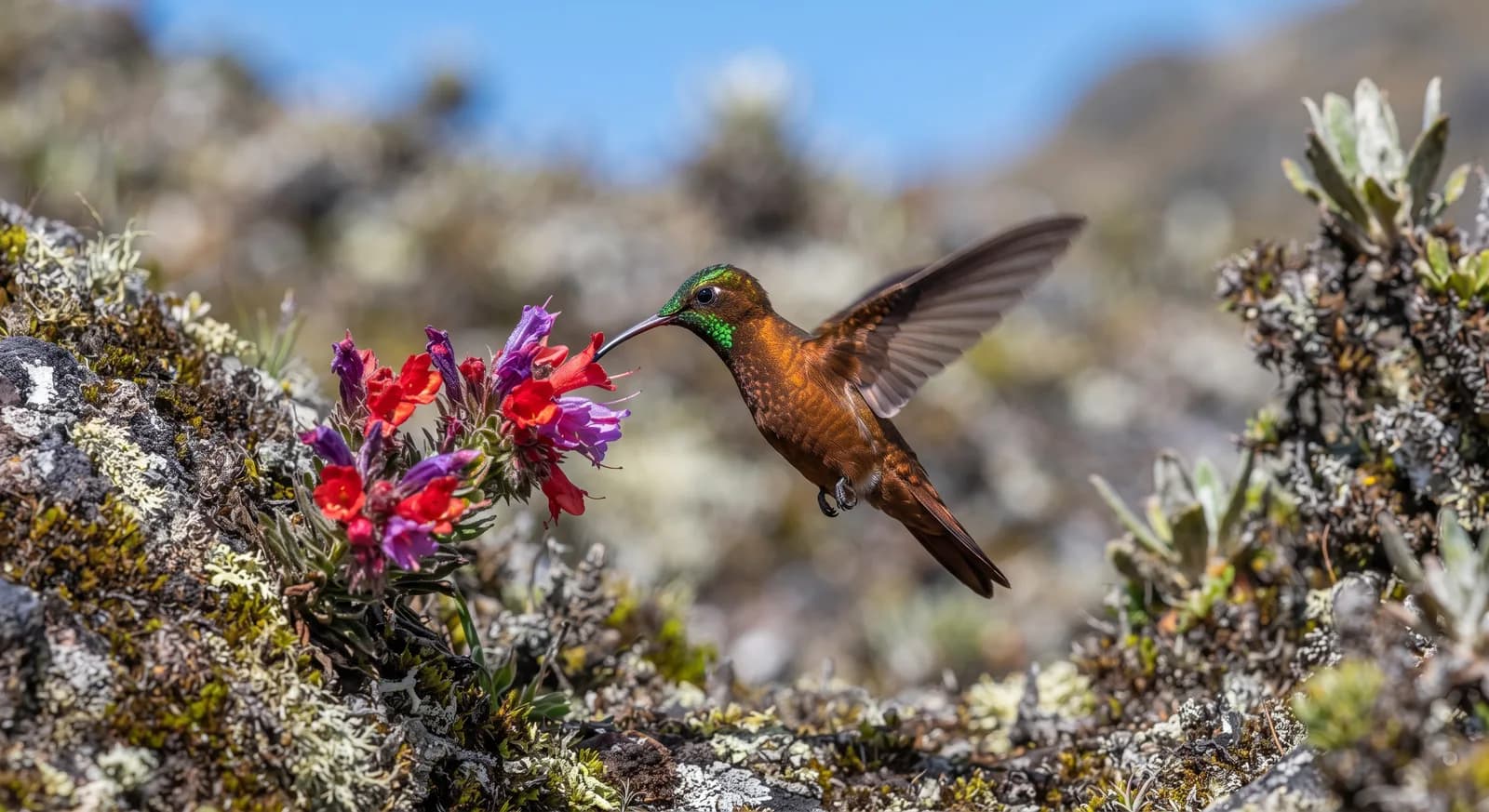
Shining Sunbeam
Aglaeactis cupripennis
The species is abundant and widely distributed; it faces no significant short-term risk. See full glossary
The shining sunbeam, also called the coppery hummingbird or long-winged hummingbird, is an apodiform bird of the family Trochilidae belonging to the genus Aglaeactis. It is native to the Andean regions of north-western and west-central South America.
Weight
6 g – 9 g
Size
11 cm – 13 cm
Lifespan
8 years
Diet
Nectarivore
Feeds mainly on flower nectar.
Activity
Diurnal
Active mainly during the day.
Social structure
Solitary
Lives and hunts alone, joining others only to breed.
Sighting difficulty
Easy
Fun facts
- Its iridescence is on the rump, not the throat: from the front it looks like a plain brown hummingbird, and only when it turns does it show a flash of copper and violet.
- It lives above 4,000 metres at some points in the Andes, where the night-time temperature drops below zero all year round, and it depends on nightly torpor to survive.
- It pollinates the frailejones (Espeletia) and other páramo plants, an ecosystem that exists only in the northern Andes and that is the main regulator of that region's water supply.
Life cycle & biology
- Skeleton type
- Vertebrate - internal bony skeleton (bird)
- Habitat & environment
- Páramo, high-Andean scrub and cloud forest edge, between 2,500 and 4,500 metres
- Sexual maturity
- 12 months
- Gestation / incubation
- 17 days of incubation
- Litter / clutch size
- 2 eggs
Sources consulted: https://es.wikipedia.org/wiki/Aglaeactis_cupripennis
Where to find it
See its range on the interactive mapWhere to watch it
Parks and dive sites where this species has been documented.
Related species
Other species in the catalogue with the most in common with Shining Sunbeam — same habitat, park, country, tags or family.
Giant Hummingbird
Patagona gigas
Sword-billed Hummingbird
Ensifera ensifera
Green-backed Firecrown
Sephanoides sephaniodes
Crimson Topaz
Topaza pella
Marvelous Spatuletail
Loddigesia mirabilis
 Vulnerable
Andean Condor
Vultur gryphus
Keep exploring
Based on what we already know about shining sunbeam.
Comments
Share an experience, a fun fact or a tip for seeing the shining sunbeam.
Be the first to comment.