One of the 8 marmots on WAnimals
Mammals · Rodentia · Sciuridae
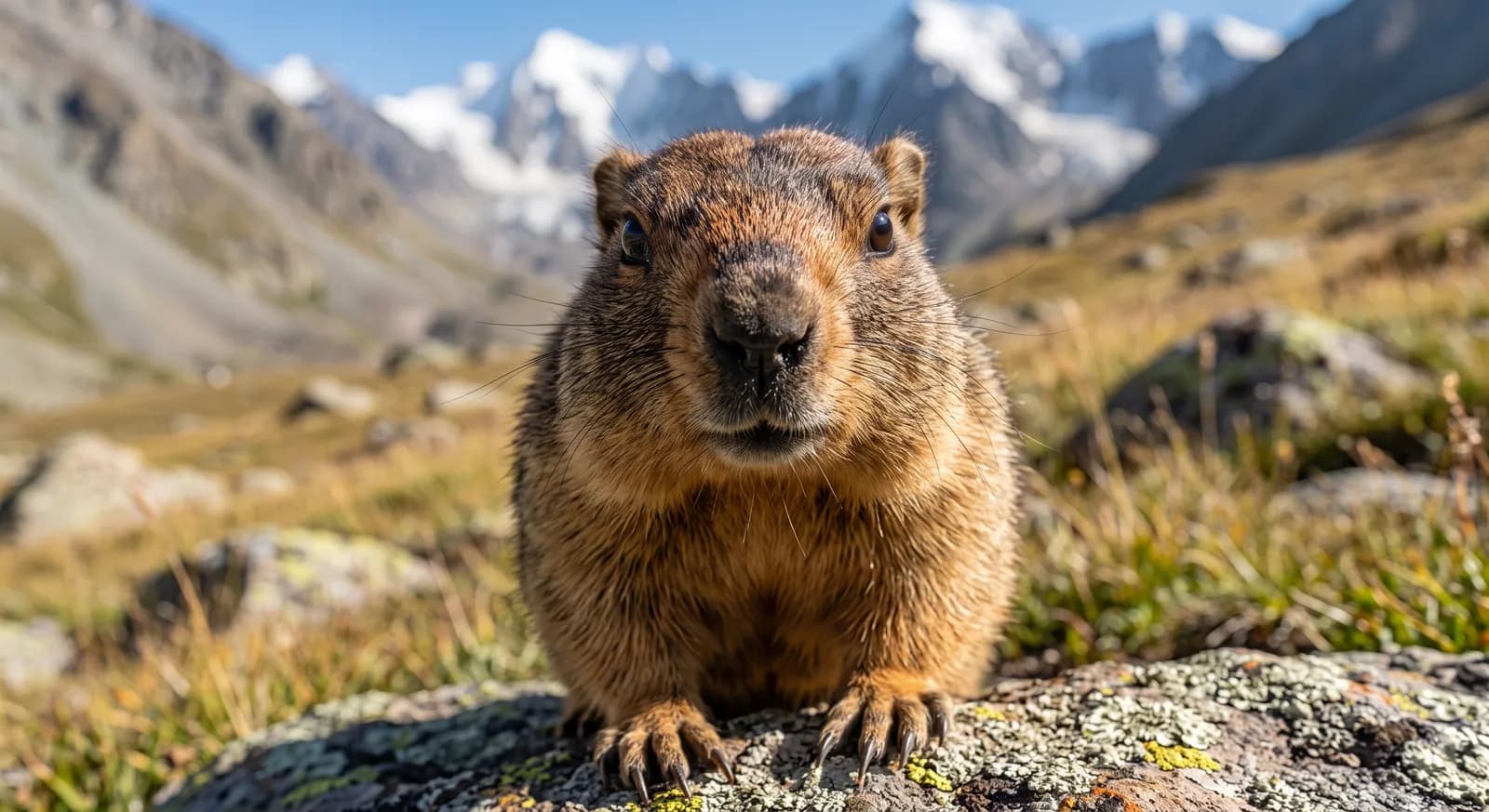
Menzbier's Marmot
Marmota menzbieri
It faces a high risk of extinction in the wild over the medium term. See full glossary
Menzbier's marmot is the smallest of the Asian marmots and has one of the most restricted distributions in the genus: it lives only in the alpine meadows of the western Tian Shan, on the border between Uzbekistan, Kazakhstan and Kyrgyzstan. It forms family colonies that dig deep tunnels and communicate with alarm whistles. It hibernates for between six and eight months a year. Intensive livestock grazing on its meadows and hunting are the causes of its retreat.
Weight
2.5 kg – 3.5 kg
Size
40 cm – 50 cm
Lifespan
12 years
Diet
Herbivore
Feeds mainly on plants.
Activity
Diurnal
Active mainly during the day.
Social structure
Colony
Lives in large concentrations, often for breeding reasons.
Sighting difficulty
Moderate
Fun facts
- Its range is so small that it would fit comfortably inside a Spanish province: it is the marmot with the most restricted distribution in Asia.
- It synchronises birth with the thaw, so that the young come out of the burrow just as the alpine meadow starts to green up and there is enough food to fatten up before the next winter.
Life cycle & biology
- Skeleton type
- Vertebrate - internal bony skeleton (mammal)
- Habitat & environment
- Alpine and subalpine meadows of the western Tian Shan, between 2,000 and 3,400 metres
- Sexual maturity
- 3 years
- Gestation / incubation
- 30 days
- Litter / clutch size
- 4
Sources consulted: https://es.wikipedia.org/wiki/Marmota_menzbieri
Where to find it
See its range on the interactive mapWhere to watch it
Parks and dive sites where this species has been documented.
Related species
Other species in the catalogue with the most in common with Menzbier's Marmot — same habitat, park, country, tags or family.
Steppe Tortoise
Testudo horsfieldii
Himalayan Marmot
Marmota himalayana
European Ground Squirrel
Spermophilus citellus
 Least Concern
Long-tailed Marmot
Marmota caudata
 Vulnerable
Snow Leopard
Panthera uncia
Pallas's Pika
Ochotona pallasii
How to help
The menzbier's marmot is classified as vulnerable. Organizations such as UICN, WWF y Wildlife Conservation Society work specifically on its conservation and that of its habitat; looking into their programs is a good starting point if you want to get involved.
It's documented in 3 real protected areas — part of why protecting these places matters for its conservation.
Keep exploring
Based on what we already know about menzbier's marmot.
Comments
Share an experience, a fun fact or a tip for seeing the menzbier's marmot.
Be the first to comment.