Birds · Galliformes · Cracidae
Helmeted Curassow
Pauxi pauxi
It faces a very high risk of extinction in the wild in the near future. See full glossary
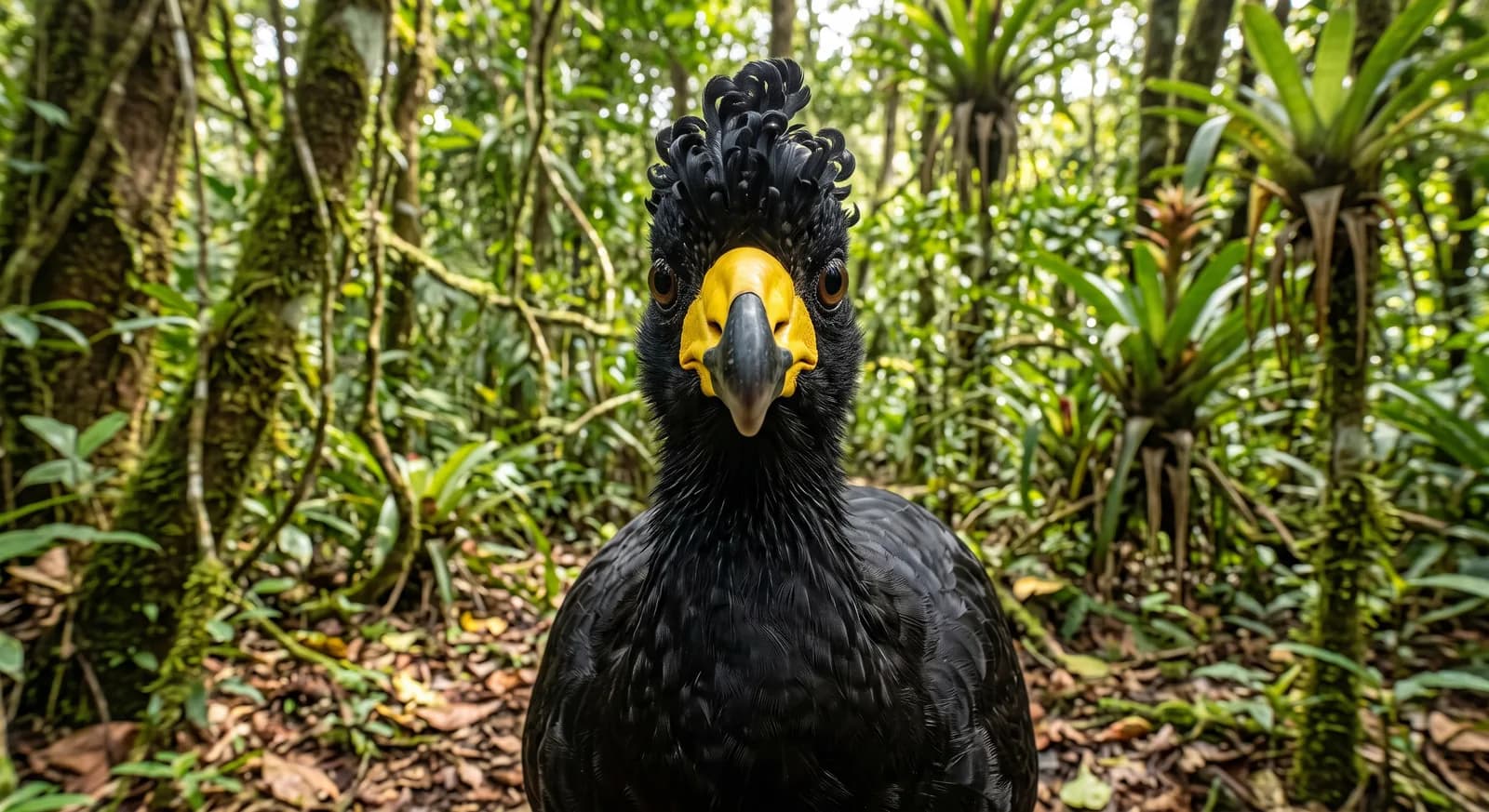
The helmeted curassow is a large black bird with a strange blue stone-shaped casque above the bill, found only in the cloud forests of Venezuela and Colombia. It works the forest floor looking for fallen fruit, seeds and invertebrates, and roosts in the trees. Hunting for food, made easier by its size and its confiding nature, and the deforestation of the Andean forests have reduced it to fragmented populations in continuous retreat.
Weight
2.5 kg – 3.6 kg
Size
85 cm – 92 cm
Lifespan
25 years
Diet
Herbivore
Feeds mainly on plants.
Activity
Diurnal
Active mainly during the day.
Social structure
In pairs
Usually lives in pairs, sometimes for life.
Sighting difficulty
Hard
Fun facts
- The bluish-grey casque projecting from its forehead is hollow inside and probably works as a sounding box: the male gives a deep booming call that carries through the cloud forest and is hard to pinpoint.
- It is one of the birds most sought after by birdwatchers in Venezuela and Colombia, and at the same time one of the hardest to see: hunting pressure has made it extremely shy.
Life cycle & biology
- Skeleton type
- Vertebrate - internal bony skeleton (bird)
- Habitat & environment
- Montane cloud forest of the Venezuelan and Colombian Andes, between 500 and 2,200 m
- Sexual maturity
- 3 years
- Gestation / incubation
- 30 days of incubation
- Litter / clutch size
- 2 eggs
Sources consulted: https://www.iucnredlist.org/ | https://animaldiversity.org/ | https://es.wikipedia.org/
Where to watch it
Parks and dive sites where this species has been documented.
Related species
Other species in the catalogue with the most in common with Helmeted Curassow — same habitat, park, country, tags or family.
Crested Guan
Penelope purpurascens
Mountain Tapir
Tapirus pinchaque
Black-and-chestnut Eagle
Spizaetus isidori
Santa Marta Parakeet
Pyrrhura viridicata
 Vulnerable
Great Curassow
Crax rubra
Collared Trogon
Trogon collaris
How to help
The helmeted curassow is classified as endangered. Organizations such as UICN, WWF y Wildlife Conservation Society work specifically on its conservation and that of its habitat; looking into their programs is a good starting point if you want to get involved.
It's documented in 7 real protected areas — part of why protecting these places matters for its conservation.
Keep exploring
Based on what we already know about helmeted curassow.
Comments
Share an experience, a fun fact or a tip for seeing the helmeted curassow.
Be the first to comment.