One of the 2 wrist-winged gliders on WAnimals
Mammals · Diprotodontia · Petauridae
Sugar Glider
Petaurus breviceps
The species is abundant and widely distributed; it faces no significant short-term risk. See full glossary
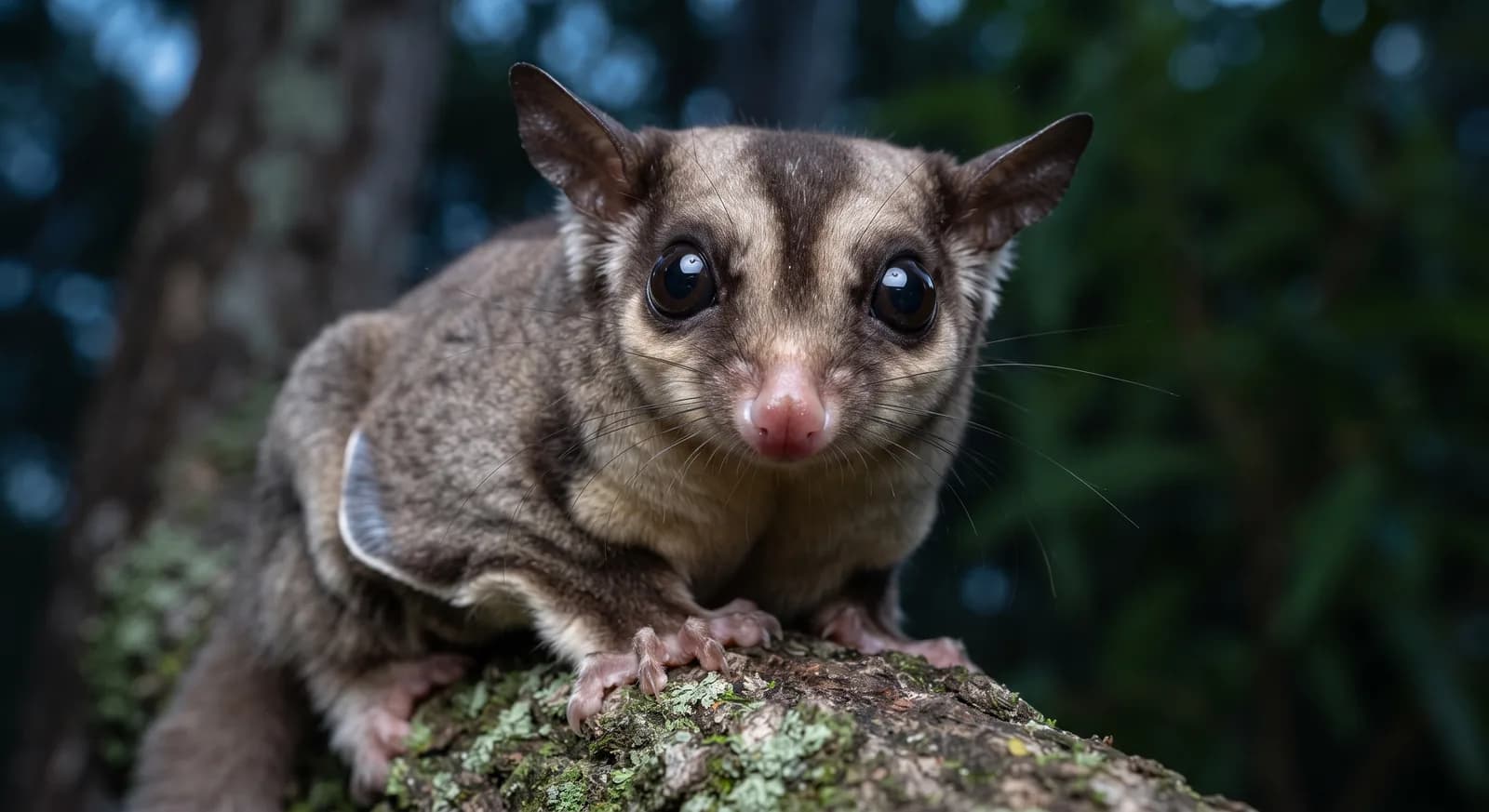
It can glide up to 50 metres between trees thanks to a membrane of skin stretched between its front and hind limbs, a case of convergent evolution with the flying squirrels.
Weight
80 g – 170 g
Size
12 cm – 30 cm
Lifespan
5 years
Diet
Omnivore
Combines animal and plant food depending on availability.
Activity
Nocturnal
Active mainly at night.
Social structure
Family group
Lives in small family groups with close bonds.
Sighting difficulty
Easy
Fun facts
- Females can nurse young of different ages at the same time, producing milk of a different composition at each teat.
- It eats tree sap, nectar, insects and occasionally small vertebrates.
- It lives in forest and woodland of Australia, Indonesia and New Guinea.
- locomociónIt can glide up to 50 metres between trees thanks to a membrane of skin stretched between its front and hind legs.
Life cycle & biology
- Skeleton type
- Vertebrate - internal bony skeleton (marsupial mammal)
- Habitat & environment
- Forest and woodland of Australia, Indonesia and New Guinea, gliding between trees
- Birth weight
- ~0.19-0.2 grams
- Size at birth
- Tiny and helpless at birth, the size of a grain of rice
- Sexual maturity
- Female: 8-15 months | Male: 12-15 months
- Gestation / incubation
- 15-17 days
- Litter / clutch size
- 1 to 2 young per litter
- Lifespan in captivity
- Documented record of up to 17.8 years in captivity
Sources consulted: AnAge (genomics.senescence.info); MSD Veterinary Manual; San Diego Zoo; Animal Diversity Web; JungleDragon; VCA Animal Hospitals; SeaWorld; Animalia.bio
Where to watch it
Parks and dive sites where this species has been documented.
Related species
Other species in the catalogue with the most in common with Sugar Glider — same habitat, park, country, tags or family.
Squirrel Glider
Petaurus norfolcensis
Long-nosed Bandicoot
Perameles nasuta
Southern Brown Bandicoot
Isoodon obesulus
Common Brush-tailed Possum
Trichosurus vulpecula
Feathertail Glider
Acrobates pygmaeus
Eastern Pygmy Possum
Cercartetus nanus
Keep exploring
Based on what we already know about sugar glider.
Comments
Share an experience, a fun fact or a tip for seeing the sugar glider.
Be the first to comment.