One of the 2 wrist-winged gliders on WAnimals
Mammals · Diprotodontia · Petauridae
Squirrel Glider
Petaurus norfolcensis
The species is abundant and widely distributed; it faces no significant short-term risk. See full glossary
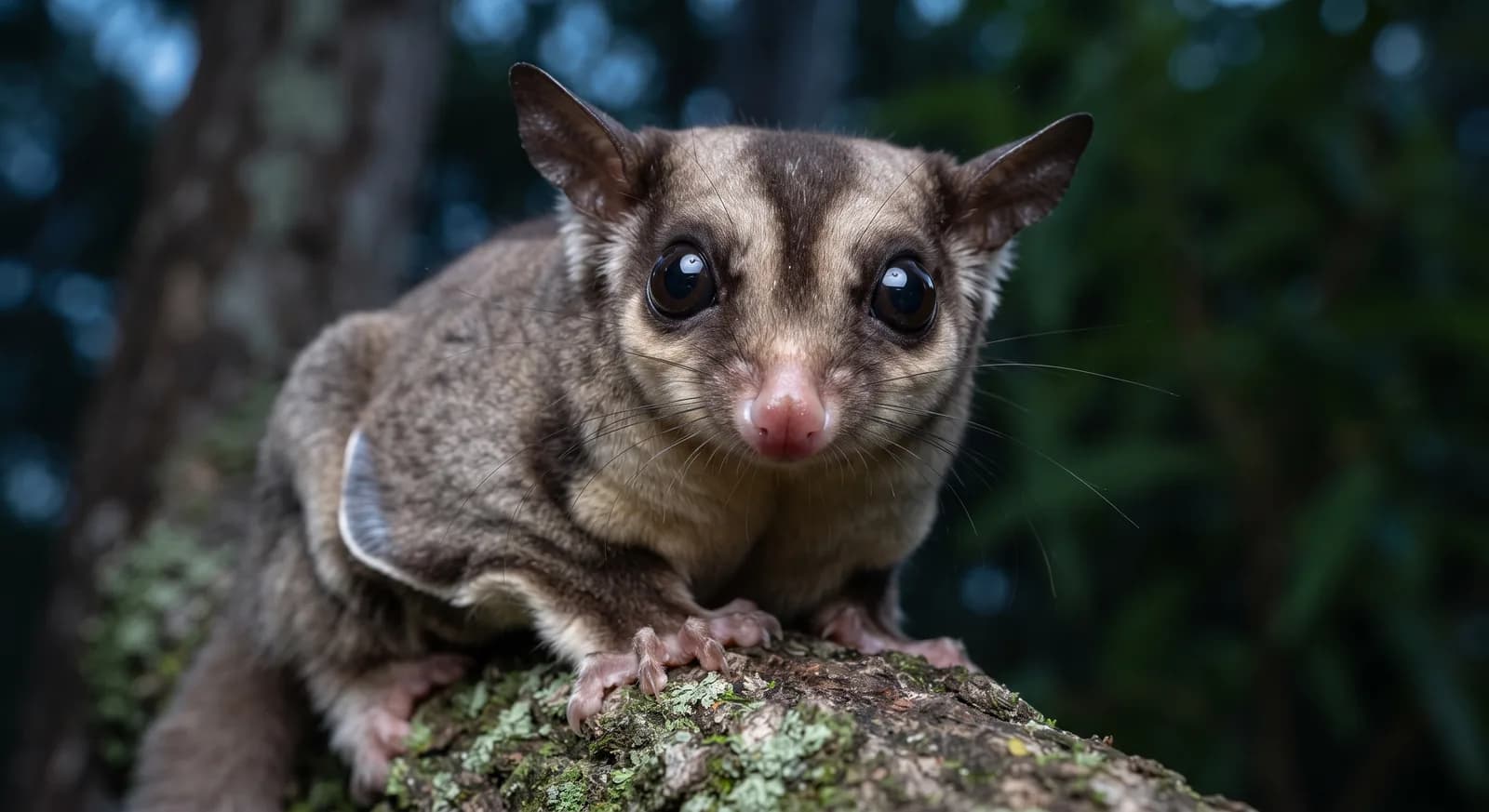
The squirrel glider is a gliding marsupial of eastern Australia, intermediate in size between the sugar glider and the greater glider. It spreads a membrane of skin between wrists and ankles and glides between trees, covering up to fifty metres. It feeds on eucalypt sap, nectar, pollen and insects, and makes incisions in the bark of particular trees to make them bleed. It lives in family groups and depends entirely on old trees with hollows to nest in, a scarce resource in managed forests.
Weight
170 g – 300 g
Size
18 cm – 23 cm
Lifespan
6 years
Diet
Omnivore
Combines animal and plant food depending on availability.
Activity
Nocturnal
Active mainly at night.
Social structure
Family group
Lives in small family groups with close bonds.
Sighting difficulty
Easy
Fun facts
- It can glide up to fifty metres between trees, steering with the curve of its wrists and using its bushy tail as a rudder.
- It depends on hollow-bearing trees, which a eucalypt takes more than a century to develop: that is why it disappears from forests logged on rotation even when they are covered in trees again.
Life cycle & biology
- Skeleton type
- Vertebrate - internal bony skeleton (mammal)
- Habitat & environment
- Dry eucalypt forest with mature, hollow-bearing trees, in eastern Australia
- Birth weight
- A tiny marsupial neonate that completes its development in the mother's pouch
- Size at birth
- A tiny marsupial neonate that completes its development in the mother's pouch
- Sexual maturity
- 12 months
- Gestation / incubation
- 20 days
- Litter / clutch size
- 1.5 (average)
Sources consulted: https://www.iucnredlist.org/ | https://animaldiversity.org/ | https://es.wikipedia.org/
Where to find it
See its range on the interactive mapBest time: All year in eastern Australia, at night; found by torchlight in the eucalypts and acacias whose sap it takes.
Where to watch it
Parques y spots de buceo donde se ha documentado esta especie — se muestran 10 de 15 documentados.
Related species
Other species in the catalogue with the most in common with Squirrel Glider — same habitat, park, country, tags or family.
 Least Concern
Sugar Glider
Petaurus breviceps
Long-nosed Bandicoot
Perameles nasuta
Southern Brown Bandicoot
Isoodon obesulus
Common Brush-tailed Possum
Trichosurus vulpecula
Feathertail Glider
Acrobates pygmaeus
Eastern Pygmy Possum
Cercartetus nanus
Keep exploring
Based on what we already know about squirrel glider.
Comments
Share an experience, a fun fact or a tip for seeing the squirrel glider.
Be the first to comment.