Bony fish · Tetraodontiformes · Tetraodontidae
Japanese Pufferfish
Takifugu rubripes
It has not yet been assessed against the IUCN criteria. See full glossary
The Japanese fugu is a pufferfish of temperate waters in the north-western Pacific, with a brown back and a large black blotch ringed in white behind the pectoral fin. It crushes crustaceans and molluscs with its beak-like teeth. Its liver, ovaries and skin concentrate tetrodotoxin in lethal amounts.
Size
40 cm – 75 cm
Diet
Carnivore
Feeds mainly on other animals.
Social structure
Solitary
Lives and hunts alone, joining others only to breed.
Sighting difficulty
Unknown
Fun facts
- Preparing it in Japan requires a specific licence, obtained after years of training and a practical examination, and certain organs are banned by law.
- The fish does not produce the toxin itself: it comes from bacteria taken in with its food, and fish reared in captivity on controlled feed turn out to be non-toxic.
- Its genome, published in 2002, is one of the most compact of any vertebrate, with very little non-coding DNA, which made it a reference for identifying genes in the human genome.
- Its genome was a key piece of genomics. It was sequenced in 2002, and it was chosen precisely because it is among the most compact vertebrate genomes known: around eight times smaller than the human genome yet with a similar number of genes, which made it a reference for locating human genes by comparison.
- Its toxin, tetrodotoxin, blocks the sodium channels of nerves and muscles and has no antidote. It is concentrated above all in the liver, gonads and skin.
- The fish does not make it itself: bacteria produce it, and the fish accumulates it through the food chain. Specimens reared in captivity on a controlled diet turn out to be non-toxic.
- Preparing it in Japan requires a licence, obtained after years of training and a practical examination.
- It inflates by swallowing water until it triples its volume, a defence that makes it almost impossible for a predator to swallow.
Life cycle & biology
- Skeleton type
- Vertebrate - internal bony skeleton (fish)
- Habitat & environment
- Coastal and shelf waters of the north-western Pacific
Sources consulted: https://es.wikipedia.org/wiki/Takifugu_rubripes
Where to find it
See its range on the interactive mapWhere to watch it
Parks and dive sites where this species has been documented.
Related species
Other species in the catalogue with the most in common with Japanese Pufferfish — same habitat, park, country, tags or family.
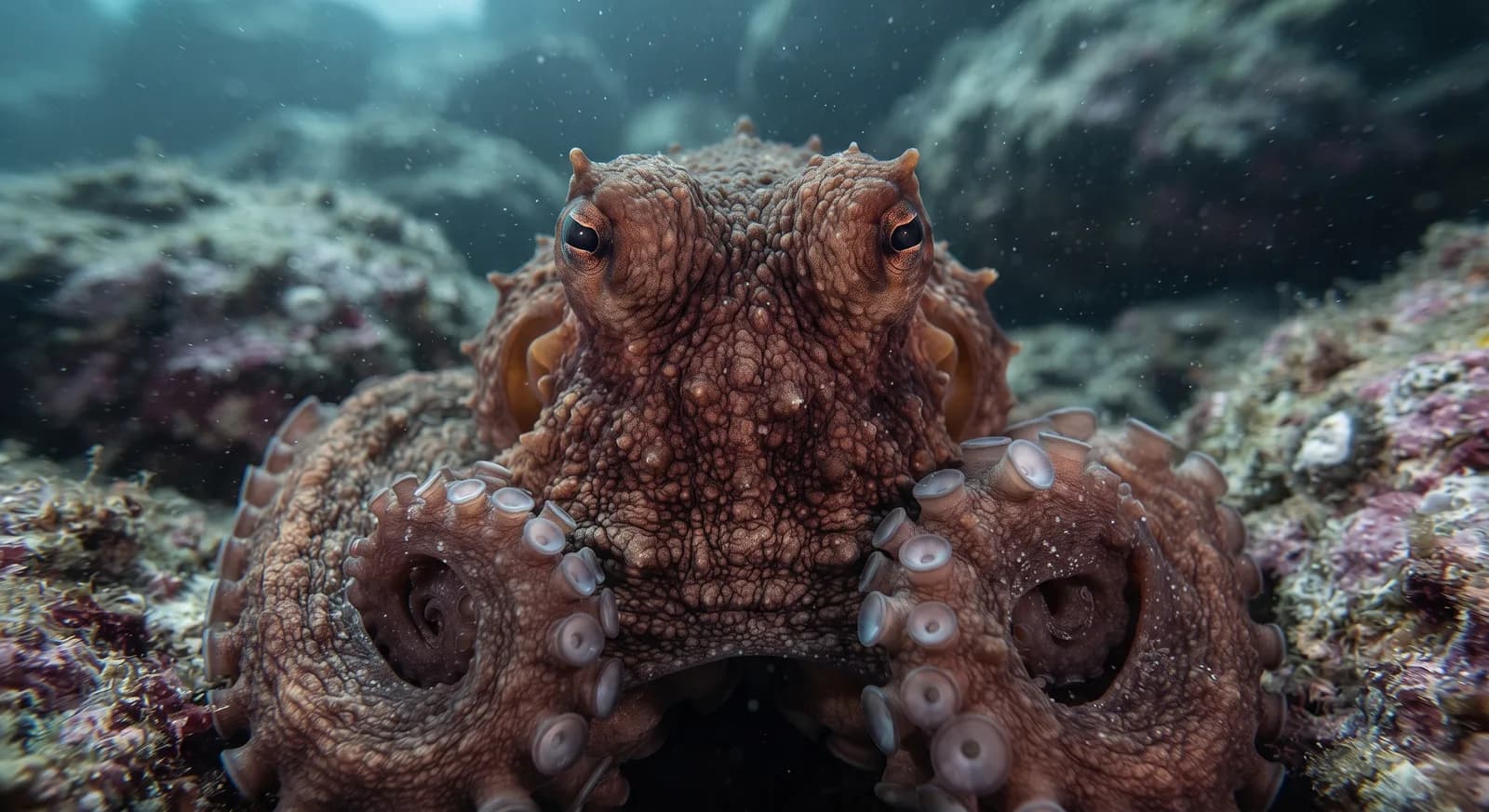 Least Concern
Giant Pacific Octopus
Enteroctopus dofleini
Cuvier's Beaked Whale
Ziphius cavirostris
Bryde's Whale
Balaenoptera edeni
Moon Jellyfish
Aurelia aurita
Immortal Jellyfish
Turritopsis dohrnii
Pacific Sardine
Sardinops sagax
Keep exploring
Based on what we already know about japanese pufferfish.
Comments
Share an experience, a fun fact or a tip for seeing the japanese pufferfish.
Be the first to comment.