Hydrozoans · Anthoathecata · Oceaniidae
Immortal Jellyfish
Turritopsis dohrnii
It has not yet been assessed against the IUCN criteria. See full glossary
Turritopsis dohrnii, formerly classified as T. nutricula and also known as the immortal jellyfish or, in Spanish, medusa lunar, is a small jellyfish found in the Mediterranean and in the waters of Japan. It is one of the known cases of animals able to revert individually from adulthood to a sexually immature stage. Other biologically immortal animals include the jellyfish Laodicea undulata and Aurelia sp.
Size
up to 0.5 cm
Diet
Carnivore
Feeds mainly on other animals.
Social structure
Solitary
Lives and hunts alone, joining others only to breed.
Sighting difficulty
Unknown
Fun facts
- GeneralIt can run its life cycle backwards to the polyp stage, and so avoid dying of old age.
- biologíaIt can run its life cycle backwards to a juvenile state (a polyp) after reaching maturity, and so avoid dying of old age.
- Faced with hunger, injury or stress, the adult medusa settles on the bottom, reabsorbs itself and turns back into a polyp, the juvenile stage, through a process of transdifferentiation in which already specialised cells change identity.
- That reversal can be repeated many times over, so that an individual has no lifespan set by ageing — though it can still be eaten or fall ill: immortal does not mean invulnerable.
- It is an extremely rare case among animals, and for that reason is intensively studied in research on regeneration and ageing.
- It is the only animal known whose adults can reverse their development to avoid death. When damaged, diseased or in poor condition, the medusa contracts into a cyst of undifferentiated tissue and turns back into a polyp, restarting the cycle.
- The process is called transdifferentiation: already specialised cells change identity and become another cell type. It takes between 48 and 72 hours.
- Related species can do it when young but lose the ability on maturing. This one keeps it once sexually mature, with rejuvenation rates of up to 100 %.
- It was described in the Mediterranean in 1883, but its ability was not recognised until the 1990s.
- A 2022 study compared its genome with that of a non-immortal relative and found duplicated genes for DNA repair and protection, along with the silencing of repressor complexes and the activation of pluripotency factors during reversal.
- The adult medusa is barely 4.5 millimetres across and has a bright red stomach.
Life cycle & biology
- Habitat & environment
- Shallow coastal waters
Sources consulted: https://es.wikipedia.org/wiki/Turritopsis_dohrnii
Where to find it
See its range on the interactive mapWhere to watch it
Parques y spots de buceo donde se ha documentado esta especie — se muestran 20 de 96 documentados.
Related species
Other species in the catalogue with the most in common with Immortal Jellyfish — same habitat, park, country, tags or family.
Beadlet Anemone
Actinia equina
Portuguese Man-of-war
Physalia physalis
Moon Jellyfish
Aurelia aurita
Shortfin Mako
Isurus oxyrinchus
Porbeagle
Lamna nasus
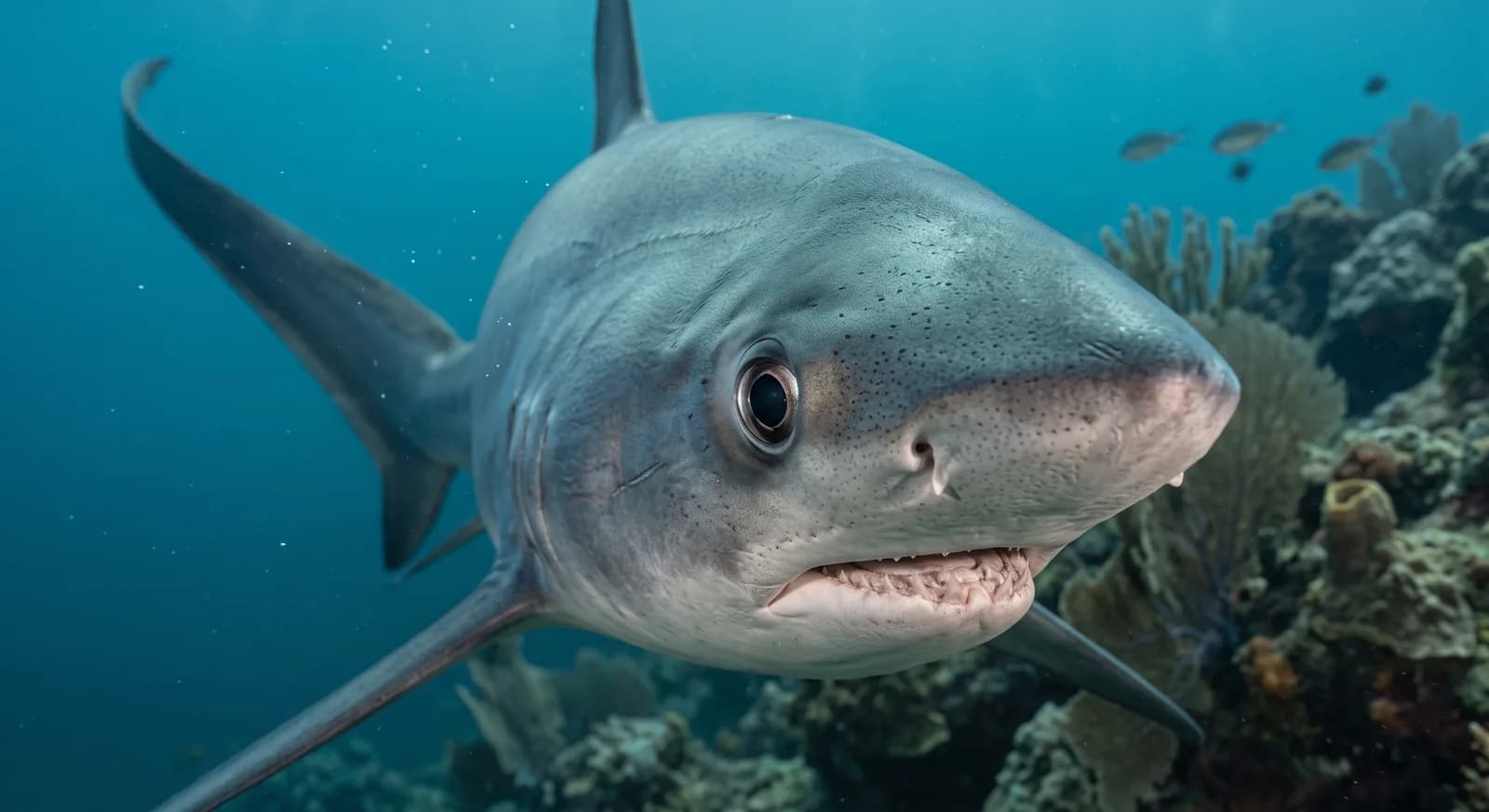 Vulnerable
Grayfish
Alopias vulpinus
Keep exploring
Based on what we already know about immortal jellyfish.
Comments
Share an experience, a fun fact or a tip for seeing the immortal jellyfish.
Be the first to comment.