One of the 47 frogs on WAnimals
Amphibians · Anura · Rhinodermatidae
Southern Darwin's Frog
Rhinoderma darwinii
It faces a very high risk of extinction in the wild in the near future. See full glossary
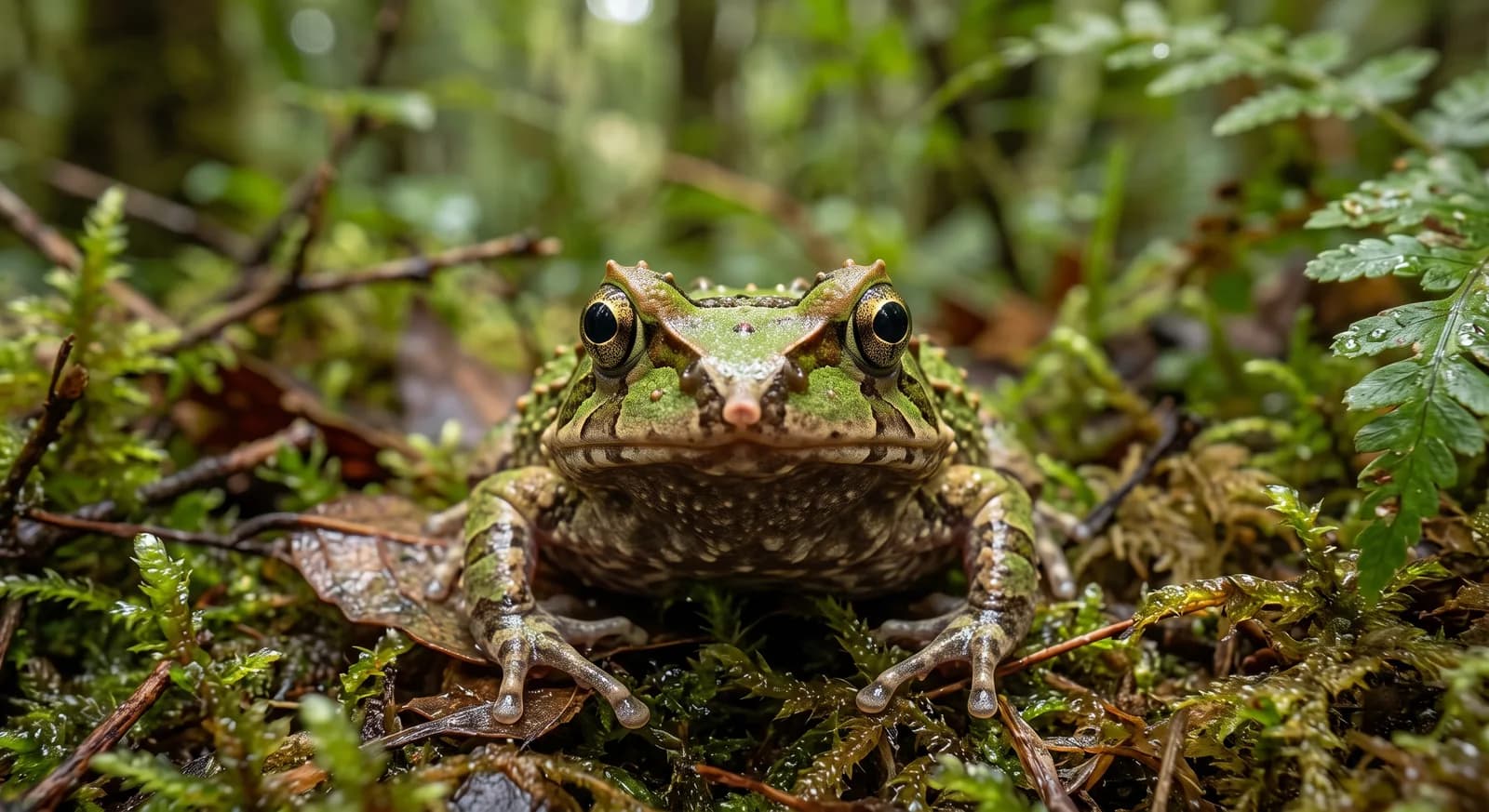
Darwin's frog is an anuran amphibian of the family Rhinodermatidae. It is endemic to the temperate forests of Chile and Argentina, though in the latter country its presence is restricted to areas bordering Chile, in both the provinces of Neuquén and Río Negro. In Chile it lives up to 1,800 m above sea level, ranging from the city of Concepción to Aysén, in the Biobío and Aysén regions respectively. It is found in areas of vegetation with either a closed or an open layer of tree species whose canopy stands more than 15 metres high, and is associated, according to Crump (2002), with Nothofagus sp., alerce and luma. The species is most abundant in mature native forest, which has a high degree of structural complexity.
Size
2.5 cm – 3.5 cm
Lifespan
15 years
Diet
Insectivore
Feeds mainly on insects and other invertebrates.
Activity
Diurnal
Active mainly during the day.
Social structure
Solitary
Lives and hunts alone, joining others only to breed.
Sighting difficulty
Hard
Fun facts
- reproducciónThe male broods the fertilised eggs inside his own vocal sac until the young complete their metamorphosis.
- The male swallows the tadpoles and raises them inside his vocal sac: they stay there six or seven weeks feeding on secretions from its walls, and emerge from their father's mouth as fully formed froglets. There is nothing like it in any other vertebrate.
- It was discovered by Charles Darwin in Chile during the voyage of the Beagle in 1834, and has borne his name ever since.
- Its pointed snout and triangular body make it indistinguishable from a dead leaf on the forest floor, and in the face of danger it drops into the water and floats motionless on its back, imitating a drifting leaf.
Life cycle & biology
- Skeleton type
- Vertebrate - internal bony skeleton (amphibian)
- Habitat & environment
- Damp understorey of the Valdivian temperate forest of Chile and south-western Argentina
- Birth weight
- It leaves the male's vocal sac already metamorphosed, at about 12 mm
- Size at birth
- The tadpoles complete metamorphosis inside the male's vocal sac and emerge as froglets of about 12 mm
- Sexual maturity
- 2 years
- Gestation / incubation
- 7 weeks of development in the male's vocal sac
- Litter / clutch size
- 15 young
Sources consulted: https://es.wikipedia.org/wiki/Rhinoderma_darwinii
Where to find it
See its range on the interactive mapBest time: From November to March in the temperate forests of Chile and Argentina, by day, among damp leaf litter; it is very scarce and hard to find.
Where to watch it
Parks and dive sites where this species has been documented.
Related species
Other species in the catalogue with the most in common with Southern Darwin's Frog — same habitat, park, country, tags or family.
 Endangered
Southern River Otter
Lontra provocax
Darwin's Fox
Lycalopex fulvipes
Buff-Necked Ibis
Theristicus caudatus
Chucao Tapaculo
Scelorchilus rubecula
Southern Monito del Monte
Dromiciops gliroides
 Least Concern
Puma
Puma concolor
How to help
The southern darwin's frog is classified as endangered. Organizations such as UICN, WWF y Wildlife Conservation Society work specifically on its conservation and that of its habitat; looking into their programs is a good starting point if you want to get involved.
It's documented in 4 real protected areas — part of why protecting these places matters for its conservation.
Keep exploring
Based on what we already know about southern darwin's frog.
Comments
Share an experience, a fun fact or a tip for seeing the southern darwin's frog.
Be the first to comment.