One of the 41 turtles and tortoises on WAnimals
Reptiles · Testudines · Platysternidae
Big-headed Turtle
Platysternon megacephalum
It faces an extremely high risk of imminent extinction in the wild. See full glossary
The big-headed turtle is the only living member of its family and one of the most peculiar turtles in the world: it has a head so large that it cannot pull it inside its shell, protected instead by a bony helmet, and a tail almost as long as its body. It climbs over rocks and even into bushes, which is extraordinary in a river turtle.
Weight
500 g – 1.5 kg
Size
15 cm – 20 cm
Lifespan
25 years
Diet
Carnivore
Feeds mainly on other animals.
Activity
Nocturnal
Active mainly at night.
Social structure
Solitary
Lives and hunts alone, joining others only to breed.
Sighting difficulty
Very hard
Fun facts
- It cannot pull its head into its shell because the head is too large: instead it is covered by a bony plate that works as a helmet, a solution no other turtle has developed.
- It climbs: it has been seen scaling wet rocks, fallen trunks and even bushes beside the streams, using its long tail as a prop and its sharp claws.
- It is the only living representative of its family, a lineage isolated for tens of millions of years, and collection for the pet trade and for food in China has taken it to the brink of extinction.
Life cycle & biology
- Skeleton type
- Vertebrate - internal bony skeleton with a shell (reptile)
- Habitat & environment
- Cold, fast mountain streams with stony beds, in southern China and northern Indochina
- Sexual maturity
- 5 years
- Gestation / incubation
- 70 days of incubation
- Litter / clutch size
- 2 eggs
Sources consulted: https://es.wikipedia.org/wiki/Platysternon_megacephalum
Where to find it
See its range on the interactive mapWhere to watch it
Parks and dive sites where this species has been documented.
Related species
Other species in the catalogue with the most in common with Big-headed Turtle — same habitat, park, country, tags or family.
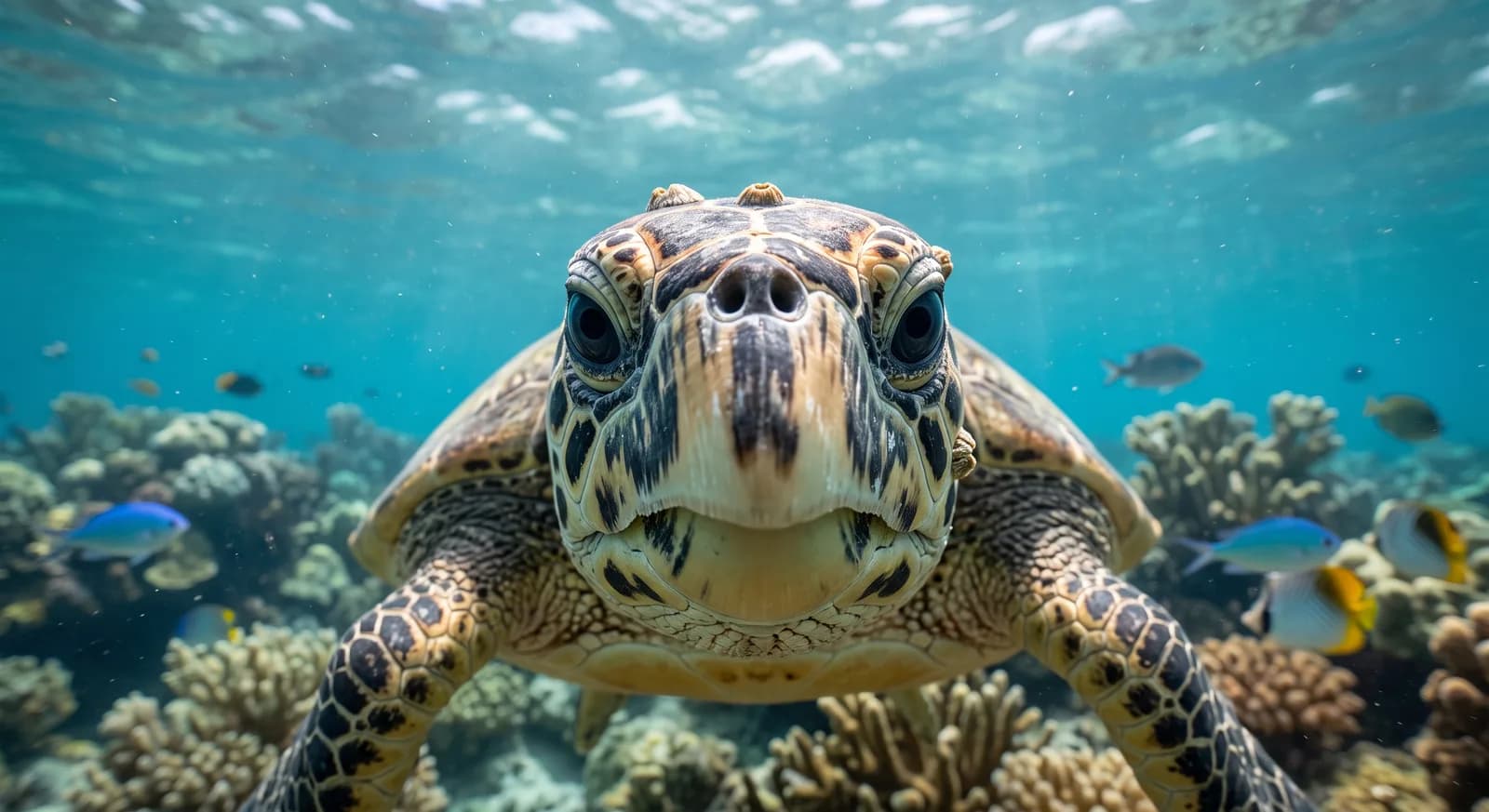 Critically Endangered
Hawksbill Turtle
Eretmochelys imbricata
Elephant Trunk Snake
Acrochordus javanicus
Yellow-bellied Sea Snake
Hydrophis platurus
Yellow-lipped Sea Krait
Laticauda colubrina
Red Lionfish
Pterois volitans
Swordfish
Xiphias gladius
How to help
The big-headed turtle is classified as critically endangered. Organizations such as UICN, WWF y Wildlife Conservation Society work specifically on its conservation and that of its habitat; looking into their programs is a good starting point if you want to get involved.
It's documented in 1 real protected area — part of why protecting these places matters for its conservation.
Keep exploring
Based on what we already know about big-headed turtle.
Comments
Share an experience, a fun fact or a tip for seeing the big-headed turtle.
Be the first to comment.