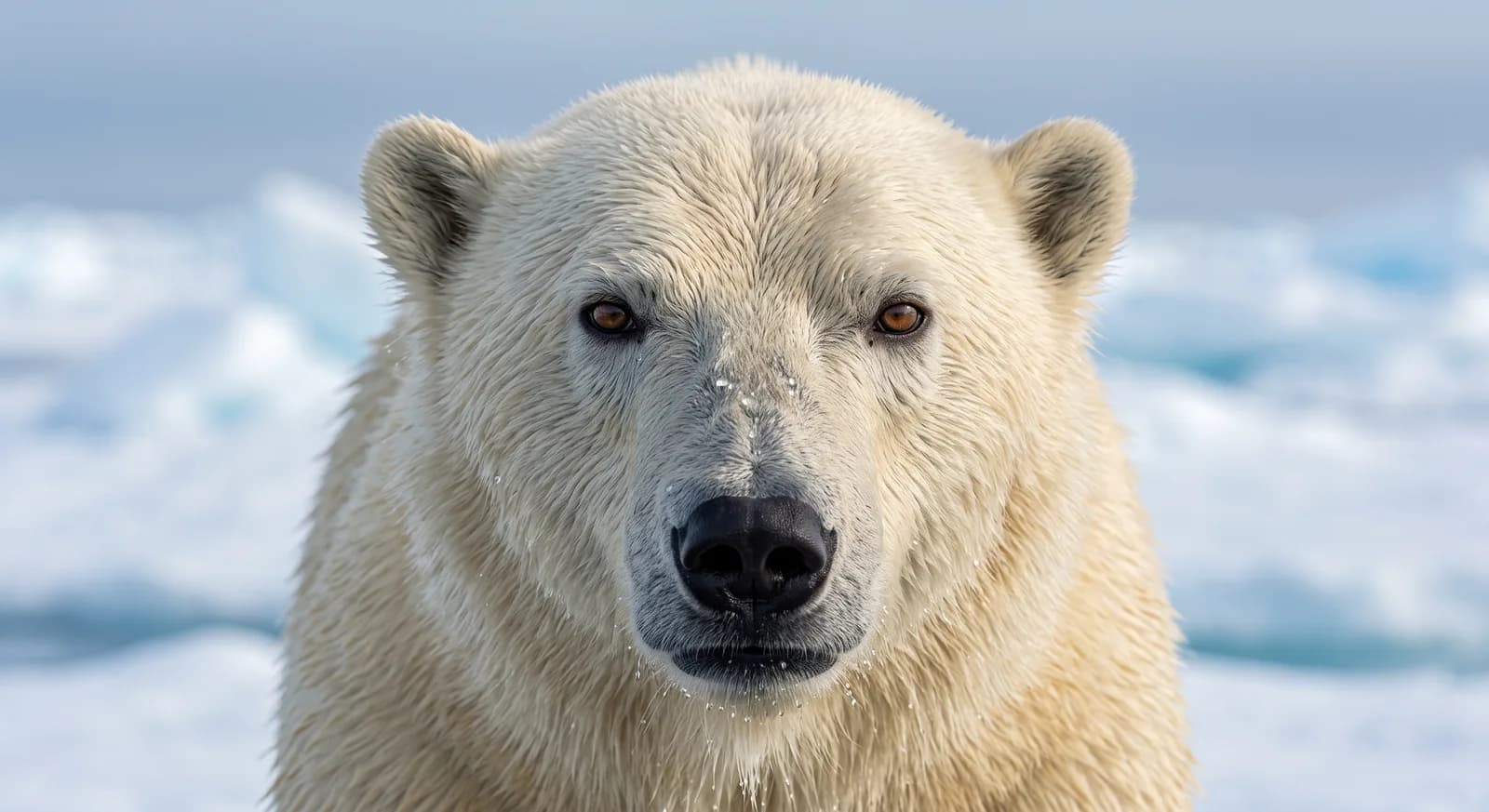
 Vulnerable
Polar Bear
Ursus maritimus
The world's finest site of the "Age of Fishes", documenting the step from fish to the first land vertebrates.
Area
0.87 km²
Designated in
1999
Region
North America
The fossil cliff of the Escuminac Formation (Upper Devonian)
Miguasha National Park covers barely 87.3 hectares on the northern shore of the Restigouche River, on the southern coast of the Gaspé Peninsula, in south-eastern Quebec. It is the smallest of the Quebec national parks and was created in 1985 by the Government of Quebec to protect the coastal exposure of the Escuminac Formation. UNESCO inscribed it on the World Heritage List in 1999 under criterion (viii), considering it the world's most outstanding fossil site for the representation of vertebrate life in the Devonian, the period known as the Age of Fishes.
The Escuminac Formation dates from some 370 million years ago and is made up of alternating beds of sandstone, siltstone and shale. It is eight kilometres long and one wide and reaches a hundred metres in height, across four exposures; the most important, three kilometres long and up to thirty metres high, essentially constitutes the park. Five of the six great groups of Devonian fossil fish are represented in it, but its prime importance lies in the sarcopterygians, or lobe-finned fishes: here are preserved the greatest number and the best-preserved specimens in the world of this group, from which the first air-breathing terrestrial tetrapod vertebrates arose. Eusthenopteron foordi, the site's emblematic fossil, is one of the key pieces for understanding that transition.
The site has been known since 1842, when Abraham Gesner collected the first specimens and sent them to the Royal Scottish Museum and the British Museum; since then it has also appeared in the scientific literature as Escuminac Bay, Scaumenac Bay or Hugh Miller Cliffs. Some 13,000 specimens have been recovered and the park museum holds a collection of more than 9,000. A provincial mining act of 1990 prohibited the exploration and exploitation of hydrocarbons and minerals across a periphery of some 775 hectares divided among a hundred or so private owners; in 2004 Quebec raised that band to the status of a reserve, so that any action requires prior ministerial authorisation. Fieldwork remains active and continues to produce finds.
1 dive site within 300 km is also shown.
Ecosystems found in Canada, where Miguasha lies.
Where can I dive near here?
275 km away
What is worth looking out for this month in Canada?
Now is a good time: Polar bear gathering at Churchill (October to November)
Which other parks are like this one?
Same country: Canada
Same country: Canada
Same country: Canada
Same country: Canada
Based on what we already know about this park.
Share your experience visiting Miguasha, or a tip for other travellers.
Be the first to comment.
Climate
Temperate, Polar / cold
Best season
June to September
 Canada