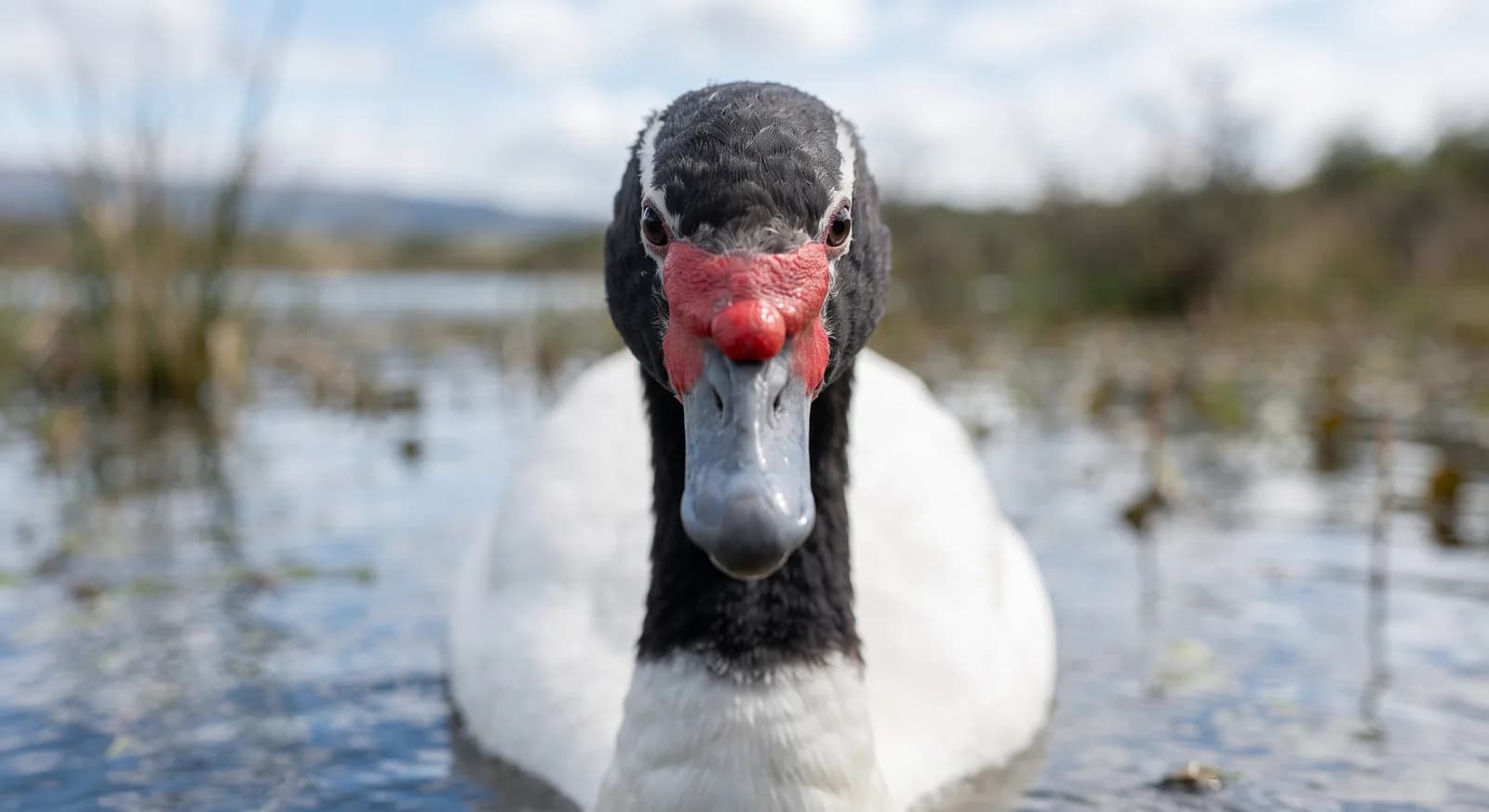
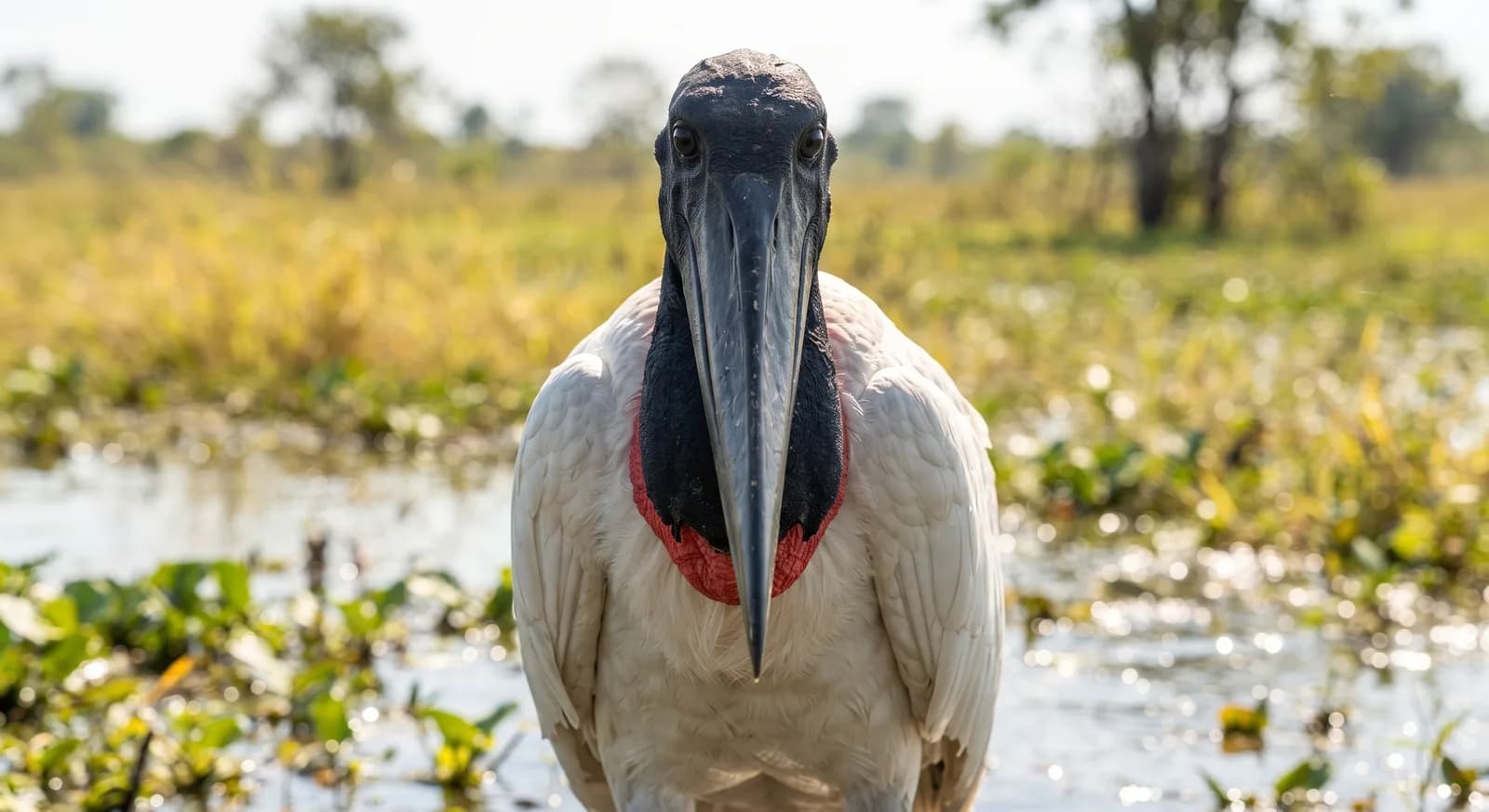
The smallest of the swans of the genus Cygnus. A white body with the head and the upper two thirds of the neck black, and a white stripe that borders the eyelids and runs back towards the nape. The bill is greyish blue with a very prominent red caruncle at the base. The male is larger and has three caruncles; the female has a shorter neck and only two.
AI-generated images: illustrations, not photographs.
Fun facts
It is the only representative of the genus Cygnus in South America.
It filters water by putting its bill into shallow areas and opening and closing it slightly to make the water circulate through it.
The young climb onto the adults' backs and hide under a wing when there is danger, a behaviour that is more frequent in this species than in the black swan.
The parents carry their chicks on their backs. It is the species' best-known image: black-necked swans swim with their young perched between their wings, sheltered from the cold and from predators.
It is the smallest swan in the southern hemisphere and the only one with a black neck and a white body, with a red caruncle on the bill.
Its recent history in Chile is a textbook case of environmental impact. In 2004, the start-up of a pulp mill beside the Río Cruces wetland, in Valdivia, caused the disappearance of the macrophyte Egeria densa, which made up 99% of its diet there.
The population, thousands of birds strong, collapsed: the swans died or moved away, and many survivors dispersed as far as the marine wetlands of Chiloé Island, where they began breeding in an environment new to them.
The episode had judicial and regulatory consequences in Chile and turned the species into a symbol of the defence of wetlands.
It is clumsy on land, far more so than other swans, and spends almost its entire life on the water.
Life cycle and biology
Skeleton type
Vertebrate - internal bony skeleton (bird)
Habitat and environment
It breeds in the emergent vegetation fringing freshwater lakes; for the rest of the year it also appears on brackish lakes, bays, fjords, slow rivers, estuaries and coastal waters. Resident across much of its range, although the southernmost populations are migratory
Birth weight
Precocial chicks covered in white down, carried on their parents' backs for the first few days
Size at birth
The chicks hatch pure white and develop the dark neck within a month or two
Sexual maturity
3 years; the red caruncle on the bill is not fully developed until three or four
Gestation / incubation
34-36 days of incubation, by the female alone, while the male defends the nest
Litter / clutch size
3-7 eggs; some sources raise the clutch to 4-8
Sources consulted: IUCN Red List (BirdLife International 2016); Birds of the World (Carboneras, Kirwan y Pantoja-Maggi 2026); Ministerio del Medio Ambiente de Chile (RCE, 16.º proceso); SIB - Parques Nacionales de Argentina; Schlatter et al. 1991, Wildfowl; Silva 2018, Atlas de las aves nidificantes de Chile; Molina 1782
Where to find it
Best time: The austral spring and summer, when it breeds in Chile, Argentina, Paraguay, Uruguay and the Falklands
Loading map…
The pins mark the parks where its presence is documented.
Where to see it
Parks and dive sites where this species has been documented — showing 10 of 20.
Related species
Other species in the catalogue with the most in common with Black-necked Swan — same habitat, park, country, tags or family.
Same taxonomic family
Same taxonomic family
Same taxonomic family
Same taxonomic family
Shares a park
Shares a park
Keep exploring
Based on what we already know about black-necked swan.
Comments
Share an experience, a fun fact or a tip for seeing the black-necked swan.