Skip to content
WAnimals
  • Map
  • Species
  • Parks
  • Diving
Log inCreate account
WAnimals

The guide for travellers and animal lovers: discover, plan and share your wild adventures around the world.

Discover wildlife

  • Species
  • Ecosystems
  • Glossary
  • Tags

Explore places

  • Map
  • Countries
  • Parks
  • Diving

Plan experiences

  • Guides

Learn

  • Blog

Resources

  • About us
  • How we build our profiles
  • Help centre
  • Contact
  • Install the app

Follow us

Account

  • Log in
  • Create account

© 2026 WAnimals. All rights reserved.

Terms of servicePrivacyCookiesLegal notice
MapSpeciesParksDiving
  1. Home
  2. Species
  3. Giant Hummingbird

One of the 11 hummingbirds on WAnimals

Birds · Apodiformes · Trochilidae

Giant Hummingbird

Patagona gigas

Least Concern

The species is abundant and widely distributed; it faces no significant short-term risk.

Spotted something wrong?

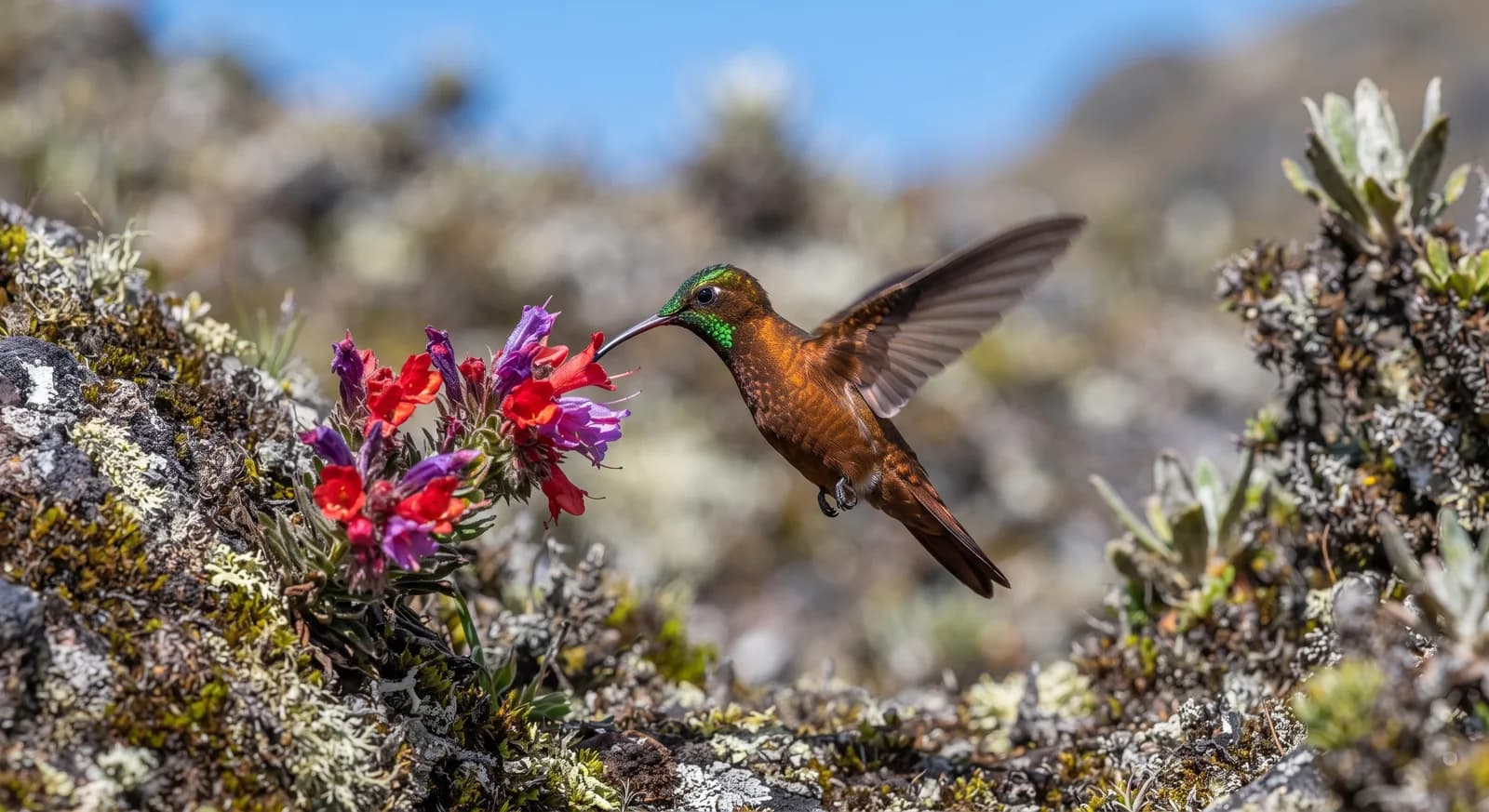
The giant hummingbird is by some way the largest hummingbird in the world: it measures more than twenty centimetres and weighs as much as eight ordinary hummingbirds. Its size forces it into a wingbeat that is slow for a hummingbird, about fifteen beats a second, which gives it a flight that from a distance is more reminiscent of a swift. It lives in the arid Andes, from Ecuador to Chile and Argentina, and feeds above all on the nectar of columnar cacti and agaves.

Weight

18 g – 24 g

Size

21 cm – 23 cm

Life expectancy

8 years

Diet

Nectarivore

Feeds mainly on flower nectar.

Activity

Diurnal

Active mainly during the day.

Social structure

Solitary

Lives and hunts alone, joining others only to breed.

DesertMountain
7countries26parks15same family

Fun facts

  • It is the largest hummingbird on the planet, and its wingbeat is so slow for a hummingbird that it can be followed with the naked eye, whereas in a small hummingbird it is invisible.
  • In 2024 genetic studies revealed that the migratory southern populations and the resident northern ones have been separate for millions of years and are in fact two different species, despite being practically identical to look at.

Life cycle and biology

Skeleton type
Vertebrate - internal bony skeleton (bird)
Habitat and environment
Arid Andean scrub, high-altitude woodland and dry valleys with cacti, between 1,500 and 4,500 metres
Sexual maturity
12 months
Gestation / incubation
18 days of incubation
Litter / clutch size
2 eggs

Sources consulted: Wikipedia (es): Patagona gigas

Where to find it

Loading map…

The pins mark the parks where its presence is documented.

Where to see it

Parks and dive sites where this species has been documented — showing 10 of 26.

Related species

Other species in the catalogue with the most in common with Giant Hummingbird — same habitat, park, country, tags or family.

Same taxonomic family
Shares a park
Same taxonomic family

Keep exploring

Based on what we already know about giant hummingbird.
Share an experience, a fun fact or a tip for seeing the giant hummingbird.
See full glossary
This page in other languages: Español · Deutsch · Français · Português · Italiano
See its range on the interactive map→
LaucaChile
HuascaránPeru
CotopaxiEcuador
SangayEcuador
Los NevadosColombia
El CocuyColombia
Eduardo AvaroaBolivia
SajamaBolivia
PuracéColombia
PodocarpusEcuador
See all 26 parks
Sword-billed HummingbirdLeast Concern

Sword-billed Hummingbird

Ensifera ensifera

Shining SunbeamLeast Concern

Shining Sunbeam

Aglaeactis cupripennis

Least Concern

Green-backed Firecrown

Sephanoides sephaniodes

Black-chested Buzzard-EagleLeast Concern

Black-chested Buzzard-Eagle

Geranoaetus melanoleucus

Least Concern

Crimson Topaz

Topaza pella

Endangered

Marvelous Spatuletail

Loddigesia mirabilis

CountriesEcuador
ParksLaucaChile
TagsNectarivore
Nectarivore
Diurnal
Solitary
Bird
Desert
Mountain
Ecuador
Argentina
Chile
Colombia
Bolivia
Peru
Venezuela