 Near Threatened
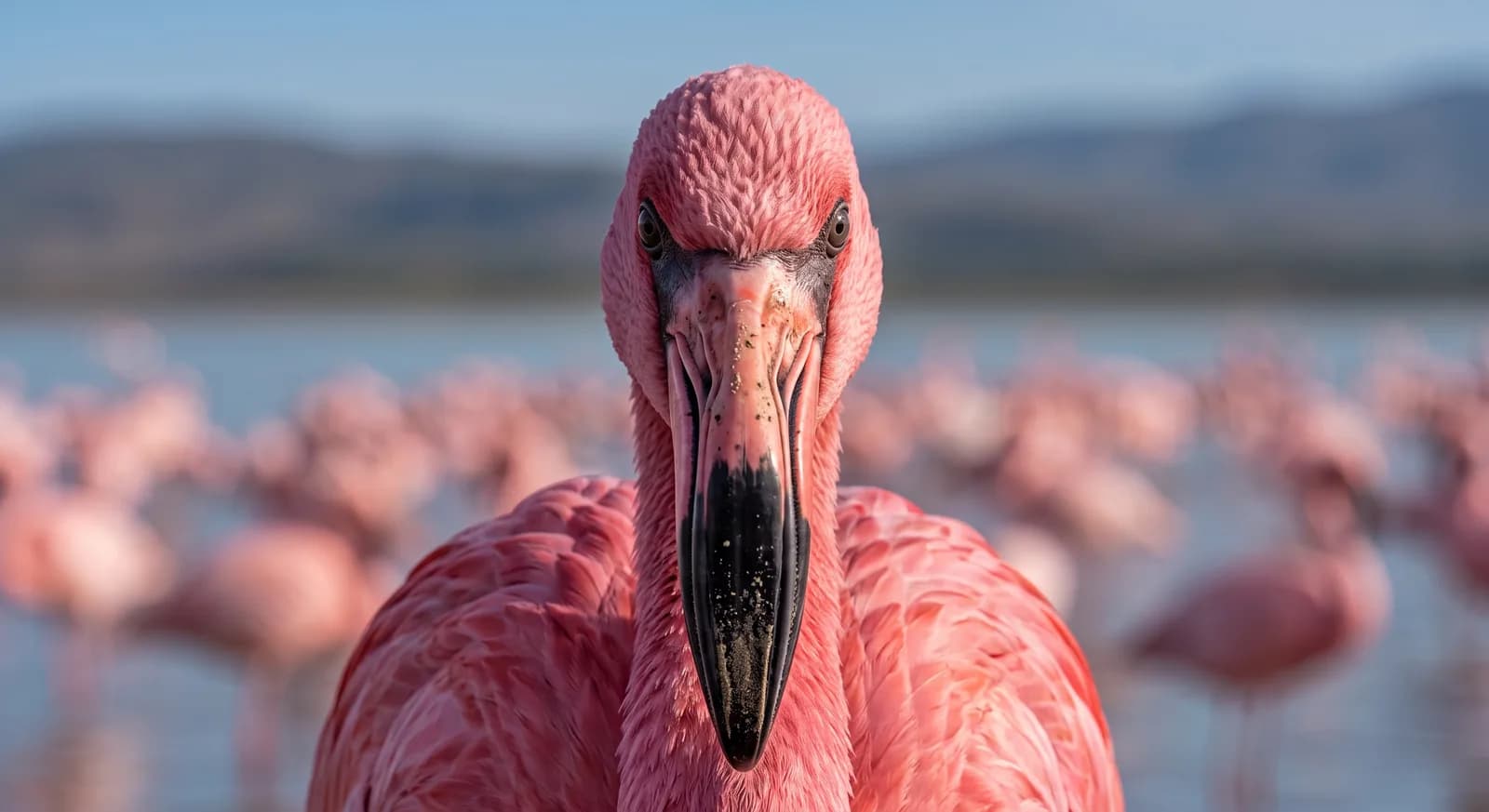
Lesser Flamingo
Phoeniconaias minor
Africa
The Republic of the Congo is largely covered by equatorial rainforest and by one of the most singular wetland systems on the planet: the peatlands of the Cuvette Centrale, a flooded swamp forest that also extends into the Democratic Republic of the Congo and makes up the largest known tropical peat complex, with carbon stores of global scale. In the north, Nouabalé-Ndoki and Odzala-Kokoua protect primary rainforest dotted with bais, swampy clearings where gorillas, forest elephants, buffalo and sitatungas gather. On the coast, Conkouati-Douli links ocean to mountain and brings together sea turtles, manatees, humpback whales and lowland forest in a single park. The Congo, Sangha and Likouala rivers structure the region's transport and life.
National animal: No official national animal; the lion appears as a supporter on the state coat of arms
In the Goualougo Triangle, inside Nouabalé-Ndoki, lives a community of chimpanzees that had barely had contact with humans and that, instead of fleeing, approached the first researchers out of curiosity. It was there that they were documented using genuine tool kits: first a thick stick to pierce the termite mound and then a slender rod, whose end they fray with their teeth into a brush, to extract the termites.
The peatlands of the Cuvette Centrale, mapped in detail from 2017, store an amount of carbon comparable to several years of global emissions, and draining them would be catastrophic. Nouabalé-Ndoki is a World Heritage Site within the Sangha Trinational property.
Odzala in the dry season for gorillas at the bais. Nouabalé-Ndoki year-round for chimpanzees and forest elephants. Conkouati between July and October for humpback whales.
Where else might I want to travel?
Same region: Central Africa
Same region: Central Africa
Same region: Central Africa
Same region: Central Africa
202 species found
Based on what we already know about Republic of the Congo.