Skip to content
WAnimals
  • Map
  • Species
  • Parks
  • Diving
Log inCreate account
WAnimals

The guide for travellers and animal lovers: discover, plan and share your wild adventures around the world.

Discover wildlife

  • Species
  • Ecosystems
  • Glossary
  • Tags

Explore places

  • Map
  • Countries
  • Parks
  • Diving

Plan experiences

  • Guides

Learn

  • Blog

Resources

  • Help centre
  • Contact
  • Install the app

Follow us

Account

  • Log in
  • Create account

© 2026 WAnimals. All rights reserved.

About usHow we build our profilesTerms of servicePrivacyLegal notice
MapSpeciesParksDiving
  1. Home
  2. Species
  3. European Bee-eater

One of the 2 bee-eaters on WAnimals
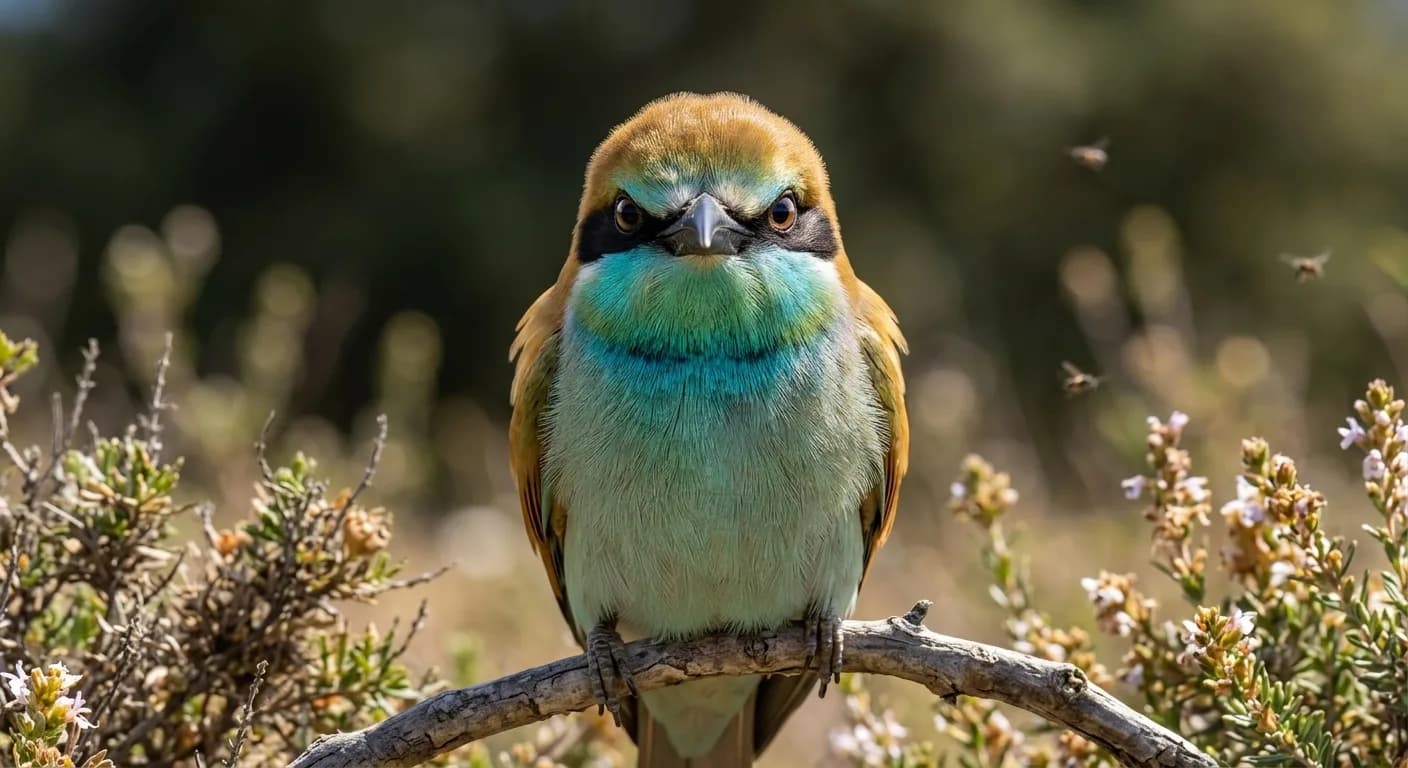
European Bee-eater (Merops apiaster)

Birds · Coraciiformes · Meropidae

European Bee-eater

Merops apiaster

Least Concern

The species is abundant and widely distributed; it faces no significant short-term risk.

Spotted something wrong?

It nests in colonies of over 100 pairs, digging tunnels into clay banks, and non-breeding "helpers" pitch in to feed the chicks.

Weight

45 g – 80 g

Size

27 cm – 29 cm

Life expectancy

5 years
Diet

Insectivore

Feeds mainly on insects and other invertebrates.

Activity

Diurnal

Active mainly during the day.

Social structure

Colony

Lives in large concentrations, often for breeding reasons.

Sighting difficulty

Easy

SavannaTemperate forest
99countries55parks1same family

AI-generated images: illustrations, not photographs.

Fun facts

  • It catches bees and wasps in flight, and has techniques for removing the sting before swallowing them.
  • It breeds cooperatively, a behaviour that is uncommon among birds.
  • It winters in sub-Saharan Africa.
  • alimentaciónIt rubs the bees and wasps it catches against a branch to work the venom out of the sting before swallowing them whole.

Life cycle and biology

Skeleton type
Vertebrate - pneumatised bony skeleton (bird)
Habitat and environment
Open country with broken ground and river banks across southern Europe, North Africa and western Asia; it winters in sub-Saharan Africa
Birth weight
Weight at hatching not found as a precise figure
Size at birth
Born blind and naked
Sexual maturity
1 year
Gestation / incubation
19-28 days (usual reference 19-20 days)
Litter / clutch size
2 to 10 eggs per clutch (most commonly 4-7)

Sources consulted: A-Z Animals; Wildlife Vagabond; Birds of the World; Birds Discovery; The Animal Facts; Animal Diversity Web; AnAge (genomics.senescence.info); Birdfact

Where to find it

Best time: From April to September in the Iberian Peninsula; it is a trans-Saharan migrant and is easily located by its liquid call in flight.

Loading map…

Where to see it

Parks and dive sites where this species has been documented — showing 10 of 55.

Related species

Other species in the catalogue with the most in common with European Bee-eater — same habitat, park, country, tags or family.

Same taxonomic family
Shares a park
Shares a park
Shares a park
Shares a park
Shares a park

Keep exploring

Based on what we already know about european bee-eater.

Comments

Share an experience, a fun fact or a tip for seeing the european bee-eater.

Be the first to comment.

See full glossary
This page in other languages: Español · Deutsch · Français · Português · Italiano

The pins mark the parks where its presence is documented.

See its range on the interactive map→
Doñana National ParkSpain
Sierra de las NievesSpain
Peneda-GeresPortugal
CalanquesFrance
Alta MurgiaItaly
Danube DeltaRomania
IchkeulTunisia
Hortobágy National ParkHungary
CabañerosSpain
PrespaGreece
See all 55 parks
Northern Carmine Bee-eaterLeast Concern

Northern Carmine Bee-eater

Merops nubicus

Least Concern

European Roller

Coracias garrulus

Least Concern

European Green Woodpecker

Picus viridis

Eurasian WrenLeast Concern

Eurasian Wren

Troglodytes troglodytes

Short-toed EagleLeast Concern

Short-toed Eagle

Circaetus gallicus

Least Concern

Eurasian Wryneck

Jynx torquilla

CountriesSpain
ParksDoñana National ParkSpain
TagsInsectivore
Insectivore
Diurnal
Colonial
Bird
Savanna
Temperate forest

Africa48

Europe35

Asia16

Spain
Portugal
Hungary
Italy
Bulgaria
France
Algeria
Angola
Benin
Botswana
Burkina Faso
Burundi
Cameroon
Central African Republic
Chad
Côte d’Ivoire
Democratic Republic of the Congo
Djibouti
Egypt
Equatorial Guinea
Eritrea
Eswatini
Ethiopia
Gabon
Gambia
Ghana
Guinea
Guinea-Bissau
Kenya
Lesotho
Liberia
Libya
Malawi
Mali
Mauritania
Morocco
Mozambique
Namibia
Niger
Nigeria
Republic of the Congo
Rwanda
Senegal
Sierra Leone
Somalia
South Africa
South Sudan
Sudan
Tanzania
Togo
Tunisia
Uganda
Zambia
Zimbabwe
Albania
Andorra
Austria
Belarus
Belgium
Bosnia and Herzegovina
Bulgaria
Croatia
Cyprus
Czechia
France
Germany
Gibraltar
Greece
Hungary
Italy
Kosovo
Liechtenstein
Luxembourg
Malta
Moldova
Monaco
Montenegro
Netherlands
North Macedonia
Poland
Portugal
Romania
San Marino
Serbia
Slovakia
Slovenia
Spain
Switzerland
Ukraine
Armenia
Azerbaijan
Bangladesh
Bhutan
Georgia
India
Israel
Jordan
Lebanon
Myanmar
Nepal
Pakistan
Palestine
Sri Lanka
Syria
Türkiye