One of the 8 hornbills on WAnimals
Birds · Bucerotiformes · Bucerotidae
Indian Grey Hornbill
Ocyceros birostris
The species is abundant and widely distributed; it faces no significant short-term risk. See full glossary
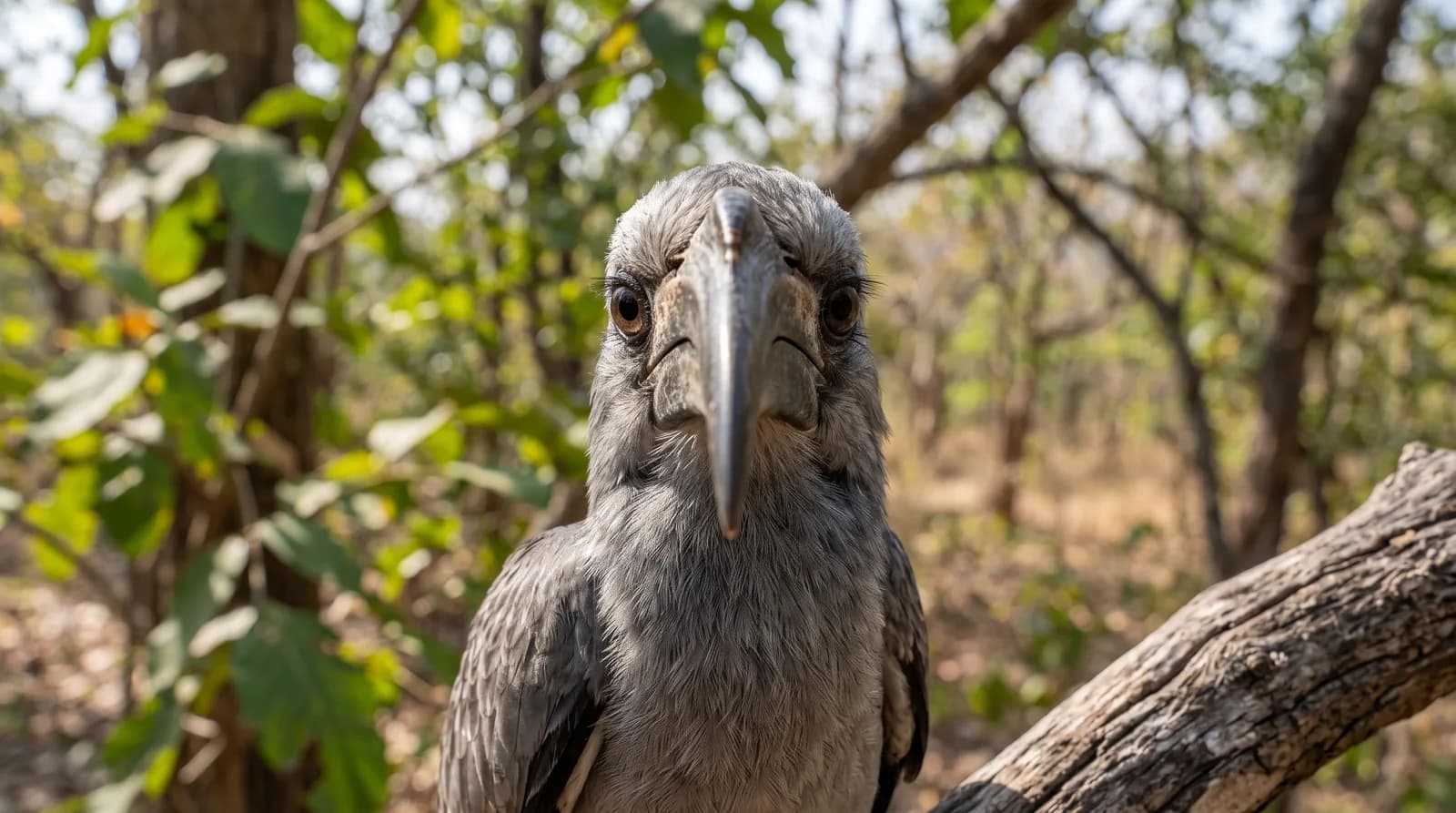
The Indian grey hornbill is the commonest and most urban hornbill of the Indian subcontinent: it is frequently seen along tree-lined avenues and in the parks and gardens of cities such as Delhi and Mumbai. It is brownish grey with an elongated casque above the bill and very conspicuous long black eyelashes. It eats mainly fruit, especially figs, along with insects and small reptiles. As in the rest of the hornbills, the female seals herself into the nest hole while raising the young.
Weight
350 g – 500 g
Size
50 cm – 60 cm
Lifespan
20 years
Diet
Omnivore
Combines animal and plant food depending on availability.
Activity
Diurnal
Active mainly during the day.
Social structure
In pairs
Usually lives in pairs, sometimes for life.
Sighting difficulty
Easy
Fun facts
- It has eyelashes: long, stiff modified feathers that shield its eyes, a striking feature and an uncommon one among birds.
- It is one of the few hornbills in the world to have thrived in large cities: the old trees of India's avenues provide the nest holes it has lost in the forest.
Life cycle & biology
- Skeleton type
- Vertebrate - internal bony skeleton (bird)
- Habitat & environment
- Open woodland, urban avenues, gardens and wooded farmland of the Indian subcontinent
- Sexual maturity
- 2 years
- Gestation / incubation
- 27 days of incubation
- Litter / clutch size
- 3 eggs
Sources consulted: https://es.wikipedia.org/wiki/Ocyceros_birostris
Where to find it
See its range on the interactive mapWhere to watch it
Parks and dive sites where this species has been documented.
Related species
Other species in the catalogue with the most in common with Indian Grey Hornbill — same habitat, park, country, tags or family.
Indian Peafowl
Pavo cristatus
Rose-ringed Parakeet
Psittacula krameri
Red-whiskered Bulbul
Pycnonotus jocosus
Common Myna
Acridotheres tristis
Common Tailorbird
Orthotomus sutorius
Mountain Hawk-Eagle
Nisaetus nipalensis
Keep exploring
Based on what we already know about indian grey hornbill.
Comments
Share an experience, a fun fact or a tip for seeing the indian grey hornbill.
Be the first to comment.