One of the 2 rockfowls on WAnimals
Birds · Passeriformes · Picathartidae
White-necked Rockfowl
Picathartes gymnocephalus
It faces a high risk of extinction in the wild over the medium term. See full glossary
The white-necked rockfowl, or white-necked picathartes, is a passerine bird of the family Picathartidae that lives mainly in the forests of high, rocky areas of West Africa, from Guinea to Ghana. It is a slender, medium-sized bird with a long neck, legs and tail. Its range is fragmented, with populations often isolated from one another. It generally chooses to live near streams and hills. No subspecies are recognised, though it is thought to form a superspecies with the grey-necked rockfowl. The white-necked rockfowl has mainly blackish upperparts and white underparts. It uses its tail, which is brown and unusually long, for balance, and its hips are highly muscular. Its head is almost featherless, showing intensely yellow skin except for two large black circles behind the eyes. Although these birds are generally silent, several types of call have been recorded.
Weight
200 g – 250 g
Size
38 cm – 41 cm
Lifespan
15 years
Diet
Insectivore
Feeds mainly on insects and other invertebrates.
Activity
Diurnal
Active mainly during the day.
Social structure
Colony
Lives in large concentrations, often for breeding reasons.
Sighting difficulty
Moderate
Fun facts
- Its bare yellow head with two black patches gives it so unusual a look that for decades ornithologists did not know which family to place it with: today it forms a family of its own with a single sister species.
- It follows army ant columns to catch the invertebrates fleeing the swarm, a hunting technique it shares with several African forest birds.
Life cycle & biology
- Skeleton type
- Vertebrate - internal bony skeleton (bird)
- Habitat & environment
- Rainforest with rock outcrops and caves in West Africa
- Sexual maturity
- 2 years
- Gestation / incubation
- 23 days of incubation
- Litter / clutch size
- 2 eggs
Sources consulted: https://es.wikipedia.org/wiki/Picathartes_gymnocephalus
Where to find it
See its range on the interactive mapWhere to watch it
Parks and dive sites where this species has been documented.
Related species
Other species in the catalogue with the most in common with White-necked Rockfowl — same habitat, park, country, tags or family.
Yellow-casqued Hornbill
Ceratogymna elata
 Endangered
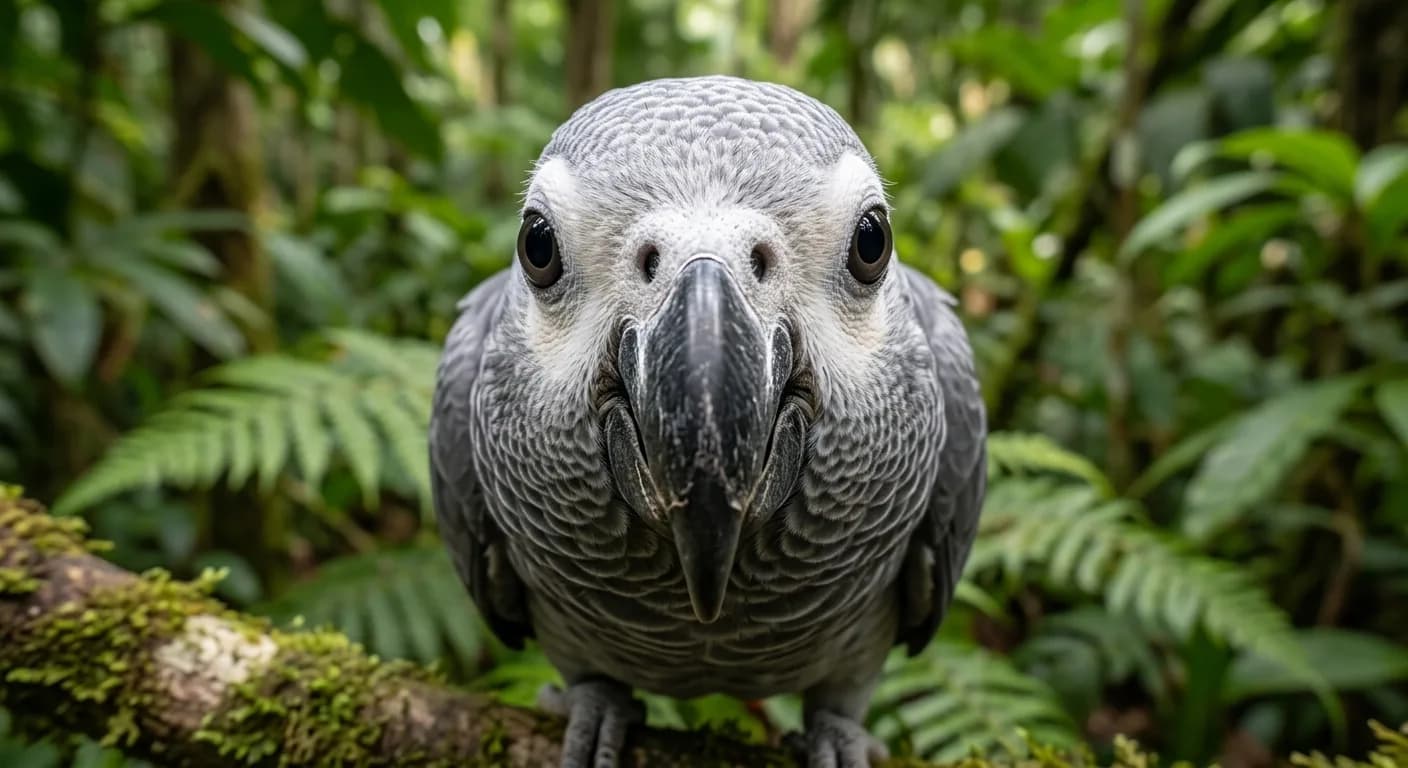
Grey Parrot
Psittacus erithacus
 Vulnerable
Diana Monkey
Cercopithecus diana
Narina Trogon
Apaloderma narina
African Golden Cat
Caracal aurata
Crowned Eagle
Stephanoaetus coronatus
How to help
The white-necked rockfowl is classified as vulnerable. Organizations such as UICN, WWF y Wildlife Conservation Society work specifically on its conservation and that of its habitat; looking into their programs is a good starting point if you want to get involved.
It's documented in 3 real protected areas — part of why protecting these places matters for its conservation.
Keep exploring
Based on what we already know about white-necked rockfowl.
Comments
Share an experience, a fun fact or a tip for seeing the white-necked rockfowl.
Be the first to comment.