Skip to content
WAnimals
  • Map
  • Species
  • Parks
  • Diving
Log inCreate account
WAnimals

The guide for travellers and animal lovers: discover, plan and share your wild adventures around the world.

Discover wildlife

  • Species
  • Ecosystems
  • Glossary
  • Tags

Explore places

  • Map
  • Countries
  • Parks
  • Diving

Plan experiences

  • Guides

Learn

  • Blog

Resources

  • About us
  • How we build our profiles
  • Help centre
  • Contact
  • Install the app

Follow us

Account

  • Log in
  • Create account

© 2026 WAnimals. All rights reserved.

Terms of servicePrivacyCookiesLegal notice
MapSpeciesParksDiving
  1. Home
  2. Species
  3. Red Bull Ant

One of the 13 ants on WAnimals

Insects · Hymenoptera · Formicidae

Red Bull Ant

Myrmecia gulosa

Not Evaluated

It has not yet been assessed against the IUCN criteria.

Spotted something wrong?

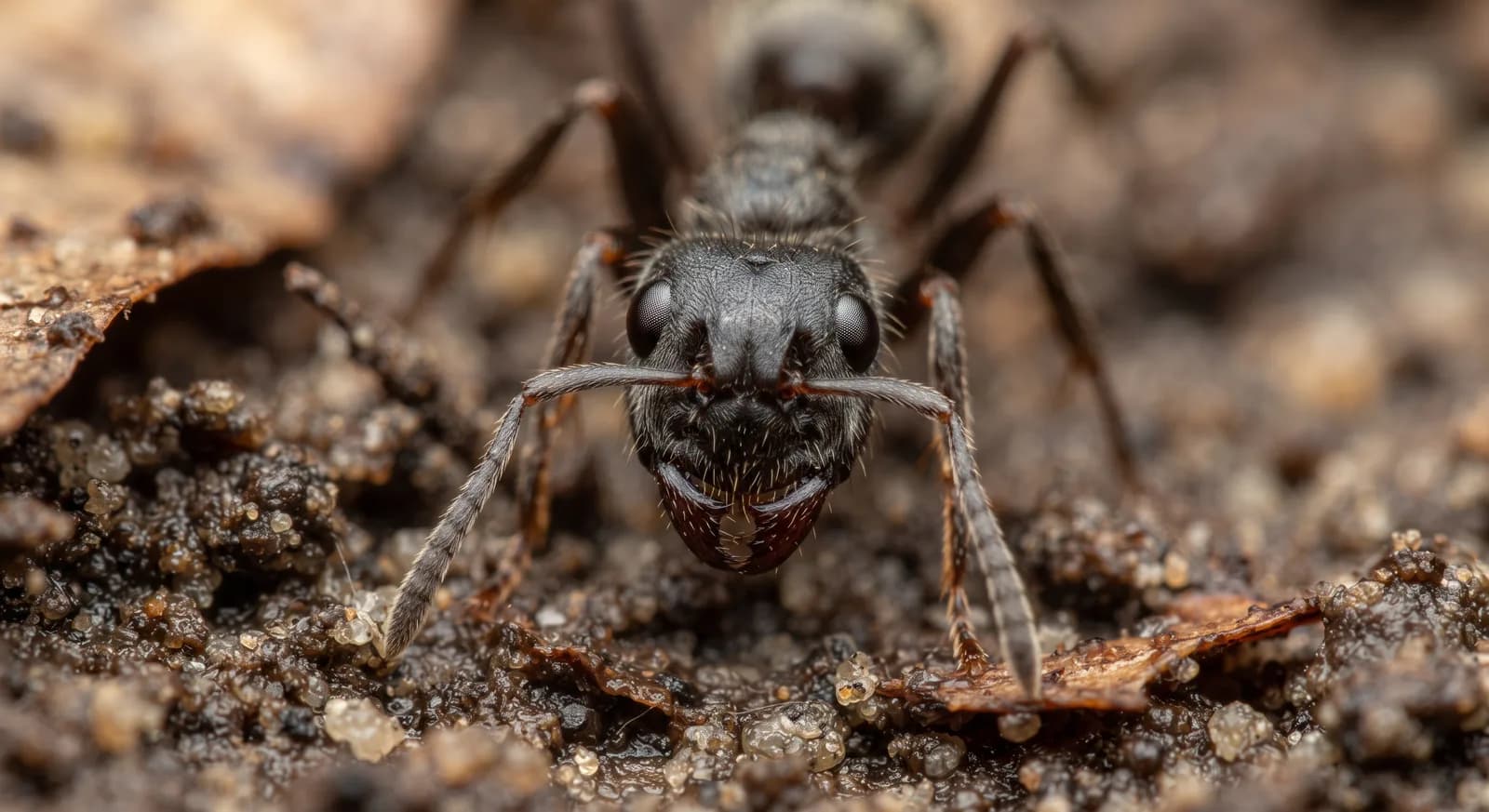
The red bull ant is a large, reddish Australian bulldog ant with very long, toothed jaws. Unlike most ants, it hunts by sight: it has exceptional visual acuity, chases its prey and leaps on it, and has a powerful sting.

Size

1.5 cm – 2.5 cm

Diet

Omnivore

Combines animal and plant food depending on availability.

Activity

Diurnal

Active mainly during the day.

Social structure

Colony

Lives in large concentrations, often for breeding reasons.

Temperate forest
1countries33parks10same family

Fun facts

  • It sees and tracks an intruder from more than a metre away, a visual ability without parallel in the world of ants, most of which navigate by smell.
  • Its sting is among the most painful in Australia and causes severe allergic reactions relatively often, with documented cases of anaphylaxis.
  • The workers hunt alone rather than recruiting nestmates with pheromone trails, a behaviour regarded as primitive among ants.
  • It sees. Unlike almost all ants, which navigate by smell, bulldog ants have large eyes and excellent vision: they track and leap on their prey, and detect an intruder a metre away.
  • It does not simply bite and leave it at that: it grips with its jaws and curls its abdomen round to drive in its sting repeatedly. The sting is very painful, and in Australia there are documented deaths from anaphylaxis.
  • Its genus retains traits considered primitive among ants: small colonies, solitary foraging without pheromone trails and little-differentiated workers.
  • One of its species, Myrmecia pilosula, has the lowest chromosome number of any animal: a single pair.
  • The workers hunt insects for the larvae and gather nectar and honeydew for themselves.

Life cycle and biology

Skeleton type
Invertebrate - chitin exoskeleton (insect)
Habitat and environment
Open woodland and eucalypt scrub of eastern Australia
Sexual maturity
The fertile females fly briefly and then live underground as queens; in the genus Myrmecia queens of up to 15 years are reported. The winged males die shortly after mating
Gestation / incubation
The full passage from egg to adult takes several months, through the four stages of egg, larva, pupa and adult
Litter / clutch size
Underground colonies of up to about 3,000 individuals; the workers also contribute infertile trophic eggs that are given to the queen and the larvae

Sources consulted: Museo Australiano · Haight, trabajos sobre Myrmecia · Crosland y Crozier (1986), Science · Australian Geographic, ficha Bull ant · ficha de especie de Myrmecia gulosa · Fichas australianas de manejo de hormigas toro · Australian Geographic, ficha Bull ant (Myrmecia spp.)

Where to find it

Best time: Foraging by day and at dusk; the workers hunt alone, guided by sight rather than pheromone trails, and detect intruders at 1-2 metres

Loading map…

The pins mark the parks where its presence is documented.

Where to see it

Parks and dive sites where this species has been documented — showing 10 of 33.

Related species

Other species in the catalogue with the most in common with Red Bull Ant — same habitat, park, country, tags or family.

Same taxonomic family
Shares a park
Shares a park
Shares a park

Keep exploring

Based on what we already know about red bull ant.

Share an experience, a fun fact or a tip for seeing the red bull ant.
See full glossary
This page in other languages: Español · Deutsch · Français · Português · Italiano
See its range on the interactive map→
DaintreeAustralia
Blue MountainsAustralia
K'gari (Fraser Island)Australia
FreycinetAustralia
KosciuszkoAustralia
Grampians (Gariwerd)Australia
Tasmanian Wilderness (Cradle Mountain-Lake St Clair)Australia
Wilsons PromontoryAustralia
Royal National ParkAustralia
LamingtonAustralia
See all 33 parks
Not Evaluated

Asian Weaver Ant

Oecophylla smaragdina

Not Evaluated

South American Fire Ant

Solenopsis invicta

Argentine AntNot Evaluated

Argentine Ant

Linepithema humile

Least Concern

Australian Brushturkey

Alectura lathami

Least Concern

Sulphur-crested Cockatoo

Cacatua galerita

Least Concern

Common Bluetongue

Tiliqua scincoides

CountriesAustralia
ParksDaintreeAustralia
TagsOmnivore
Omnivore
Diurnal
Colonial
Insect
Temperate forest
Australia