Skip to content
WAnimals
  • Map
  • Species
  • Parks
  • Diving
Log inCreate account
WAnimals

The guide for travellers and animal lovers: discover, plan and share your wild adventures around the world.

Discover wildlife

  • Species
  • Ecosystems
  • Glossary
  • Tags

Explore places

  • Map
  • Countries
  • Parks
  • Diving

Plan experiences

  • Guides

Learn

  • Blog

Resources

  • Help centre
  • Contact
  • Install the app

Follow us

Account

  • Log in
  • Create account

© 2026 WAnimals. All rights reserved.

About usHow we build our profilesTerms of servicePrivacyLegal notice
MapSpeciesParksDiving
  1. Home
  2. Species
  3. South American Fire Ant

One of the 13 ants on WAnimals

Insects · Hymenoptera · Formicidae

South American Fire Ant

Solenopsis invicta

Not Evaluated

It has not yet been assessed against the IUCN criteria.

Spotted something wrong?

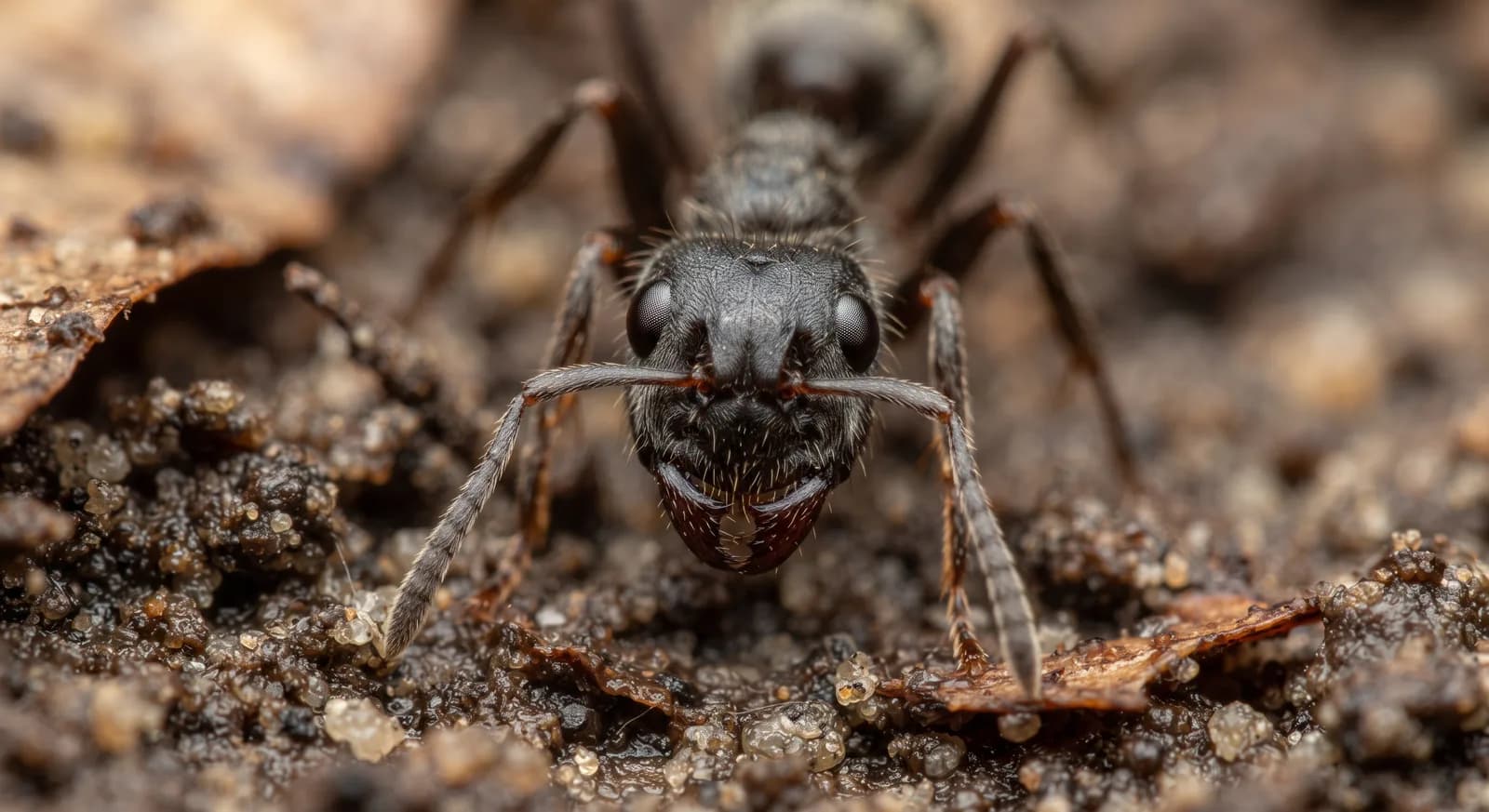
The South American fire ant is a hymenopteran insect of the family Formicidae native to South America. It is one of the best-known ant species for having a strong, painful and persistently irritating sting that often leaves a pustule on the skin. It was introduced as an invasive species into the southern United States, Australia, Taiwan, the Philippines, Puerto Rico and China, specifically Macau and southern Guangdong province. It is included on the list of 100 of the world's worst invasive alien species drawn up by the International Union for Conservation of Nature.

Size

0.2 cm – 0.6 cm

Life expectancy

7 years

Diet

Omnivore

Combines animal and plant food depending on availability.

Activity

Diurnal

Active mainly during the day.

Social structure

Colony

Lives in large concentrations, often for breeding reasons.

Sighting difficulty

Unknown

Grassland
23countries10same family

Fun facts

  • comportamientoIt can form living rafts that behave like a non-Newtonian fluid, changing shape under pressure, to survive floods.
  • It is on the IUCN list of the 100 most damaging invasive alien species in the world.
  • In the areas it has invaded it damages crops, livestock, native wildlife and even electrical installations, where it builds up inside cabinets and causes short circuits.
  • Its scientific name, invicta, means unconquered.
  • When the nest floods, the workers link together to form floating rafts up to 45 cm across that keep the queen and the brood out of the water, and that can stay adrift for weeks.
  • A mature colony has between 200,000 and 400,000 workers, and the queens live up to seven years.
  • In its native range there are about 30 mounds per hectare; in invaded areas the figure reaches 5,000.
  • It gets into electrical equipment — traffic lights, air conditioners, well pumps — and gnaws the insulation; in the United States the total cost attributed to it exceeds 6 billion dollars a year.

Life cycle and biology

Skeleton type
Invertebrate - chitin exoskeleton (insect)
Habitat and environment
Open, sunny ground — grassland, abandoned fields, verges, gardens — where it raises earth mounds up to a metre across and a metre high
Sexual maturity
The reproductives are produced in spring and wait inside the nest for the nuptial flight, which happens at midday or in late afternoon, at 21-32 °C and within the 24 hours following rain. The male dies after copulating; the mated female tears off her wings, digs a chamber and starts to lay within 24 hours
Gestation / incubation
The eggs hatch in 8-10 days; the larva goes through four instars and full development from egg to adult takes 22 to 38 days depending on the temperature
Litter / clutch size
The queen lays up to 800 eggs a day on a sustained basis, with reported peaks of 1,500 to 2,000; a founding queen's first clutch is only a dozen. A mature colony holds 80,000 to 500,000 workers

Sources consulted: https://es.wikipedia.org/wiki/Solenopsis_invicta; LSU AgCenter, ficha Red imported fire ant; The Nature Conservancy (Morisawa); Texas A&M, guia de insectos; Bugwoodwiki, Solenopsis invicta; IUCN GISD; University of Florida, ficha Red imported fire ant; IUCN GISD, ficha Solenopsis invicta; University of Florida; LSU AgCenter; Bugwoodwiki (Vinson & Sorenson 1986, Hedges 1997)

Where to find it

Best time: Nuptial flights in spring and autumn after rain; the dome-shaped mounds stand 20 to 30 cm high in open ground

Loading map…

Related species

Other species in the catalogue with the most in common with South American Fire Ant — same habitat, park, country, tags or family.

Same taxonomic family

Keep exploring

Based on what we already know about south american fire ant.

Comments

Share an experience, a fun fact or a tip for seeing the south american fire ant.

Be the first to comment.
See full glossary
This page in other languages: Español · Deutsch · Français · Português · Italiano
See its range on the interactive map→
Argentine AntNot Evaluated

Argentine Ant

Linepithema humile

Not Evaluated

Red Bull Ant

Myrmecia gulosa

Not Evaluated

Pharaoh Ant

Monomorium pharaonis

Red Wood AntNear Threatened

Red Wood Ant

Formica rufa

Not Evaluated

Kerengga Ant

Oecophylla smaragdina

Not Evaluated

Hercules Ant

Camponotus herculeanus

CountriesAntigua and Barbuda
TagsOmnivore
Omnivore
Diurnal
Colonial
Insect
Grassland

Asia8

North America7

South America5

Oceania2

Europe1

Antigua and Barbuda
Argentina
Australia
Bahamas
Bolivia
Brazil
China
India
Japan
Malaysia
Philippines
Singapore
South Korea
Taiwan
Antigua and Barbuda
Bahamas
Dominican Republic
Mexico
Puerto Rico
Trinidad and Tobago
United States
Argentina
Bolivia
Brazil
Paraguay
Uruguay
Australia
New Zealand
Italy