Skip to content
WAnimals
  • Map
  • Species
  • Parks
  • Diving
Log inCreate account
WAnimals

The guide for travellers and animal lovers: discover, plan and share your wild adventures around the world.

Discover wildlife

  • Species
  • Ecosystems
  • Glossary
  • Tags

Explore places

  • Map
  • Countries
  • Parks
  • Diving

Plan experiences

  • Guides

Learn

  • Blog

Resources

  • Help centre
  • Contact
  • Install the app

Follow us

Account

  • Log in
  • Create account

© 2026 WAnimals. All rights reserved.

About usHow we build our profilesTerms of servicePrivacyLegal notice
MapSpeciesParksDiving
  1. Home
  2. Species
  3. Hercules Ant

One of the 13 ants on WAnimals

Insects · Hymenoptera · Formicidae

Hercules Ant

Camponotus herculeanus

Not Evaluated

It has not yet been assessed against the IUCN criteria.

Spotted something wrong?

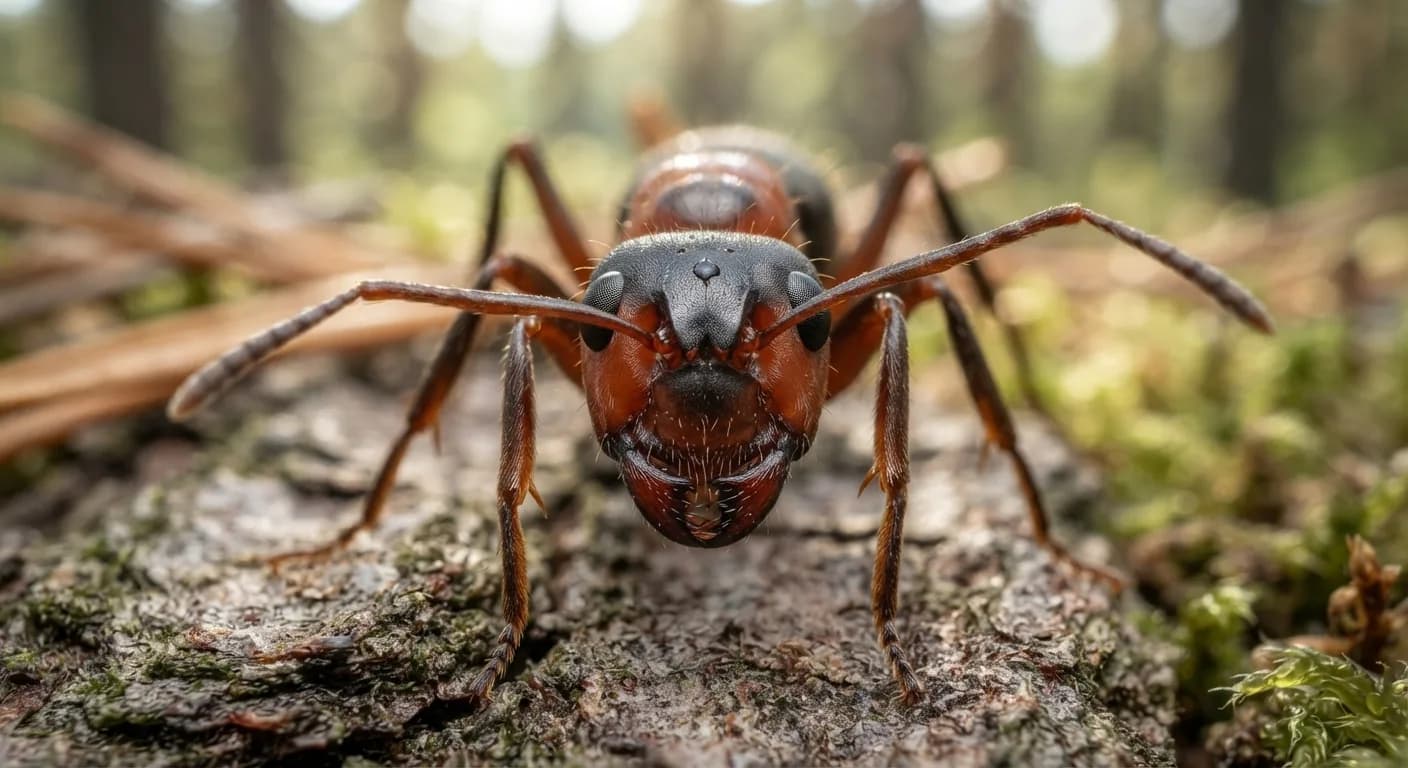
A large carpenter ant, black with a reddish base to the abdomen, which tunnels into dead or damp conifer wood. It does not eat the wood: it removes it to build its chambers, leaving little piles of sawdust that give the nest away.

Size

0.6 cm – 1.8 cm

Life expectancy

15 years

Diet

Omnivore

Combines animal and plant food depending on availability.

Social structure

Colony

Lives in large concentrations, often for breeding reasons.

Sighting difficulty

Unknown

Temperate forest
44countries25parks10same family

Fun facts

  • Unlike termites, it does not digest cellulose: it tunnels into wood purely to live in it, and its food is insects and the sugary honeydew provided by aphids.
  • It survives winters of tens of degrees below zero by building up glycerol in its tissues, a natural antifreeze.
  • A colony can live for more than twenty years, and its queen is one of the longest-lived in the insect world.
  • It does not eat wood: it excavates it with its mandibles to make the nest and pushes the debris out, unlike termites, which do digest it.
  • The queen can live between ten and fifteen years.
  • It has three worker castes (major, media and minor): the large ones defend the nest and forage, the small ones excavate and tend the brood.
  • It forms satellite nests connected to the main one by underground tunnels, in warmer, drier places, where it keeps the older larvae, the pupae and the reproductives.
  • A colony takes between three and six years to grow large.

Life cycle and biology

Skeleton type
Invertebrate - chitin exoskeleton (insect)
Habitat and environment
Conifer and mixed forests of northern Europe, Asia and North America
Gestation / incubation
From egg to worker, between 8 and 10 weeks

Sources consulted: AntWiki; Wikipedia (Camponotus herculeanus); Encyclopaedia Britannica; Fichas de especie de Camponotus herculeanus

Where to find it

Loading map…

Where to see it

Parks and dive sites where this species has been documented — showing 10 of 25.

Related species

Other species in the catalogue with the most in common with Hercules Ant — same habitat, park, country, tags or family.

Same taxonomic family
Shares a park
Shares a park
Shares a park
Shares a park
Same taxonomic family

Keep exploring

Based on what we already know about hercules ant.

Comments

Share an experience, a fun fact or a tip for seeing the hercules ant.

Be the first to comment.

See full glossary
This page in other languages: Español · Deutsch · Français · Português · Italiano

The pins mark the parks where its presence is documented.

See its range on the interactive map→
YosemiteUnited States
Great Smoky MountainsUnited States
RedwoodUnited States
AcadiaUnited States
OlympicUnited States
Mammoth CaveUnited States
FundyCanada
Point PeleeCanada
North CascadesUnited States
VoyageursUnited States
See all 25 parks
Red Wood AntNear Threatened

Red Wood Ant

Formica rufa

Near Threatened

Decim Periodical Cicada

Magicicada septendecim

Not Evaluated

Eastern Subterranean Termite

Reticulitermes flavipes

Least Concern

Acorn Woodpecker

Melanerpes formicivorus

Not Evaluated

Cave Cricket

Pristoceuthophilus rhoadsi

Not Evaluated

Red Bull Ant

Myrmecia gulosa

CountriesUnited States
ParksYosemiteUnited States
TagsOmnivore
Omnivore
Colonial
Insect
Temperate forest

Europe37

Asia5

North America2

United States
Canada
Albania
Austria
Belarus
Belgium
Albania
Austria
Belarus
Belgium
Bosnia and Herzegovina
Bulgaria
Croatia
Cyprus
Czechia
Denmark
Estonia
Finland
France
Germany
Greece
Hungary
Ireland
Italy
Latvia
Lithuania
Luxembourg
Malta
Moldova
Montenegro
Netherlands
Norway
Poland
Portugal
Romania
Serbia
Slovakia
Slovenia
Spain
Sweden
Switzerland
Ukraine
United Kingdom
China
Japan
Kazakhstan
Mongolia
Russia
Canada
United States