Skip to content
WAnimals
  • Map
  • Species
  • Parks
  • Diving
Log inCreate account
WAnimals

The guide for travellers and animal lovers: discover, plan and share your wild adventures around the world.

Discover wildlife

  • Species
  • Ecosystems
  • Glossary
  • Tags

Explore places

  • Map
  • Countries
  • Parks
  • Diving

Plan experiences

  • Guides

Learn

  • Blog

Resources

  • Help centre
  • Contact
  • Install the app

Follow us

Account

  • Log in
  • Create account

© 2026 WAnimals. All rights reserved.

About usHow we build our profilesTerms of servicePrivacyLegal notice
MapSpeciesParksDiving
  1. Home
  2. Species
  3. Red-eyed Treefrog

One of the 47 frogs on WAnimals
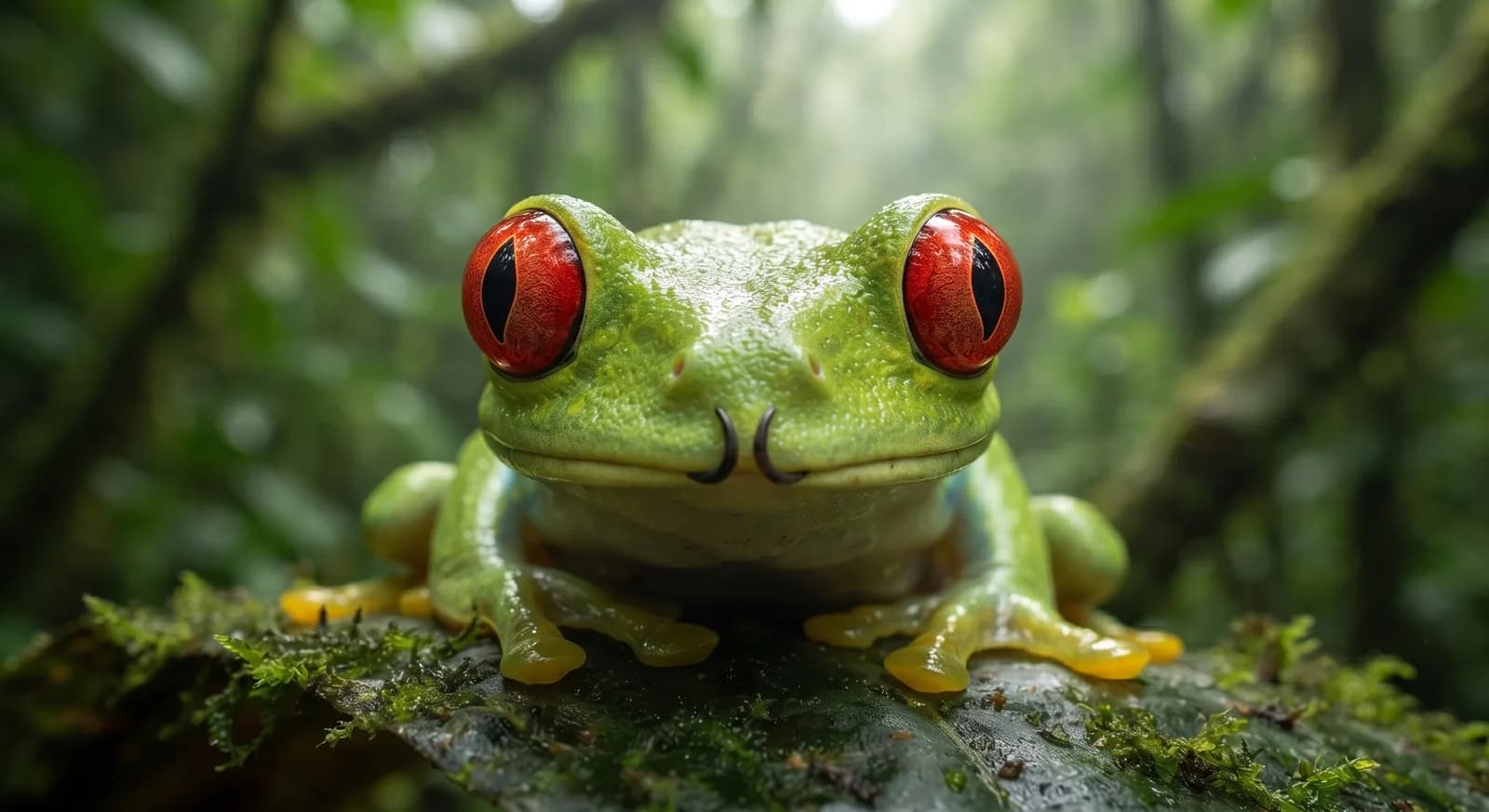
Red-eyed Treefrog (Agalychnis callidryas)

Amphibians · Anura · Phyllomedusidae

Red-eyed Treefrog

Agalychnis callidryas

Least Concern

The species is abundant and widely distributed; it faces no significant short-term risk.

Spotted something wrong?

The red-eyed tree frog is an anuran amphibian of the family Hylidae that lives from eastern Honduras to north-western Colombia. Its scientific name comes from the Greek (aga), meaning "full of", (lychnos) "bright", while the species name refers to (kallos) "beauty" and (dryas) "tree nymph". Most striking are its large red eyes with vertical pupils. As adults they are brightly coloured all over the body. Green predominates, but they usually show other colours such as blue or yellow. The forelimbs are bright blue, while the hind limbs are red or orange. The colouring of this frog is very eye-catching. The male is smaller than the female: 56 mm against 71 mm. They are nocturnal and arboreal.

Size

4 cm – 7 cm

Life expectancy

5 years

Diet
Insectivore

Feeds mainly on insects and other invertebrates.

Activity

Nocturnal

Active mainly at night.

Social structure

Solitary

Lives and hunts alone, joining others only to breed.

Sighting difficulty

Easy

RainforestFreshwater
9countries6parks1same family

AI-generated images: illustrations, not photographs.

Fun facts

  • reproducciónIt lays its eggs on leaves overhanging pools, and the tadpoles hatch and drop straight into the water when they feel the vibrations of an approaching predator.
  • Its embryos decide when to hatch: if a snake attacks the clutch, the tadpoles sense the vibration and hatch all at once up to three days early, dropping into the water to escape. They can tell a predator's vibration from that of rain or wind.
  • Its colouring is what is known as startle coloration: by day it is entirely green and invisible, and when disturbed it snaps open its red eyes and flashes its blue and orange flanks, a burst that throws the predator long enough for it to leap away.
  • It lays its eggs on leaves overhanging the water, and on hatching the tadpoles drop straight into the pool.

Life cycle and biology

Skeleton type
Vertebrate - internal bony skeleton (amphibian)
Habitat and environment
Vegetation over pools and streams in lowland rainforest of Central America
Sexual maturity
2 years
Gestation / incubation
7 days of egg development on leaves
Litter / clutch size
40 eggs

Sources consulted: https://es.wikipedia.org/wiki/Agalychnis_callidryas

Where to find it

Loading map…

The pins mark the parks where its presence is documented.

Where to see it

Parks and dive sites where this species has been documented.

Related species

Other species in the catalogue with the most in common with Red-eyed Treefrog — same habitat, park, country, tags or family.

Shares a park
Shares a park
Shares a park
Shares a park
Shares a park
Shares a park

Keep exploring

Based on what we already know about red-eyed treefrog.

Comments

Share an experience, a fun fact or a tip for seeing the red-eyed treefrog.

Be the first to comment.

See full glossary
This page in other languages: Español · Deutsch · Français · Português · Italiano
See its range on the interactive map→
Manuel AntonioCosta Rica
MonteverdeCosta Rica
Arenal VolcanoCosta Rica
Rincon de la ViejaCosta Rica
Cerro Azul MeambarHonduras
Braulio CarrilloCosta Rica
Least Concern

Water Opossum

Chironectes minimus

Least Concern

Common Silky Anteater

Cyclopes didactylus

Cane ToadLeast Concern

Cane Toad

Rhinella marina

Least Concern

Green and Black Poison Frog

Dendrobates auratus

Strawberry Poison FrogLeast Concern

Strawberry Poison Frog

Oophaga pumilio

Tungara FrogLeast Concern

Tungara Frog

Physalaemus pustulosus

CountriesCosta Rica
ParksManuel AntonioCosta Rica
TagsInsectivore
Insectivore
Nocturnal
Solitary
Amphibian
Rainforest
Freshwater

North America8

South America1

Costa Rica
Honduras
Belize
Colombia
El Salvador
Guatemala
Belize
Costa Rica
El Salvador
Guatemala
Honduras
Mexico
Nicaragua
Panama
Colombia