Skip to content
WAnimals
  • Map
  • Species
  • Parks
  • Diving
Log inCreate account
WAnimals

The guide for travellers and animal lovers: discover, plan and share your wild adventures around the world.

Discover wildlife

  • Species
  • Ecosystems
  • Glossary
  • Tags

Explore places

  • Map
  • Countries
  • Parks
  • Diving

Plan experiences

  • Guides

Learn

  • Blog

Resources

  • Help centre
  • Contact
  • Install the app

Follow us

Account

  • Log in
  • Create account

© 2026 WAnimals. All rights reserved.

About usHow we build our profilesTerms of servicePrivacyLegal notice
MapSpeciesParksDiving
  1. Home
  2. Species
  3. Shoebill
Shoebill (Balaeniceps rex)

Birds · Pelecaniformes · Balaenicipitidae

Shoebill

Balaeniceps rex

Vulnerable

At high risk of extinction in the wild over the medium term.

Spotted something wrong?

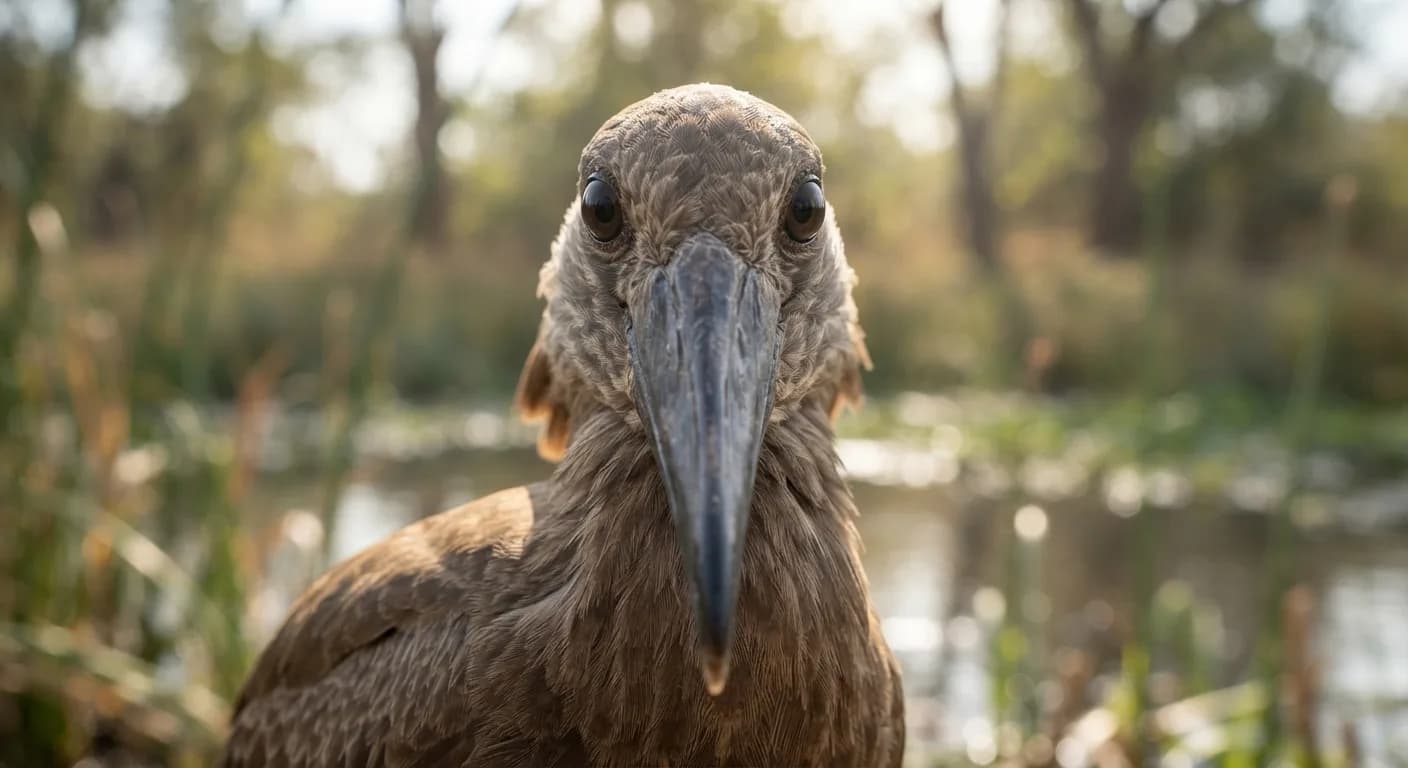
The shoebill is a pelecaniform bird, the only member of the family Balaenicipitidae and of the genus Balaeniceps. Its common name refers to the shape of its enormous bill. It has a general form somewhat like a stork's and was formerly classified with the storks in the order Ciconiiformes on that basis. Genetic evidence, however, places it with the pelicans and herons in the Pelecaniformes. The adult is mainly grey, while juveniles are browner. It lives in tropical East Africa in large swamps from South Sudan to Zambia.

Weight

6 kg on average

Life expectancy

35 years

Diet

Carnivore

Feeds mainly on other animals.

Activity

Diurnal

Active mainly during the day.

Social structure

Solitary

Lives and hunts alone, joining others only to breed.

Sighting difficulty

Moderate

Estimated population

Between 3,300 and 5,300 mature individuals, in continued decline

Freshwater
10countries4parks

AI-generated images: illustrations, not photographs.

Fun facts

  • GeneralIts enormous clog-shaped bill decapitates lungfish and young crocodiles.
  • comportamientoIt can stand completely still for hours, waiting for a fish to surface for air before striking.
  • It hunts by ambush, motionless as a statue for hours, and succeeds in around 60% of its strikes; its favourite prey is the African lungfish.

Life cycle and biology

Skeleton type
Vertebrate - internal bony skeleton (bird)
Habitat and environment
Papyrus marsh and swampy wetland
Sexual maturity
3 years
Gestation / incubation
About 30 days of incubation, shared by both parents
Litter / clutch size
1-3 eggs, usually two, of which normally only one survives

Sources consulted: https://es.wikipedia.org/wiki/Balaeniceps_rex

Where to find it

Best time: The dry season, when falling water levels concentrate the fish in the papyrus swamps of Uganda and Zambia

Loading map…

The pins mark the parks where its presence is documented.

Where to see it

Parks and dive sites where this species has been documented.

Related species

Other species in the catalogue with the most in common with Shoebill — same habitat, park, country, tags or family.

Shares a park
Shares a park
Shares a park
Shares a park
Shares a park
Shares a park

How to help

The shoebill is classified as vulnerable. Organisations such as the IUCN, WWF and the Wildlife Conservation Society work specifically on its conservation and that of its habitat; looking into their programmes is a good starting point if you want to get involved.

It's documented in 4 protected areas — one reason why protecting these places matters for its conservation.

Keep exploring

Based on what we already know about shoebill.

Comments

Share an experience, a fun fact or a tip for seeing the shoebill.

Be the first to comment.

See full glossary
This page in other languages: Español · Deutsch · Français · Português · Italiano
See its range on the interactive map→
Murchison FallsUganda
AkageraRwanda
SemulikiUganda
Bangweulu WetlandsZambia
Vulnerable

African Dwarf Crocodile

Osteolaemus tetraspis

Wattled CraneVulnerable

Wattled Crane

Bugeranus carunculatus

Vulnerable

Southern Ground-Hornbill

Bucorvus leadbeateri

Not Evaluated

Nile Monitor

Varanus niloticus

Least Concern

Giant Bullfrog

Pyxicephalus adspersus

HamerkopLeast Concern

Hamerkop

Scopus umbretta

CountriesUganda
ParksMurchison FallsUganda
TagsCarnivore
Carnivore
Diurnal
Solitary
Vulnerable
Bird
Freshwater
Uganda
Rwanda
Zambia
Botswana
Democratic Republic of the Congo
Ethiopia
Botswana
Democratic Republic of the Congo
Ethiopia
Malawi
Republic of the Congo
Rwanda
South Sudan
Tanzania
Uganda
Zambia