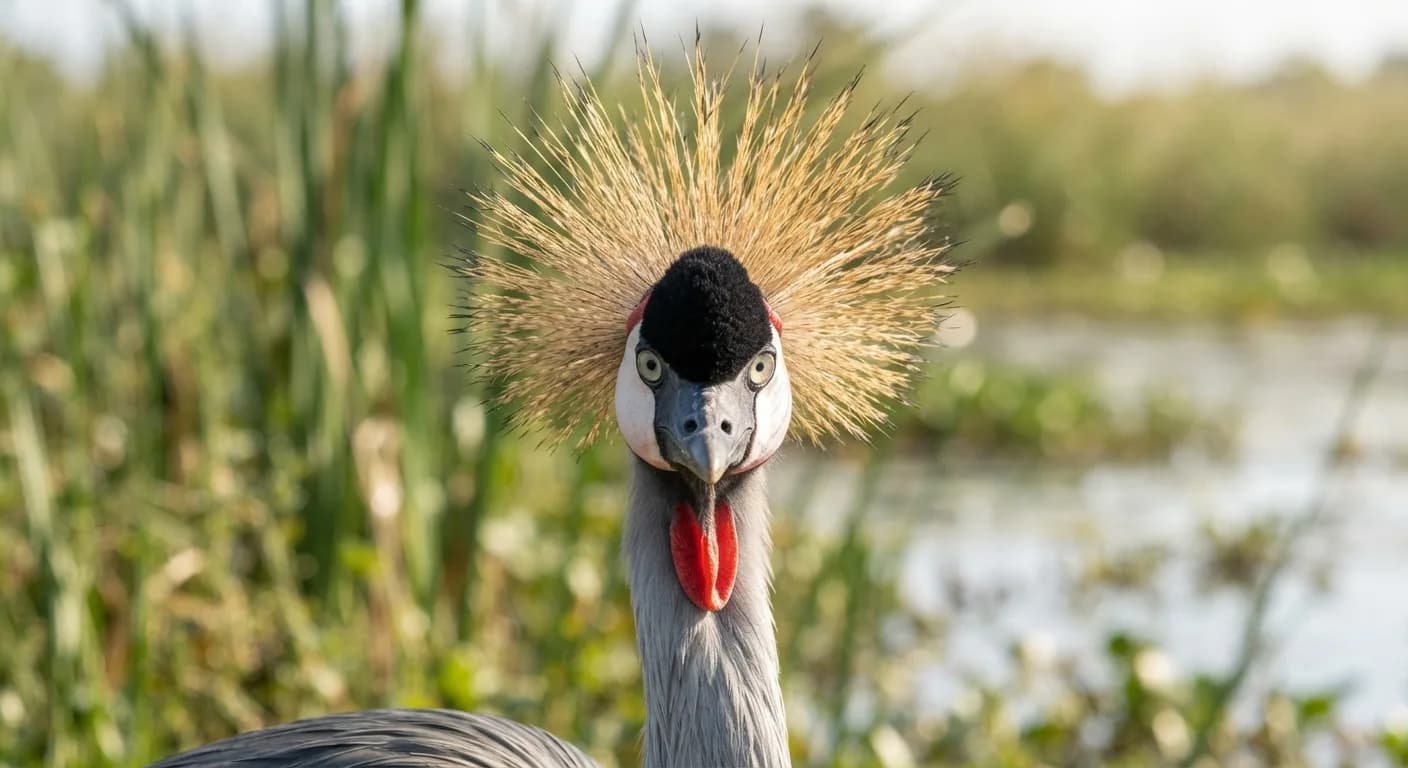
One of the 11 cranes on WAnimals

Birds · Gruiformes · Gruidae
Bugeranus carunculatus
At high risk of extinction in the wild over the medium term.
The wattled crane is the largest crane in Africa and the second tallest in the world, with a feathered wattle hanging beneath its chin. It depends entirely on the seasonal wetlands of the Okavango, the Zambezi and the Kafue: it synchronises its breeding with the flood pulse, and any dam or diversion that alters that cycle sinks its reproduction. It is the most threatened crane in mainland Africa.
Weight
6 kg – 9 kg
Size
1.5 m – 1.8 m
Life expectancy
30 years
Diet
Omnivore
Combines animal and plant food depending on availability.
Activity
Diurnal
Active mainly during the day.
Social structure
In pairs
Usually lives in pairs, sometimes for life.
Sighting difficulty
Moderate
AI-generated images: illustrations, not photographs.
Sources consulted: https://www.iucnredlist.org/ | https://animaldiversity.org/ | https://es.wikipedia.org/
The pins mark the parks where its presence is documented.
Parks and dive sites where this species has been documented — showing 10 of 26.
Other species in the catalogue with the most in common with Wattled Crane — same habitat, park, country, tags or family.
The wattled crane is classified as vulnerable. Organisations such as the IUCN, WWF and the Wildlife Conservation Society work specifically on its conservation and that of its habitat; looking into their programmes is a good starting point if you want to get involved.
It's documented in 10 protected areas — one reason why protecting these places matters for its conservation.
Based on what we already know about wattled crane.
Share an experience, a fun fact or a tip for seeing the wattled crane.
Be the first to comment.