AI-generated images: illustrations, not photographs.
Fun facts
It is the national bird of Uganda, appearing on its flag and coat of arms.
It is one of only two cranes in the world able to perch in trees.
Its population has fallen from more than 100,000 birds in 1985 to some 30,000 to 37,000 today.
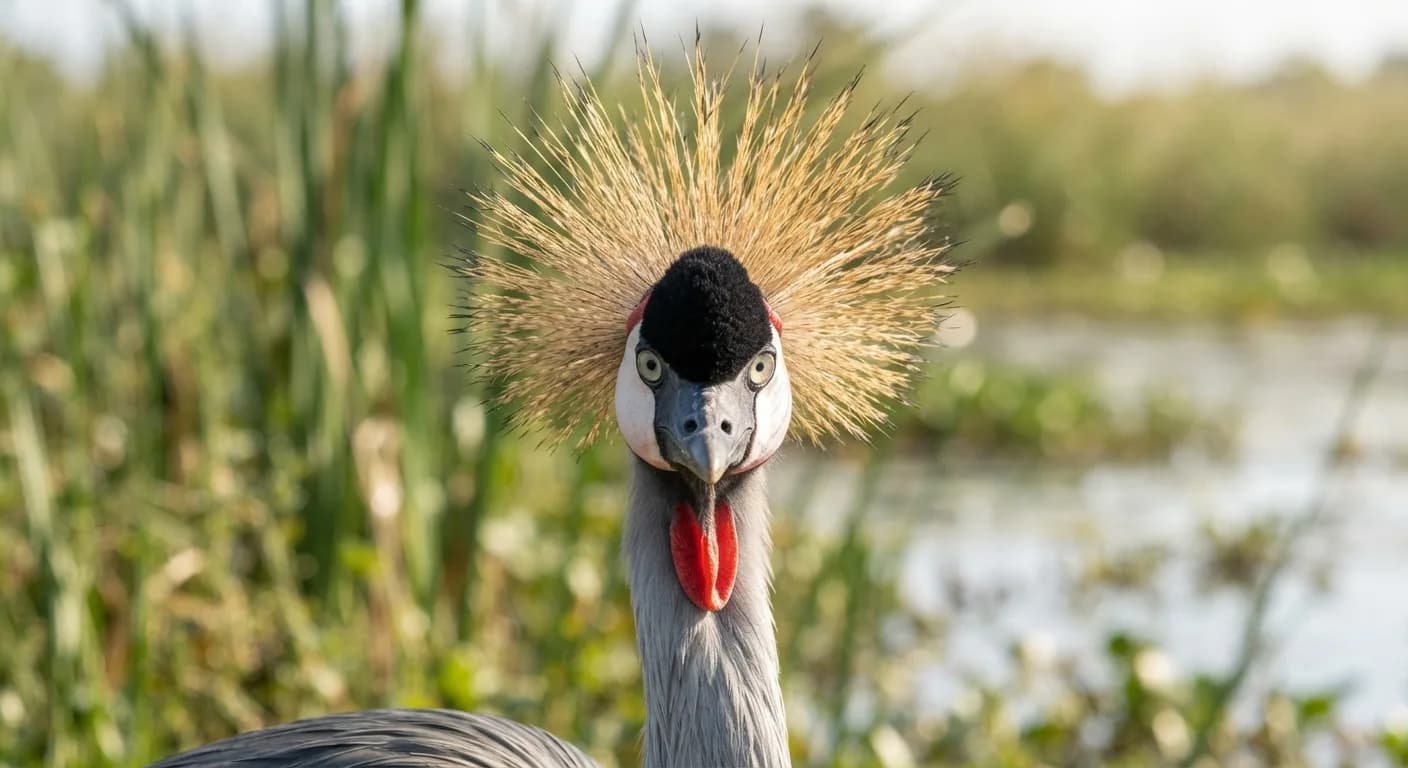
reproducciónIt has a crest of golden feathers on its head and performs elaborate courtship dances, the pair leaping and bowing in unison.
Life cycle and biology
Skeleton type
Vertebrate - pneumatised bony skeleton (bird)
Habitat and environment
Wetlands, savannah and grassland of eastern and southern Africa, often near water
Birth weight
Exact weight at hatching not found as a precise figure
Size at birth
Precocial, able to run soon after hatching
Sexual maturity
3-5 years
Gestation / incubation
27-31 days
Litter / clutch size
2 to 5 eggs per clutch
Life expectancy in captivity
Documented record of up to 30 years in captivity
Sources consulted: Animal Diversity Web · Palm Oil Detectives · Chipangali Wildlife Orphanage · AnAge (genomics.senescence.info) · Animalia.bio · Wikipedia (Grey crowned crane) · PMC (drone monitoring study, reintroduction study) · BirdLife International / IUCN Red List: la especie fue recatalogada sucesivamente de Preocupación menor a Vulnerable y después a En peligro por su rápido declive, ligado a la pérdida de humedales y a la captura para comercio · BirdLife International, ficha de Balearica regulorum
Where to find it
Best time: All year round in the savannahs and wetlands of eastern and southern Africa, as it is resident; the courtship display, with leaps and outspread wings, is concentrated in the wet season, when it nests
Loading map…
Where to see it
Parks and dive sites where this species has been documented — showing 10 of 32.
Related species
Other species in the catalogue with the most in common with Grey Crowned Crane — same habitat, park, country, tags or family.
Same taxonomic family
Shares a park
Shares a park
Shares a park
Same taxonomic family
Same taxonomic family
How to help
The grey crowned crane is classified as endangered. Organisations such as the IUCN, WWF and the Wildlife Conservation Society work specifically on its conservation and that of its habitat; looking into their programmes is a good starting point if you want to get involved.
It's documented in 10 protected areas — one reason why protecting these places matters for its conservation.
Keep exploring
Based on what we already know about grey crowned crane.
Share an experience, a fun fact or a tip for seeing the grey crowned crane.