One of the 13 cormorants on WAnimals
Birds · Suliformes · Phalacrocoracidae
Imperial Shag
Leucocarbo atriceps
The species is abundant and widely distributed; it faces no significant short-term risk. See full glossary
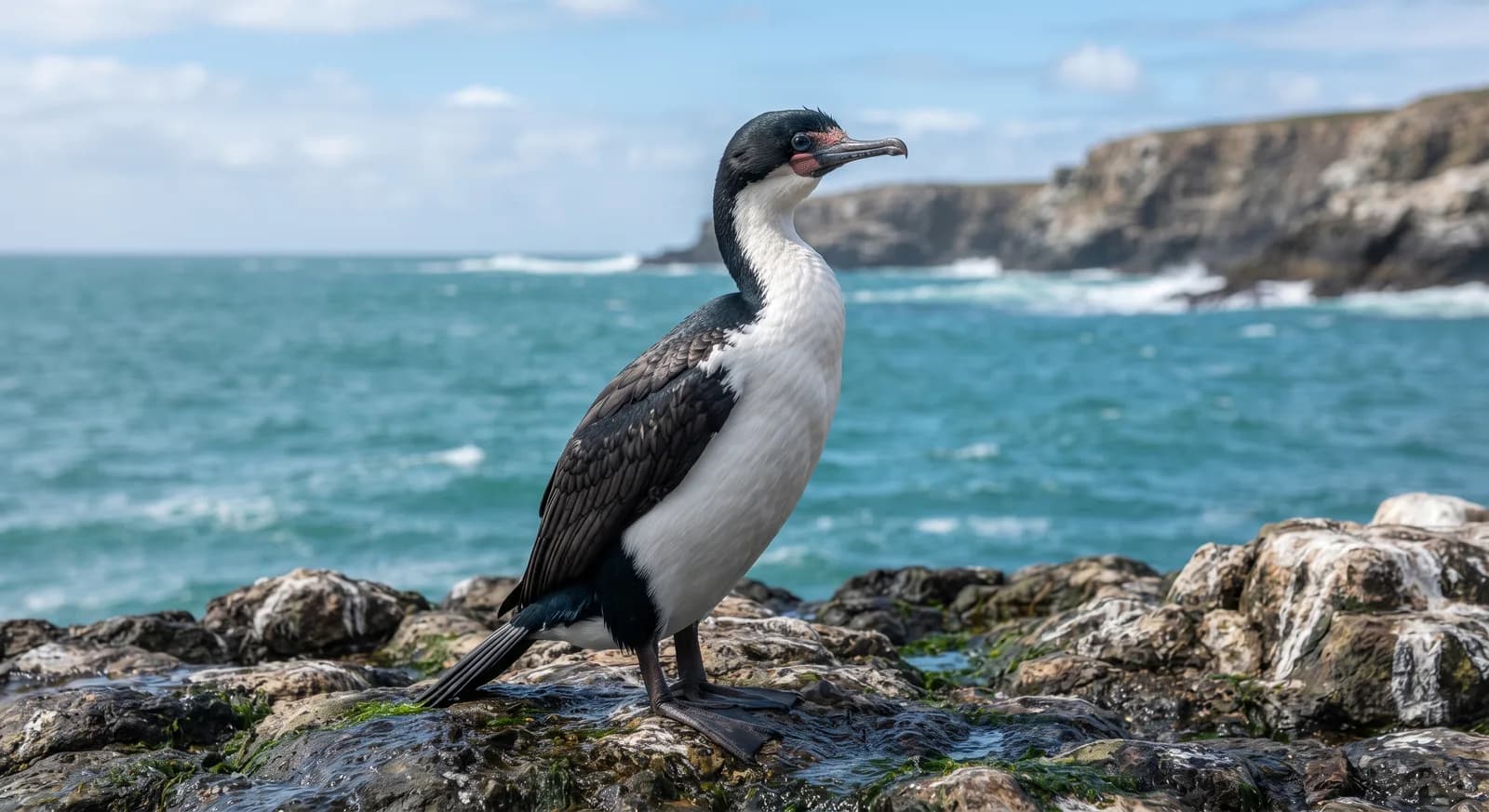
The imperial shag is a striking seabird of the southern cone of the Americas and the subantarctic islands, with a blue-black back, a white belly and orange caruncles at the base of the bill during the breeding season. It breeds in dense colonies on islets and cliffs and dives to considerable depth in pursuit of bottom-dwelling fish. Its taxonomy is the subject of constant debate: the blue-eyed shag complex of the southern hemisphere is split into more or fewer species depending on the author.
Weight
1.8 kg – 3.5 kg
Size
68 cm – 76 cm
Lifespan
15 years
Diet
Carnivore
Feeds mainly on other animals.
Activity
Diurnal
Active mainly during the day.
Social structure
Colony
Lives in large concentrations, often for breeding reasons.
Sighting difficulty
Easy
Fun facts
- It dives to more than sixty metres and stays under for as long as five minutes, extraordinary figures for a bird whose plumage is not waterproof and which comes out of the water soaked.
- Its plumage does not repel water, and that apparent disadvantage is in fact useful: by trapping no air, the bird is less buoyant and dives with far less effort.
Life cycle & biology
- Skeleton type
- Vertebrate - internal bony skeleton (bird)
- Habitat & environment
- Rocky coasts, islets and inshore waters of Patagonia, Tierra del Fuego and the subantarctic islands
- Sexual maturity
- 3 years
- Gestation / incubation
- 30 days of incubation
- Litter / clutch size
- 3 eggs
Sources consulted: https://www.iucnredlist.org/ | https://animaldiversity.org/ | https://es.wikipedia.org/
Where to find it
See its range on the interactive mapWhere to watch it
Parks and dive sites where this species has been documented.
Related species
Other species in the catalogue with the most in common with Imperial Shag — same habitat, park, country, tags or family.
Rock Shag
Leucocarbo magellanicus
South American Fur Seal
Arctocephalus australis
South American Sea Lion
Otaria flavescens
 Least Concern
Magellanic Penguin
Spheniscus magellanicus
Commerson's Dolphin
Cephalorhynchus commersonii
Peale's Dolphin
Lagenorhynchus australis
Keep exploring
Based on what we already know about imperial shag.
Comments
Share an experience, a fun fact or a tip for seeing the imperial shag.
Be the first to comment.