Species group · True jellyfish
Jellyfish
WAnimals has 6 species of jellyfish, spread across 5 families (Cassiopeidae, Cyaneidae, Pelagiidae, Periphyllidae, Ulmaridae).
- 6 species
- 5 families
- 116 countries
- 124 parks
- Length
- 3 cm – 2.5 m
- Lifespan
- 1 – 30 years
Ranges calculated from the entries that record the figure, not from all 6.
All 6 species of jellyfish on WAnimals
Each one has its own full entry. This group does not replace them: it brings them together.
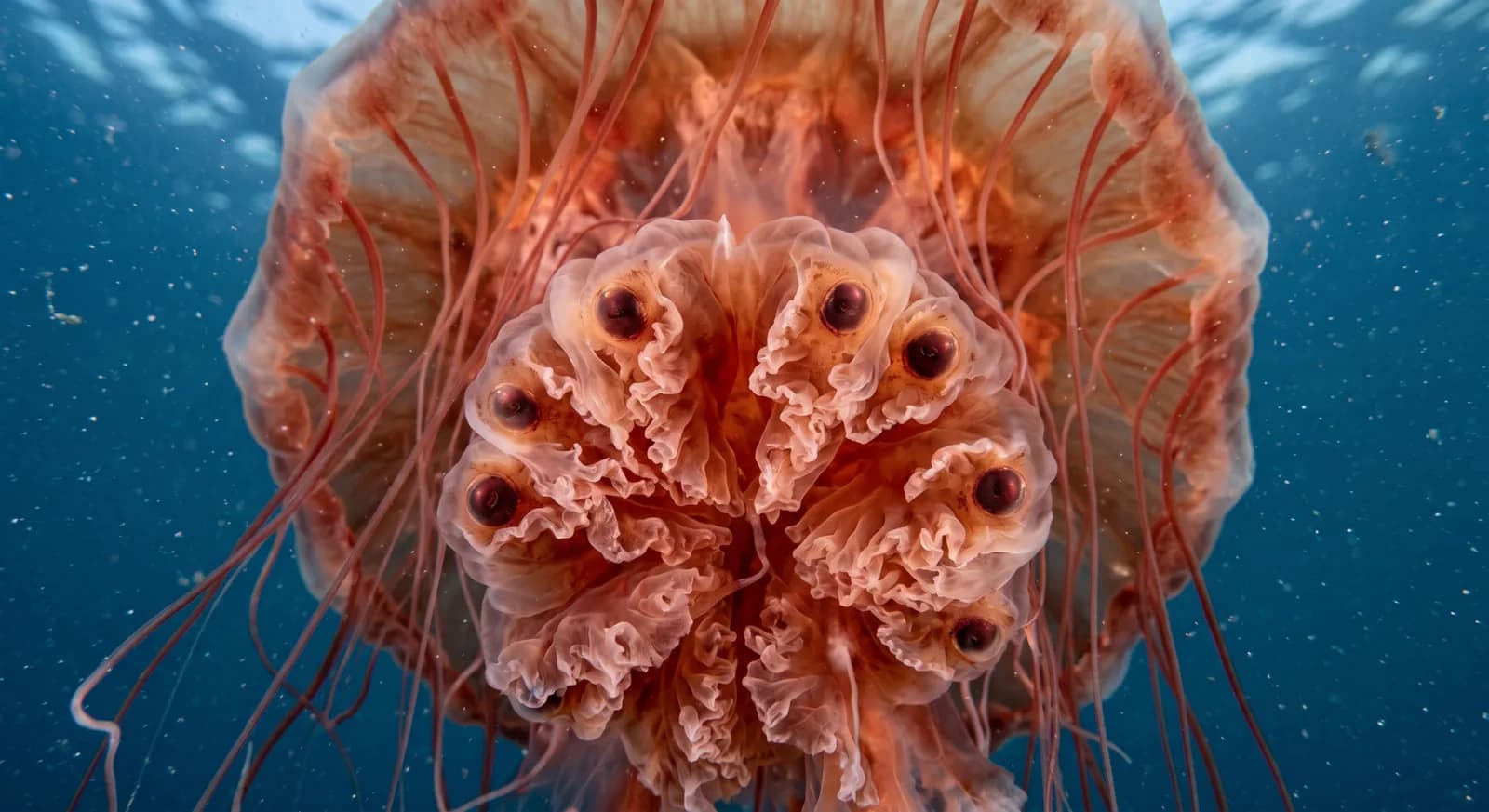 Not Evaluated
Lion's Mane Jellyfish
Cyanea capillata
Mauve Stinger
Pelagia noctiluca
Moon Jellyfish
Aurelia aurita
Upside-down Jellyfish
Cassiopea andromeda
Sea Nettle
Chrysaora fuscescens
Helmet Jelly
Periphylla periphylla
Conservation status
No species documented in this group is genuinely at risk according to the IUCN, with the data available today.
See the global conservation statusWhere they live
Recorded in 116 countries. The ones with the most species in the group:
Where to see them
- Arrábida3 species
- Burren3 species
- Calzada del Gigante3 species
- Costa de Dorset y Devon Oriental3 species
- Gulf Islands3 species
- Islas Cies3 species
- Madeira3 species
- Northumberland3 species
- Pembrokeshire Coast3 species
- Ria Formosa3 species
- St Kilda3 species
- Sudoeste Alentejano e Costa Vicentina3 species
- Browning Pass (Isla de Vancouver)diving
- Farne Islandsdiving
- Great Bear Rainforestdiving
- HMCS Nanaimo Wreckdiving
- Islas Farne (Longstone)diving
- Islas Scillydiving
Did you know…
It is the largest jellyfish in the world. The largest recorded specimen, stranded in Massachusetts Bay in 1870, had a bell 2.3 metres across and tentacles almost 37 metres long: longer than a blue whale.
Its tentacles, up to 1,200 of them, hang in eight groups forming the dense curtain that gives it the name lion's mane.
Despite its size it lives only a year: the medusa appears in spring, grows all summer and dies in autumn.
Its scientific name means 'night light', after its bioluminescence.
From Mauve Stinger
It goes straight from planktonic larva to young medusa, with no fixed polyp stage.
From Mauve Stinger
It can form large ocean swarms, especially in the Mediterranean.
From Mauve Stinger
It eats zooplankton, small crustaceans and fish larvae.
From Moon Jellyfish
It lives in temperate coastal waters and estuaries of almost every ocean in the world.
From Moon Jellyfish