One of the 11 cranes on WAnimals
Birds · Gruiformes · Gruidae
Whooping Crane
Grus americana
It faces a very high risk of extinction in the wild in the near future. See full glossary
The whooping crane is the tallest bird in North America and one of the emblematic species of world conservation. In 1941 fifteen individuals remained in total. Its recovery, through strict protection of the only wild population and captive breeding programmes, has taken it above eight hundred. It still depends on a single migratory route of more than four thousand kilometres between Canada and Texas.
Weight
5 kg – 8.5 kg
Size
1.3 m – 1.5 m
Lifespan
30 years
Diet
Omnivore
Combines animal and plant food depending on availability.
Activity
Diurnal
Active mainly during the day.
Social structure
In pairs
Usually lives in pairs, sometimes for life.
Sighting difficulty
Hard
Estimated population
Around 800 individuals, some 550 of them wild
Fun facts
- In 1941 fifteen birds remained in the whole world: the entire present population descends from that group.
- In the reintroduction programmes, the keepers raised the chicks dressed in white costumes and using puppets shaped like a crane's head, so that they would not imprint on humans.
- A population reintroduced in the eastern United States learned the migratory route by following a microlight flown by a human dressed as a crane, for fifteen consecutive seasons.
Life cycle & biology
- Skeleton type
- Vertebrate - internal bony skeleton (bird)
- Habitat & environment
- Peat bogs of Wood Buffalo National Park, in Canada; winters in the coastal marshes of Texas
- Sexual maturity
- 4 years
- Gestation / incubation
- 31 days
- Litter / clutch size
- 2
Sources consulted: https://www.iucnredlist.org/ | https://animaldiversity.org/ | https://es.wikipedia.org/
Where to watch it
Parks and dive sites where this species has been documented.
Related species
Other species in the catalogue with the most in common with Whooping Crane — same habitat, park, country, tags or family.
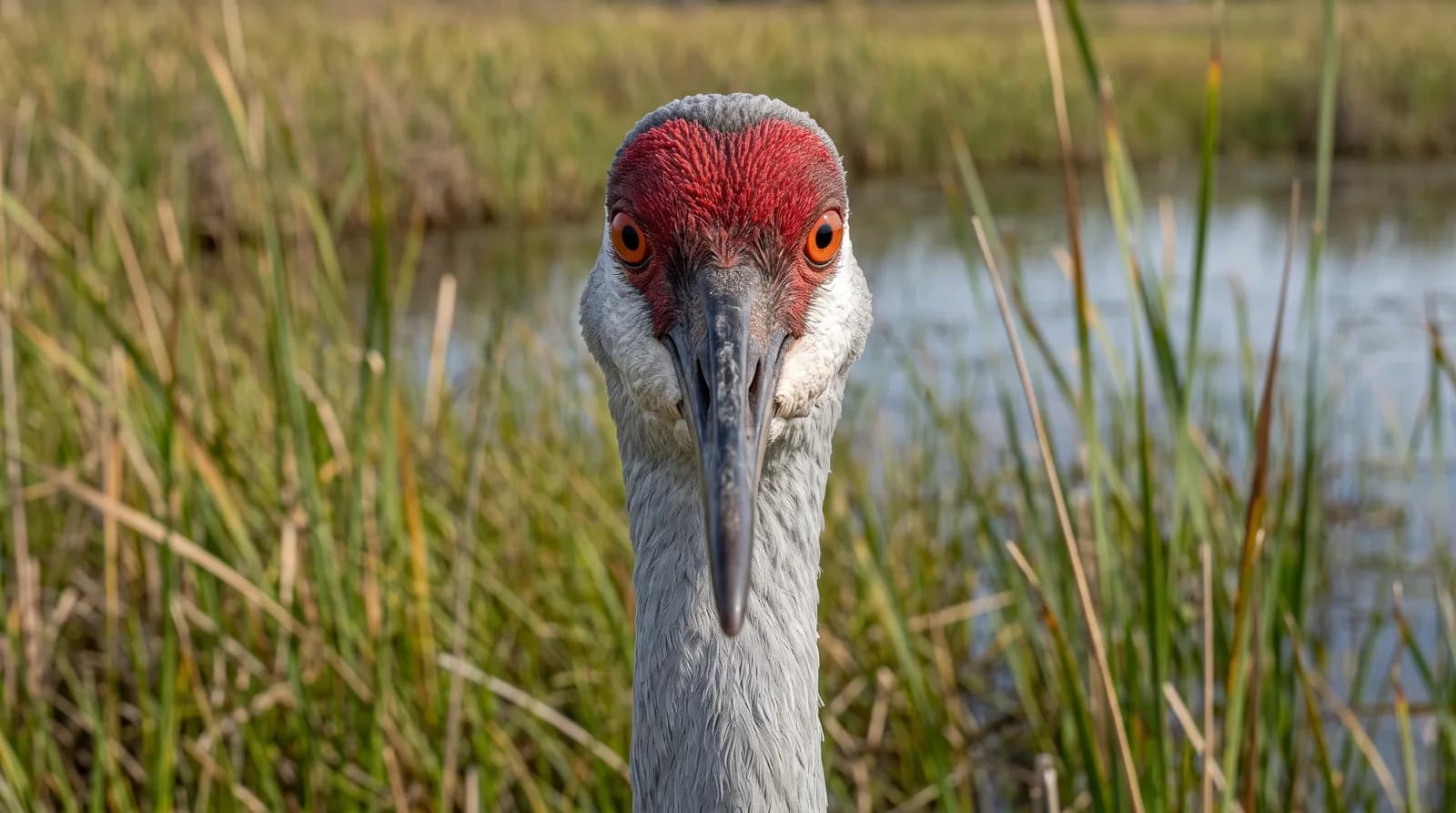 Least Concern
Sandhill Crane
Antigone canadensis
Canada Goose
Branta canadensis
Wood Duck
Aix sponsa
Mourning Dove
Zenaida macroura
American Golden Plover
Pluvialis dominica
Northern Flicker
Colaptes auratus
How to help
The whooping crane is classified as endangered. Organizations such as UICN, WWF y Wildlife Conservation Society work specifically on its conservation and that of its habitat; looking into their programs is a good starting point if you want to get involved.
It's documented in 6 real protected areas — part of why protecting these places matters for its conservation.
Keep exploring
Based on what we already know about whooping crane.
Comments
Share an experience, a fun fact or a tip for seeing the whooping crane.
Be the first to comment.