One of the 4 oryxes on WAnimals
Mammals · Artiodactyla · Bovidae
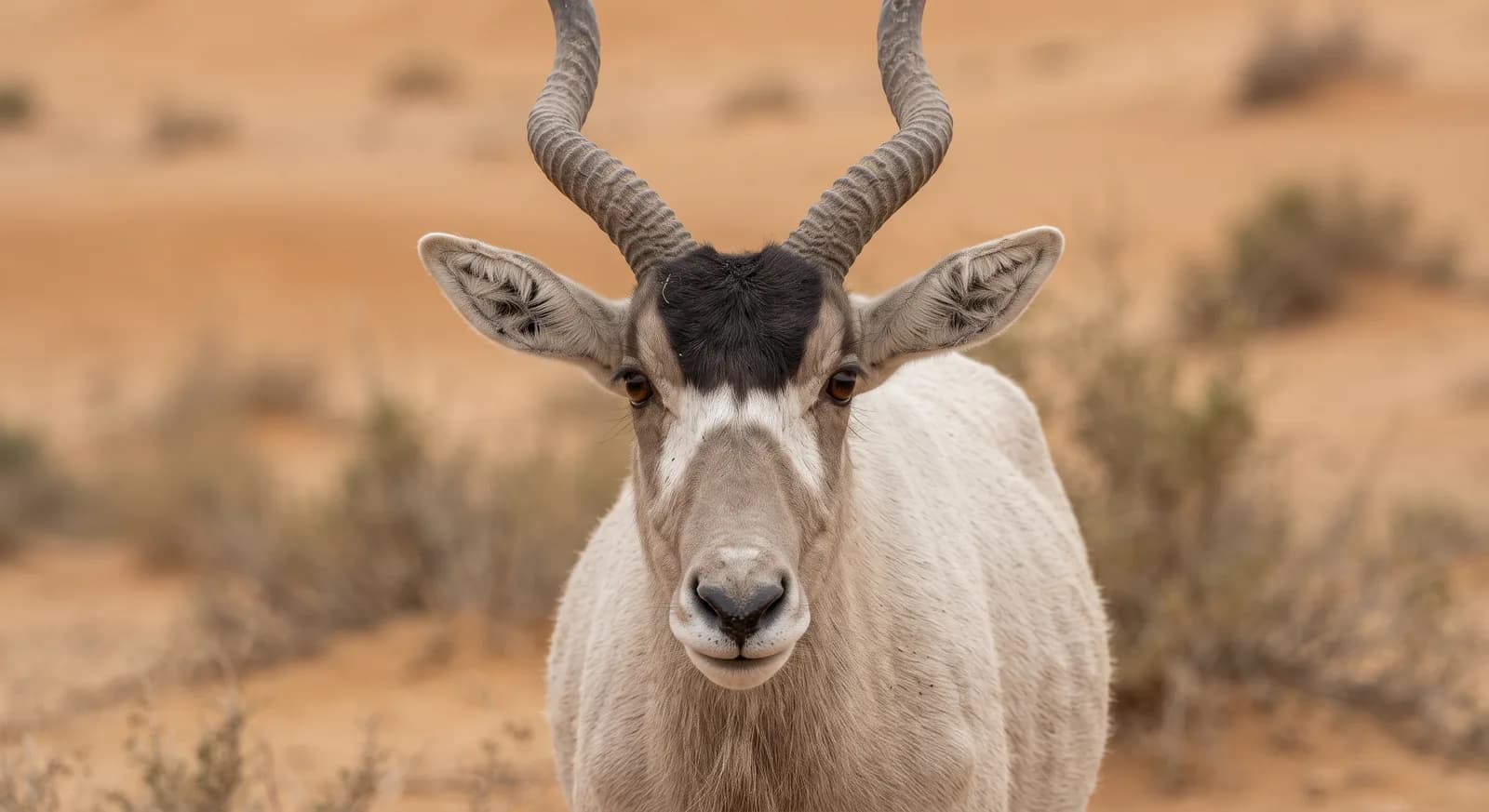
Scimitar-horned Oryx
Oryx dammah
It faces an extremely high risk of imminent extinction in the wild. See full glossary
It died out entirely in the wild by around 2000 through overhunting, surviving only in zoo populations, from which it has been successfully reintroduced to reserves in Chad since 2016.
Weight
91 kg – 210 kg
Size
1.1 m – 1.3 m
Lifespan
14 years
Diet
Herbivore
Feeds mainly on plants.
Activity
Diurnal
Active mainly during the day.
Social structure
Herd
Lives in large groups as a strategy against predators.
Sighting difficulty
Very hard
Estimated population
Several hundred animals reintroduced into the Ouadi Rimé-Ouadi Achim reserve, in Chad, plus thousands held in captivity.
Fun facts
- It died out in the wild around the year 2000 and has been reintroduced to Chad since 2016.
- It can let its body temperature rise to 46.5°C to lose as little water as possible.
- It can survive as long as ten months without drinking.
Life cycle & biology
- Skeleton type
- Vertebrate - internal bony skeleton (mammal)
- Habitat & environment
- Arid steppe and semi-desert on the edge of the Sahara; extinct in the wild since 2000 but reintroduced since
- Birth weight
- 9.3 - 15 kg
- Size at birth
- Precocial; the mother leaves the herd for a week to give birth before rejoining it
- Sexual maturity
- 1.5-2 years (both sexes)
- Gestation / incubation
- 240-247 days (~8-8.5 months)
- Litter / clutch size
- 1 young per birth, and up to one a year thanks to an immediate post-partum oestrus
- Lifespan in captivity
- Documented record of up to 27.5 years in captivity
Sources consulted: Animals Fandom Wiki; JungleDragon; Ultimate Ungulate; AnAge (genomics.senescence.info); SeaWorld; A-Z Animals; Animalia.bio; Animal Diversity Web
Where to find it
See its range on the interactive mapBest time: All year round in the Ouadi Rimé-Ouadi Achim reserve, in Chad, where it was reintroduced after becoming extinct in the wild.
Where to watch it
Parks and dive sites where this species has been documented.
Related species
Other species in the catalogue with the most in common with Scimitar-horned Oryx — same habitat, park, country, tags or family.
Dama Gazelle
Nanger dama
 Critically Endangered
Addax
Addax nasomaculatus
Arabian Sand Gazelle
Gazella marica
Klipspringer
Oreotragus oreotragus
Steenbok
Raphicerus campestris
Soemmerring's Gazelle
Nanger soemmerringii
How to help
The scimitar-horned oryx is classified as critically endangered. Organizations such as UICN, WWF y Wildlife Conservation Society work specifically on its conservation and that of its habitat; looking into their programs is a good starting point if you want to get involved.
It's documented in 2 real protected areas — part of why protecting these places matters for its conservation.
Keep exploring
Based on what we already know about scimitar-horned oryx.
Comments
Share an experience, a fun fact or a tip for seeing the scimitar-horned oryx.
Be the first to comment.