Skip to content
WAnimals
  • Map
  • Species
  • Parks
  • Diving
Log inCreate account
WAnimals

The guide for travellers and animal lovers: discover, plan and share your wild adventures around the world.

Discover wildlife

  • Species
  • Ecosystems
  • Glossary
  • Tags

Explore places

  • Map
  • Countries
  • Parks
  • Diving

Plan experiences

  • Guides

Learn

  • Blog

Resources

  • Help centre
  • Contact
  • Install the app

Follow us

Account

  • Log in
  • Create account

© 2026 WAnimals. All rights reserved.

About usHow we build our profilesTerms of servicePrivacyLegal notice
MapSpeciesParksDiving
  1. Home
  2. Species
  3. Red Junglefowl

Birds · Galliformes · Phasianidae

Red Junglefowl

Gallus gallus

Least Concern

The species is abundant and widely distributed; it faces no significant short-term risk.

Spotted something wrong?

The red junglefowl, formerly also known as the bankiva fowl, is a tropical species of the family Phasianidae native to South-East Asia. The red junglefowl is the main origin of most of the different breeds of domestic chicken, with some hybridisation from the grey junglefowl. The wild fowl was domesticated at least seven thousand years ago in Asia and later introduced throughout the world. The domestic form is raised globally as a source of meat and eggs.

Weight

500 g – 844 g

Size

40 cm – 75 cm

Life expectancy

8 years

Diet

Omnivore

Combines animal and plant food depending on availability.

Activity

Diurnal

Active mainly during the day.

Social structure

Family group

Lives in small family groups with close bonds.

Sighting difficulty

Easy

RainforestTemperate forestGrassland
15countries21same family

Fun facts

  • It is the most abundant land vertebrate on the planet: the biomass of domestic chickens exceeds that of all the wild birds in the world put together, and their bones have been proposed as a characteristic fossil marker of the Anthropocene.
  • Chickens recognise more than a hundred of their own kind as individuals and establish a stable hierarchy, the pecking order, a concept first described in this species in 1921.
  • The wild red junglefowl still exists in the Asian forests, but it hybridises with feral chickens to the point that genetically pure populations are becoming ever scarcer.

Life cycle and biology

Skeleton type
Vertebrate - internal bony skeleton (bird)
Habitat and environment
Secondary forest and scrub of South-East Asia for the wild form; farms and yards worldwide
Birth weight
Precocial: born covered in down and leaves the nest within a few hours
Size at birth
Precocial: born covered in down and leaves the nest within a few hours
Sexual maturity
6 months
Gestation / incubation
21 days of incubation
Litter / clutch size
6 eggs

Sources consulted: https://es.wikipedia.org/wiki/Gallus_gallus

Where to find it

Best time: All year round in South-East Asia, at dawn and dusk, along forest edges and in bamboo.

Loading map…

Related species

Other species in the catalogue with the most in common with Red Junglefowl — same habitat, park, country, tags or family.

Same taxonomic family

Keep exploring

Based on what we already know about red junglefowl.

Comments

Share an experience, a fun fact or a tip for seeing the red junglefowl.

Be the first to comment.
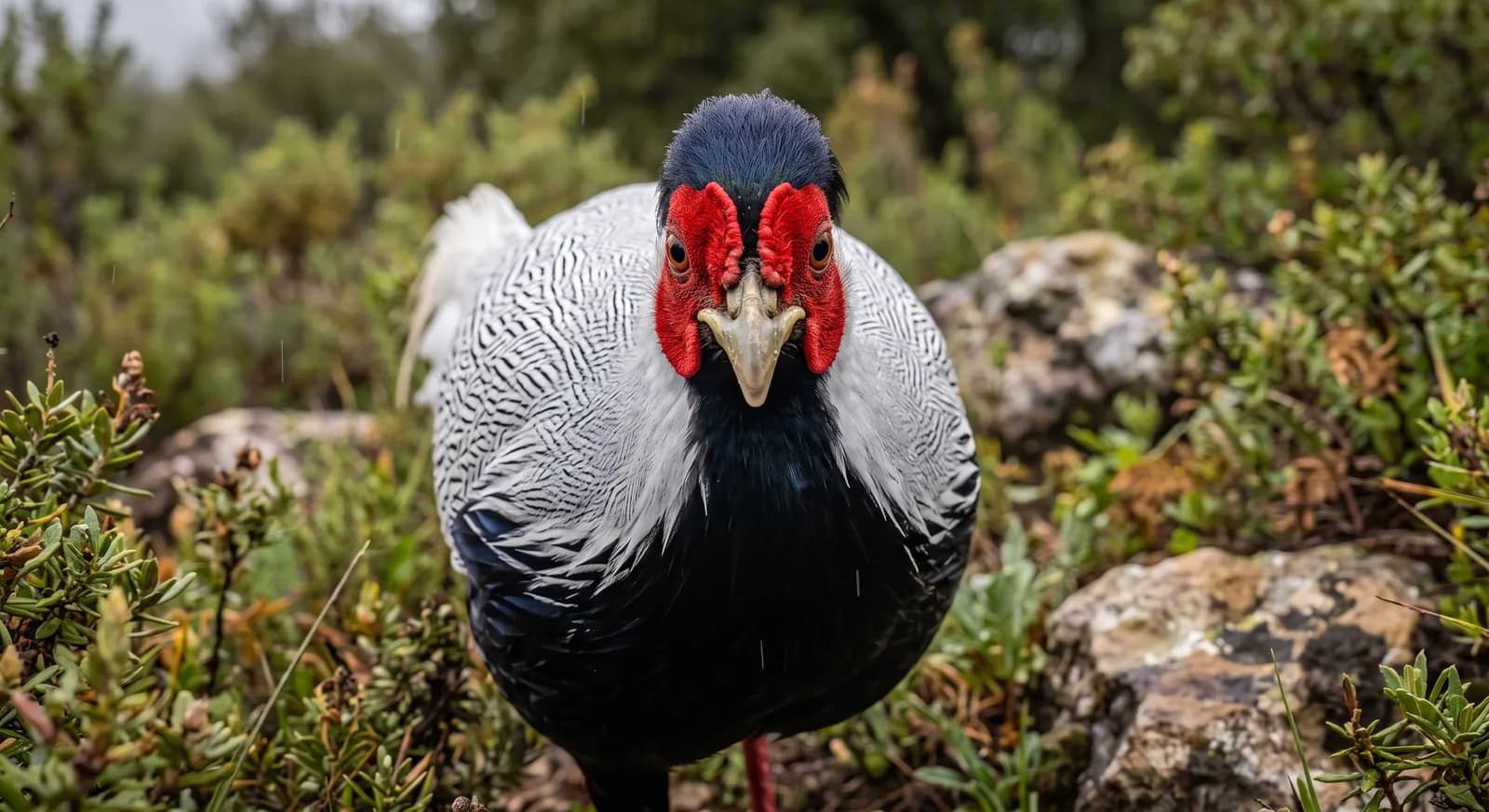
See full glossary
This page in other languages: Español · Deutsch · Français · Português · Italiano
See its range on the interactive map→
Golden PheasantLeast Concern

Golden Pheasant

Chrysolophus pictus

Least Concern

Sri Lanka Junglefowl

Gallus lafayettii

Least Concern

Indian Peafowl

Pavo cristatus

Silver PheasantLeast Concern

Silver Pheasant

Lophura nycthemera

Near Threatened

Japanese Quail

Coturnix japonica

Vulnerable

Great Argus

Argusianus argus

CountriesBangladesh
TagsOmnivore
Omnivore
Diurnal
Family group
Bird
Rainforest
Temperate forest
Grassland
Bangladesh
Bhutan
Cambodia
China
India
Indonesia
Bangladesh
Bhutan
Cambodia
China
India
Indonesia
Laos
Malaysia
Myanmar
Nepal
Pakistan
Philippines
Sri Lanka
Thailand
Vietnam