Skip to content
WAnimals
  • Map
  • Species
  • Parks
  • Diving
Log inCreate account
WAnimals

The guide for travellers and animal lovers: discover, plan and share your wild adventures around the world.

Discover wildlife

  • Species
  • Ecosystems
  • Glossary
  • Tags

Explore places

  • Map
  • Countries
  • Parks
  • Diving

Plan experiences

  • Guides

Learn

  • Blog

Resources

  • Help centre
  • Contact
  • Install the app

Follow us

Account

  • Log in
  • Create account

© 2026 WAnimals. All rights reserved.

About usHow we build our profilesTerms of servicePrivacyLegal notice
MapSpeciesParksDiving
  1. Home
  2. Species
  3. Ross's Turaco

One of the 8 turacos on WAnimals
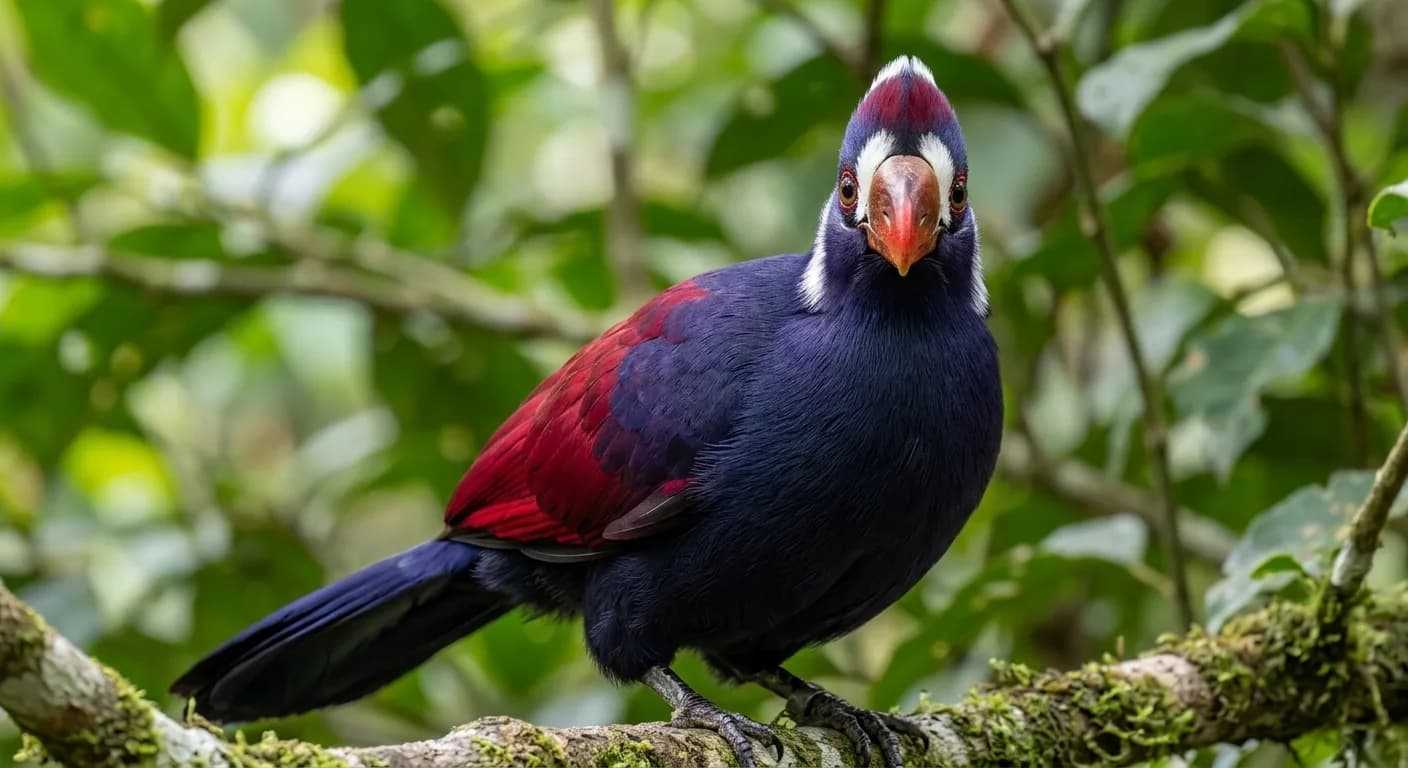
Ross's Turaco (Tauraco rossae)

Birds · Musophagiformes · Musophagidae

Ross's Turaco

Tauraco rossae

Least Concern

The species is abundant and widely distributed; it faces no significant short-term risk.

Spotted something wrong?

Ross's turaco is a spectacular bird of deep bluish violet with a yellow face and a crimson crest. It lives in noisy groups in the gallery forests of Central Africa, feeding on fruit, which it swallows whole. Turacos have two pigments that exist in no other bird family in the world, responsible for their greens and their reds, and which in this species produce a contrast that cannot be mistaken for anything else.

Weight

300 g – 450 g

Size

50 cm – 54 cm

Life expectancy

20 years

Diet

Herbivore

Feeds mainly on plants.

Activity

Diurnal

Active mainly during the day.

Sighting difficulty

Easy

SavannaRainforest
10countries30parks7same family

AI-generated images: illustrations, not photographs.

Fun facts

  • Turacos are the only birds in the world with true green and red pigments: turacoverdin and turacin, both copper-based. In every other bird green is an optical effect of the structure of the feather, not a real pigment.
  • Its red feathers run: turacin is soluble in alkaline water, and a wet feather can turn the water pink.

Life cycle and biology

Skeleton type
Vertebrate - internal bony skeleton (bird)
Habitat and environment
Gallery forest, riverine forest and miombo woodland of Central and East Africa
Sexual maturity
2 years
Gestation / incubation
25 days of incubation
Litter / clutch size
2 eggs

Sources consulted: https://www.iucnredlist.org/ | https://animaldiversity.org/ | https://es.wikipedia.org/

Where to find it

Loading map…

The pins mark the parks where its presence is documented.

Where to see it

Parks and dive sites where this species has been documented — showing 10 of 30.

Related species

Other species in the catalogue with the most in common with Ross's Turaco — same habitat, park, country, tags or family.

Same taxonomic family

Keep exploring

Based on what we already know about ross's turaco.

Comments

Share an experience, a fun fact or a tip for seeing the ross's turaco.

Be the first to comment.

See full glossary
This page in other languages: Español · Deutsch · Français · Português · Italiano
See its range on the interactive map→
Serengeti National ParkTanzania
Maasai Mara National ReserveKenya
NgorongoroTanzania
AmboseliKenya
TsavoKenya
Lake NakuruKenya
SalongaDemocratic Republic of the Congo
Nyerere (formerly Selous)Tanzania
RuahaTanzania
SamburuKenya
See all 30 parks
Ruwenzori TuracoLeast Concern

Ruwenzori Turaco

Gallirex johnstoni

Hartlaub's TuracoLeast Concern

Hartlaub's Turaco

Tauraco hartlaubi

Great Blue TuracoLeast Concern

Great Blue Turaco

Corythaeola cristata

Grey Go-away-birdLeast Concern

Grey Go-away-bird

Corythaixoides concolor

Least Concern

Violet Turaco

Musophaga violacea

Knysna TuracoLeast Concern

Knysna Turaco

Tauraco corythaix

CountriesTanzania
ParksSerengeti National ParkTanzania
TagsHerbivore
Herbivore
Diurnal
Bird
Savanna
Rainforest
Tanzania
Kenya
Uganda
Democratic Republic of the Congo
Rwanda
Cameroon
Angola
Burundi
Cameroon
Democratic Republic of the Congo
Kenya
Rwanda
South Sudan
Tanzania
Uganda
Zambia