Skip to content
WAnimals
  • Map
  • Species
  • Parks
  • Diving
Log inCreate account
WAnimals

The guide for travellers and animal lovers: discover, plan and share your wild adventures around the world.

Discover wildlife

  • Species
  • Ecosystems
  • Glossary
  • Tags

Explore places

  • Map
  • Countries
  • Parks
  • Diving

Plan experiences

  • Guides

Learn

  • Blog

Resources

  • About us
  • How we build our profiles
  • Help centre
  • Contact
  • Install the app

Follow us

Account

  • Log in
  • Create account

© 2026 WAnimals. All rights reserved.

Terms of servicePrivacyCookiesLegal notice
MapSpeciesParksDiving
  1. Home
  2. Species
  3. Spectacled Flying Fox

One of the 8 flying foxes on WAnimals

Mammals · Chiroptera · Pteropodidae

Spectacled Flying Fox

Pteropus conspicillatus

Endangered

At very high risk of extinction in the wild in the near future.

Spotted something wrong?

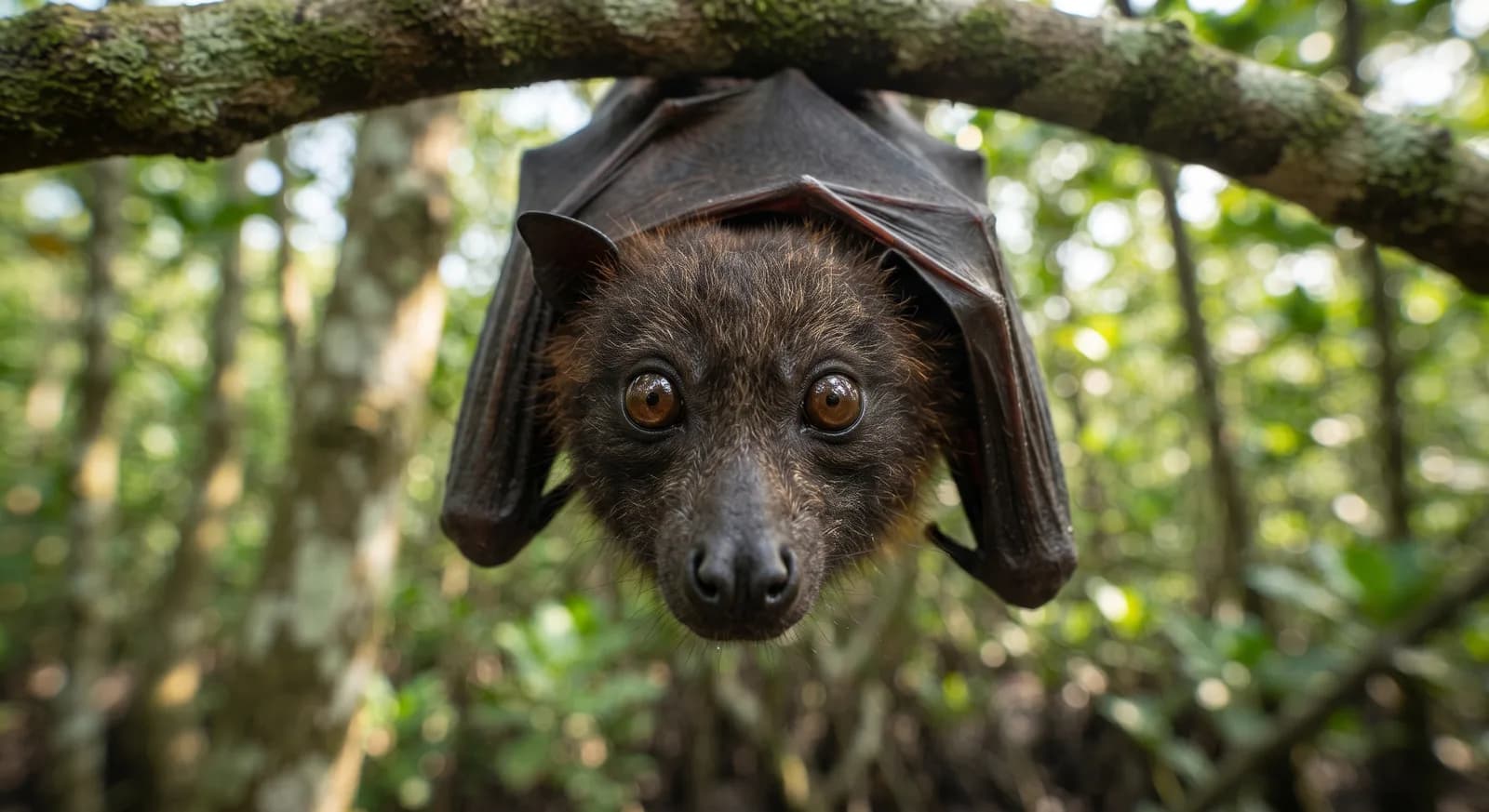
The spectacled flying fox is a large fruit-eating bat belonging to the genus Pteropus, whose members are usually known as flying foxes. It lives on the north-east coast of Queensland, Australia, and is also found on several nearby islands, among them New Guinea, Woodlark, the Kiriwina Islands and Halmahera; its natural habitat extends across areas of rainforest and mangrove. The species was classified as of least concern by the IUCN in 2008.

Weight

400 g – 1 kg

Size

22 cm – 24 cm

Life expectancy

17 years

Diet

Herbivore

Feeds mainly on plants.

Activity

Nocturnal

Active mainly at night.

Social structure

Colony

Lives in large concentrations, often for breeding reasons.

Rainforest
3countries9parks9same family

Fun facts

  • In November 2018 a heatwave of more than 42 degrees killed tens of thousands of them in two days in northern Queensland, close to a third of the species' Australian population.
  • It is the main seed disperser of the Australian wet tropical rainforest, a World Heritage site: without it, more than a hundred tree species would lose their means of long-distance dispersal.

Life cycle and biology

Skeleton type
Vertebrate - internal bony skeleton (mammal)
Habitat and environment
Tropical rainforest, mangroves and gallery forest of northern Queensland and New Guinea
Sexual maturity
2.1 years
Gestation / incubation
5.9 months
Litter / clutch size
1

Sources consulted: Wikipedia (es): Pteropus conspicillatus

Where to find it

Loading map…

The pins mark the parks where its presence is documented.

Where to see it

Parks and dive sites where this species has been documented.

Related species

Other species in the catalogue with the most in common with Spectacled Flying Fox — same habitat, park, country, tags or family.

Same taxonomic family
Shares a park
Shares a park

How to help

The spectacled flying fox is classified as endangered. Organisations such as the IUCN, WWF and the Wildlife Conservation Society work specifically on its conservation and that of its habitat; looking into their programmes is a good starting point if you want to get involved.

It's documented in 4 protected areas — one reason why protecting these places matters for its conservation.

Keep exploring

Based on what we already know about spectacled flying fox.
Share an experience, a fun fact or a tip for seeing the spectacled flying fox.
See full glossary
This page in other languages: Español · Deutsch · Français · Português · Italiano
See its range on the interactive map→
LorentzIndonesia
KakaduAustralia
DaintreeAustralia
Kokoda TrackPapua New Guinea
EungellaAustralia
WasurIndonesia
Rinyirru (Lakefield)Australia
TondaPapua New Guinea
VarirataPapua New Guinea
Black Flying FoxLeast Concern

Black Flying Fox

Pteropus alecto

Grey-headed Flying FoxVulnerable

Grey-headed Flying Fox

Pteropus poliocephalus

Large Flying-foxEndangered

Large Flying-fox

Pteropus vampyrus

Least Concern

Greater Shortnosed Fruit Bat

Cynopterus sphinx

Near Threatened

Lumholtz's Tree Kangaroo

Dendrolagus lumholtzi

Least Concern

Common Phalanger

Phalanger orientalis

CountriesAustralia
ParksLorentzIndonesia
TagsHerbivore
Herbivore
Nocturnal
Colonial
Endangered
Rainforest
Mammal
Australia
Papua New Guinea
Indonesia