One of the 13 squirrels on WAnimals
Mammals · Rodentia · Sciuridae
Indian Giant Squirrel
Ratufa indica
The species is abundant and widely distributed; it faces no significant short-term risk. See full glossary
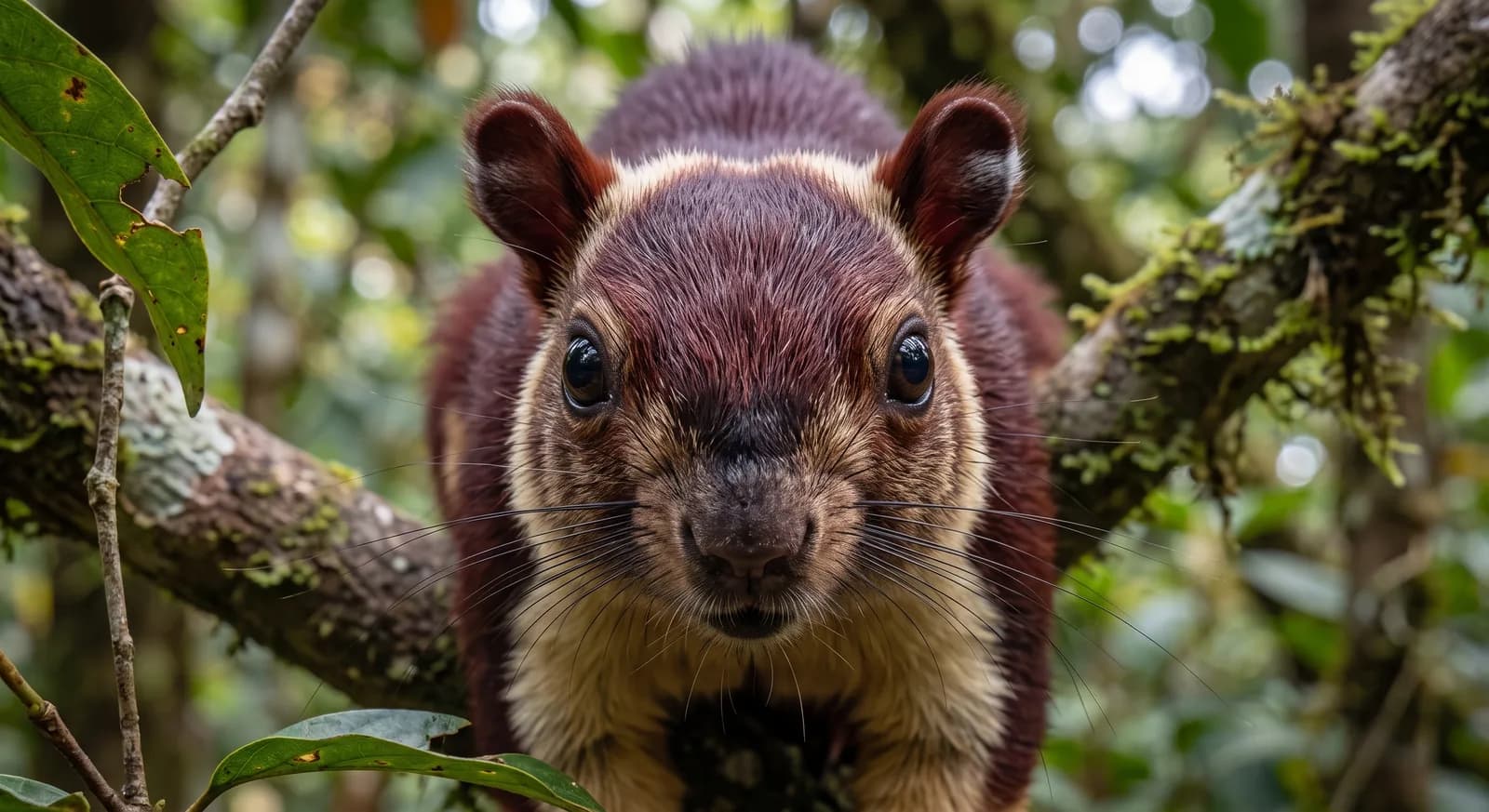
The Indian giant squirrel, or Malabar giant squirrel, is one of the largest and most striking squirrels in the world, with a coat combining chestnut, cream, maroon and purple depending on the subspecies. It lives exclusively in the high canopy of the forests of peninsular India and virtually never comes down to the ground: it moves by leaping between branches and can cover six metres in a single jump. It builds several spherical nests of twigs and leaves within its territory and uses them in rotation.
Weight
1.5 kg – 2 kg
Size
35 cm – 50 cm
Lifespan
20 years
Diet
Omnivore
Combines animal and plant food depending on availability.
Activity
Diurnal
Active mainly during the day.
Social structure
Solitary
Lives and hunts alone, joining others only to breed.
Sighting difficulty
Easy
Fun facts
- It leaps as much as six metres between trees, stretching out in mid-air and using its tail as a rudder: if it misses its grip it can fall more than ten metres and run off unhurt.
- It builds several nests within the same territory and rotates between them, some for sleeping and others for breeding, which makes it harder for a predator to learn where to find it.
Life cycle & biology
- Skeleton type
- Vertebrate - internal bony skeleton (mammal)
- Habitat & environment
- The high canopy of evergreen and deciduous moist forest in peninsular India
- Sexual maturity
- 2 years
- Gestation / incubation
- 2.8 months
- Litter / clutch size
- 1
Sources consulted: https://es.wikipedia.org/wiki/Ratufa_indica
Where to find it
See its range on the interactive mapWhere to watch it
Parks and dive sites where this species has been documented.
Related species
Other species in the catalogue with the most in common with Indian Giant Squirrel — same habitat, park, country, tags or family.
Pallas's Squirrel
Callosciurus erythraeus
Indian Peafowl
Pavo cristatus
Common Palm Civet
Paradoxurus hermaphroditus
Indian Gray Mongoose
Urva edwardsii
 Near Threatened
Black Giant Squirrel
Ratufa bicolor
Keep exploring
Based on what we already know about indian giant squirrel.
Comments
Share an experience, a fun fact or a tip for seeing the indian giant squirrel.
Be the first to comment.