One of the 9 guenons on WAnimals
Mammals · Primates · Cercopithecidae
L'Hoest's Monkey
Allochrocebus lhoesti
It faces a high risk of extinction in the wild over the medium term. See full glossary
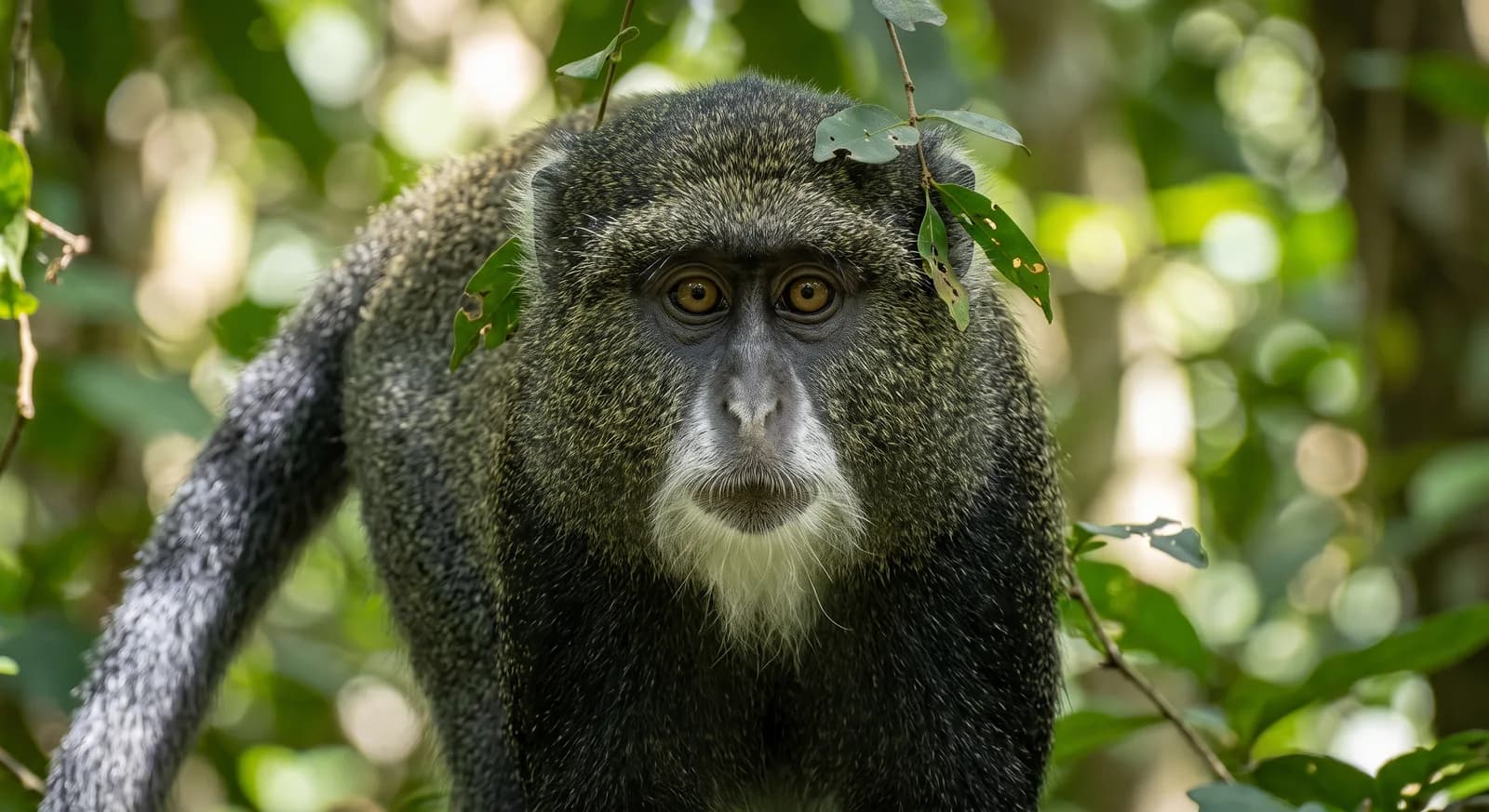
L'Hoest's monkey is a primate of the montane forests of the Albertine Rift, on the borders of Uganda, Rwanda and the Democratic Republic of the Congo. It is dark, with a striking white ruff on the throat and chest, and carries its tail hooked over its back. Unlike most guenons it spends much of its time on the ground, searching for invertebrates and shoots in the leaf litter. It depends on well-preserved forest and is in retreat through logging and hunting.
Weight
3 kg – 6 kg
Size
45 cm – 70 cm
Lifespan
24 years
Diet
Omnivore
Combines animal and plant food depending on availability.
Activity
Diurnal
Active mainly during the day.
Sighting difficulty
Moderate
Fun facts
- It is one of the most terrestrial guenons: while its relatives live in the canopy, this one works the floor of the montane forest looking for invertebrates and roots.
- It carries its tail hooked up over its back as it walks, a characteristic posture that gives it away even when only its silhouette shows through the vegetation.
Life cycle & biology
- Skeleton type
- Vertebrate - internal bony skeleton (mammal)
- Habitat & environment
- Montane forest and bamboo forest of the Albertine Rift, between 900 and 2,500 metres
- Sexual maturity
- 5 years
- Gestation / incubation
- 5 months
- Litter / clutch size
- 1
Sources consulted: https://en.wikipedia.org/wiki/L'Hoest's_monkey
Where to find it
See its range on the interactive mapWhere to watch it
Parks and dive sites where this species has been documented.
Related species
Other species in the catalogue with the most in common with L'Hoest's Monkey — same habitat, park, country, tags or family.
Grey-cheeked Mangabey
Lophocebus albigena
Angolan Colobus
Colobus angolensis
De Brazza’s Monkey
Cercopithecus neglectus
Wolf's Monkey
Cercopithecus wolfi
 Least Concern
Blue Monkey
Cercopithecus mitis
Putty-nosed Monkey
Cercopithecus nictitans
How to help
The l'hoest's monkey is classified as vulnerable. Organizations such as UICN, WWF y Wildlife Conservation Society work specifically on its conservation and that of its habitat; looking into their programs is a good starting point if you want to get involved.
It's documented in 6 real protected areas — part of why protecting these places matters for its conservation.
Keep exploring
Based on what we already know about l'hoest's monkey.
Comments
Share an experience, a fun fact or a tip for seeing the l'hoest's monkey.
Be the first to comment.