One of the 2 mangabeys on WAnimals
Mammals · Primates · Cercopithecidae
Grey-cheeked Mangabey
Lophocebus albigena
It faces a high risk of extinction in the wild over the medium term. See full glossary
The grey-cheeked mangabey is a primate of the family Cercopithecidae that lives in the forests of Central Africa. They live from Cameroon to Gabon. The grey-cheeked mangabey is a dark monkey, similar in build to a baboon. Its dense fur is almost black in its forest home, with a slightly golden fleck around the neck. There is almost no sexual dimorphism; the males are only a little larger than the females.
Weight
5 kg – 11 kg
Size
45 cm – 72 cm
Lifespan
32 years
Diet
Omnivore
Combines animal and plant food depending on availability.
Activity
Diurnal
Active mainly during the day.
Sighting difficulty
Moderate
Fun facts
- The males' call, a whoop followed by a gobble, carries more than a kilometre through closed forest and serves to keep groups apart without the need for direct encounters.
- It opens seeds with extremely hard shells that almost no other primate in its forest can make use of, which gives it access to a reliable food supply at times when ripe fruit is scarce.
Life cycle & biology
- Skeleton type
- Vertebrate - internal bony skeleton (mammal)
- Habitat & environment
- Canopy of primary rainforest, swamp forest and gallery forest of Central Africa
- Sexual maturity
- 4 years
- Gestation / incubation
- 5.9 months
- Litter / clutch size
- 1
Sources consulted: https://es.wikipedia.org/wiki/Lophocebus_albigena
Where to find it
See its range on the interactive mapWhere to watch it
Parques y spots de buceo donde se ha documentado esta especie — se muestran 10 de 14 documentados.
Related species
Other species in the catalogue with the most in common with Grey-cheeked Mangabey — same habitat, park, country, tags or family.
Black Colobus
Colobus satanas
 Vulnerable
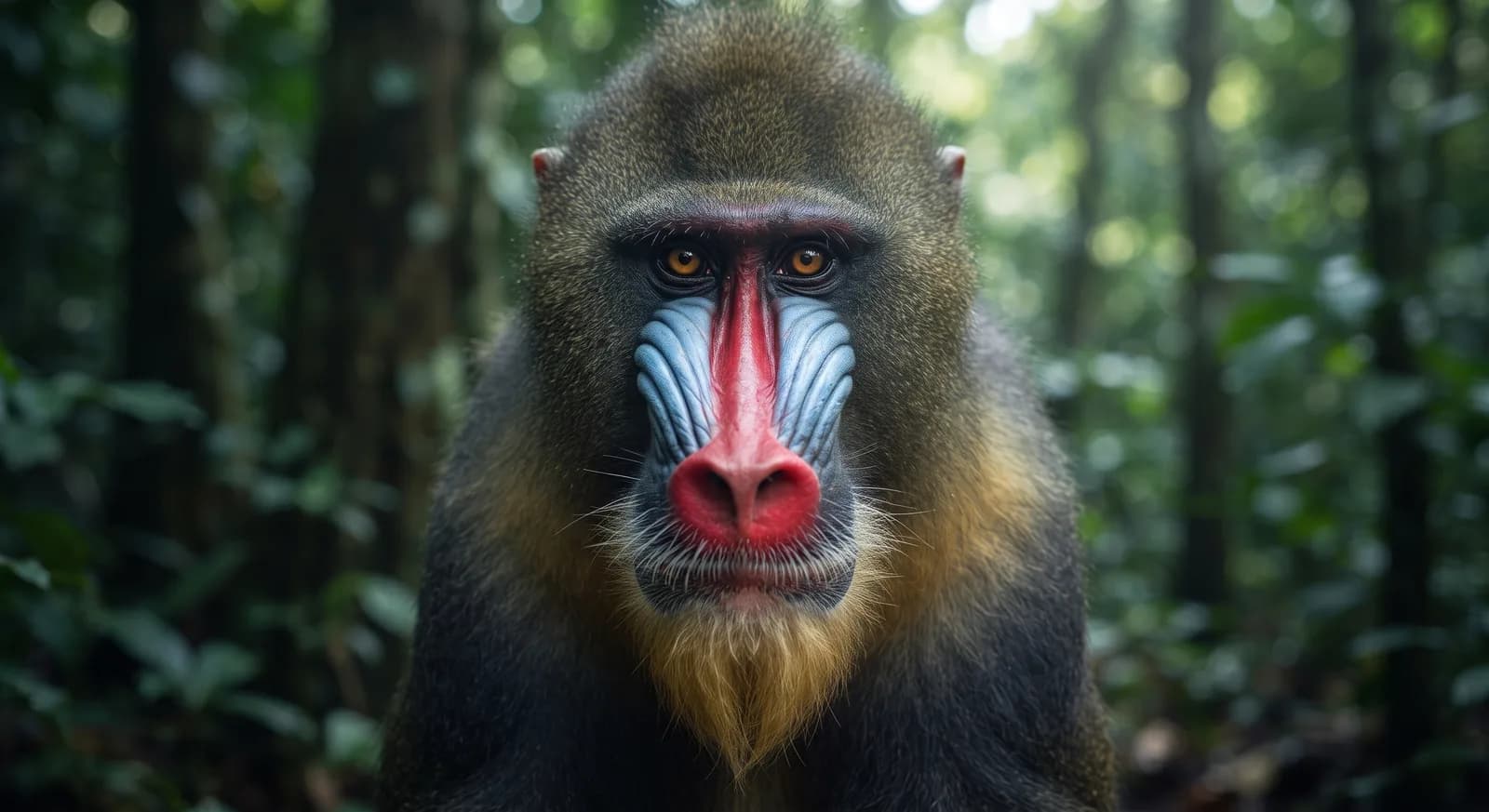
Mandrill
Mandrillus sphinx
L'Hoest's Monkey
Allochrocebus lhoesti
Angolan Colobus
Colobus angolensis
De Brazza’s Monkey
Cercopithecus neglectus
Wolf's Monkey
Cercopithecus wolfi
How to help
The grey-cheeked mangabey is classified as vulnerable. Organizations such as UICN, WWF y Wildlife Conservation Society work specifically on its conservation and that of its habitat; looking into their programs is a good starting point if you want to get involved.
It's documented in 9 real protected areas — part of why protecting these places matters for its conservation.
Keep exploring
Based on what we already know about grey-cheeked mangabey.
Comments
Share an experience, a fun fact or a tip for seeing the grey-cheeked mangabey.
Be the first to comment.