One of the 9 guenons on WAnimals
Mammals · Primates · Cercopithecidae
Putty-nosed Monkey
Cercopithecus nictitans
The species is abundant and widely distributed; it faces no significant short-term risk. See full glossary
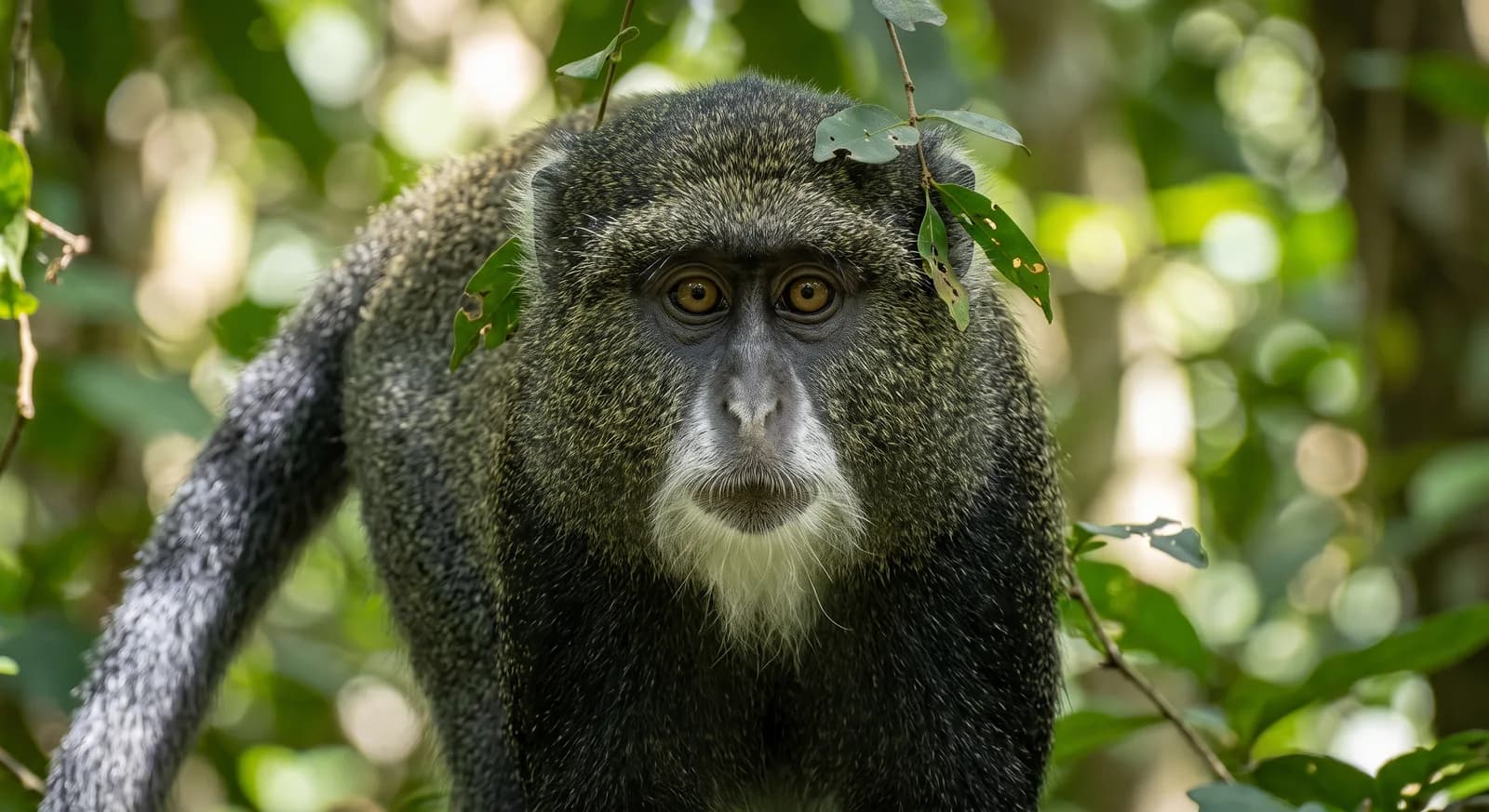
The putty-nosed monkey is a primate of the forests of the Gulf of Guinea, recognisable by the large oval white patch on its nose against a dark coat. It lives in groups of one male and several females high in the canopy, and often forms associations with mangabeys and colobus monkeys. Its vocal repertoire has been the subject of much-cited studies on the combination of signals, one of the most debated animal precedents for syntax.
Weight
4 kg – 8 kg
Size
45 cm – 70 cm
Lifespan
25 years
Diet
Omnivore
Combines animal and plant food depending on availability.
Activity
Diurnal
Active mainly during the day.
Sighting difficulty
Easy
Fun facts
- The males combine two distinct alarm calls into sequences that mean something different from what they mean separately: it is one of the most cited examples of protosyntax in a non-human animal.
- Its cheek pouches can hold as much fruit as its stomach, which lets it strip a contested tree quickly and withdraw to eat without competition.
Life cycle & biology
- Skeleton type
- Vertebrate - internal bony skeleton (mammal)
- Habitat & environment
- The canopy of primary rainforest and mature secondary forest of west-central Africa
- Sexual maturity
- 4 years
- Gestation / incubation
- 5.7 months
- Litter / clutch size
- 1
Sources consulted: https://www.iucnredlist.org/ | https://animaldiversity.org/ | https://es.wikipedia.org/
Where to find it
See its range on the interactive mapWhere to watch it
Parques y spots de buceo donde se ha documentado esta especie — se muestran 10 de 22 documentados.
Related species
Other species in the catalogue with the most in common with Putty-nosed Monkey — same habitat, park, country, tags or family.
De Brazza’s Monkey
Cercopithecus neglectus
Wolf's Monkey
Cercopithecus wolfi
 Least Concern
Blue Monkey
Cercopithecus mitis
Campbell’s Monkey
Cercopithecus campbelli
Drill
Mandrillus leucophaeus
Grey-cheeked Mangabey
Lophocebus albigena
Keep exploring
Based on what we already know about putty-nosed monkey.
Comments
Share an experience, a fun fact or a tip for seeing the putty-nosed monkey.
Be the first to comment.