One of the 4 gibbons on WAnimals
Mammals · Primates · Hylobatidae
Pileated Gibbon
Hylobates pileatus
It faces a very high risk of extinction in the wild in the near future. See full glossary
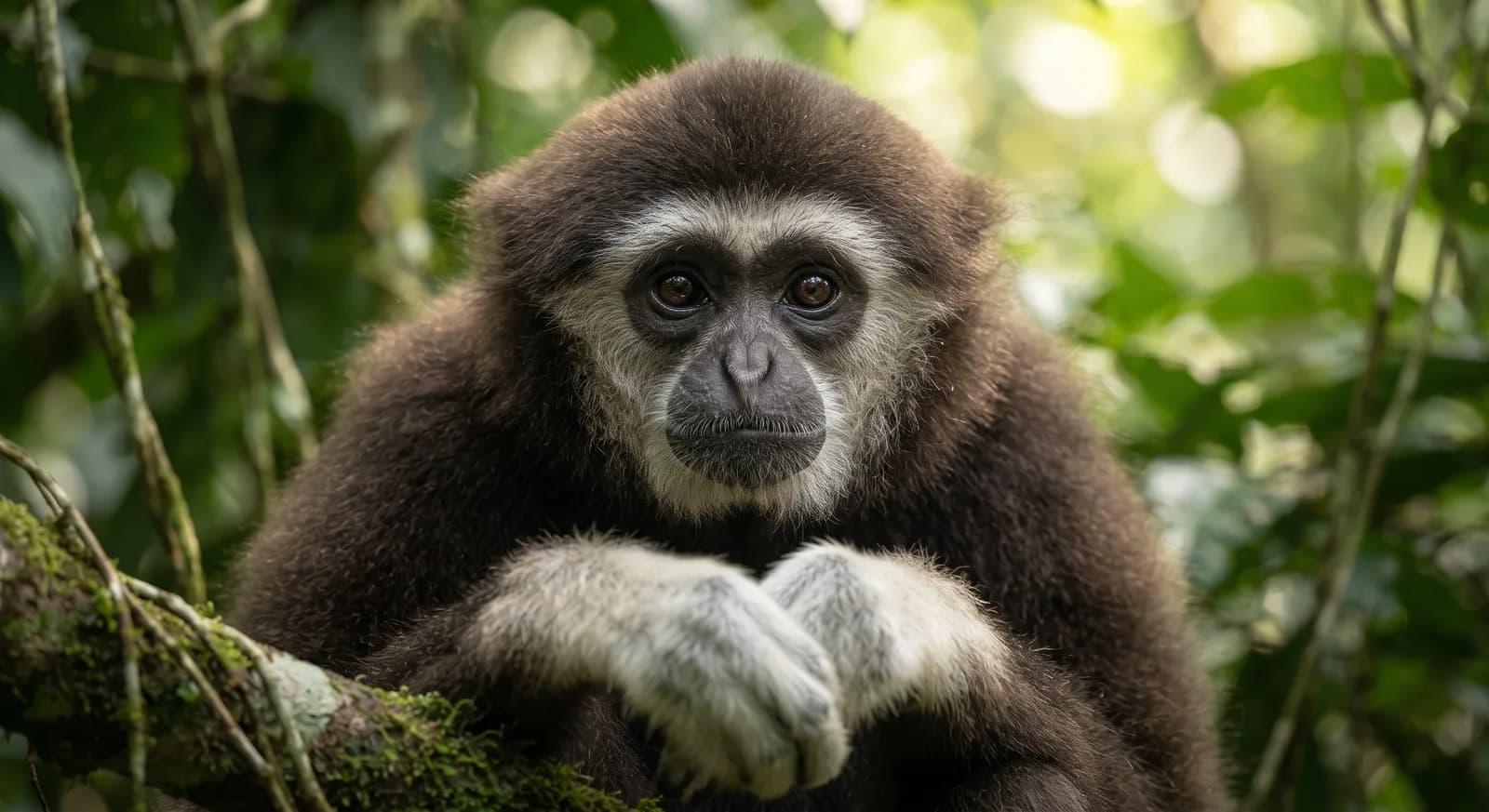
The pileated gibbon owes its name to the black cap on its head. It shows very marked dimorphism: the males are black with white hands, feet and face ring, and the females are silvery grey with a black cap. It lives in monogamous pairs that occupy a territory they rarely leave. Its range is reduced to a strip between south-eastern Thailand, western Cambodia and south-western Laos.
Weight
4.5 kg – 7.5 kg
Size
45 cm – 64 cm
Lifespan
30 years
Diet
Herbivore
Feeds mainly on plants.
Activity
Diurnal
Active mainly during the day.
Social structure
In pairs
Usually lives in pairs, sometimes for life.
Sighting difficulty
Hard
Fun facts
- The pair's duet is so distinctive that researchers use it to census whole populations without seeing a single animal: each song identifies an occupied territory.
- Male and female are so different in colour that they are often taken for different species: he is black with white extremities, she silvery with a black crown.
Life cycle & biology
- Skeleton type
- Vertebrate - internal bony skeleton (mammal)
- Habitat & environment
- Humid evergreen and semi-deciduous forest of eastern Thailand, Cambodia and Laos
- Sexual maturity
- 7 years
- Gestation / incubation
- 7.5 months
- Litter / clutch size
- 1
Sources consulted: https://es.wikipedia.org/wiki/Hylobates_pileatus
Where to watch it
Parks and dive sites where this species has been documented.
Related species
Other species in the catalogue with the most in common with Pileated Gibbon — same habitat, park, country, tags or family.
Northern White-cheeked Gibbon
Nomascus leucogenys
Agile Gibbon
Hylobates agilis
 Endangered
Lar Gibbon
Hylobates lar
 Endangered
Siamang
Symphalangus syndactylus
 Endangered
Asian Elephant
Elephas maximus
Southern Pig-tailed Macaque
Macaca nemestrina
How to help
The pileated gibbon is classified as endangered. Organizations such as UICN, WWF y Wildlife Conservation Society work specifically on its conservation and that of its habitat; looking into their programs is a good starting point if you want to get involved.
It's documented in 2 real protected areas — part of why protecting these places matters for its conservation.
Keep exploring
Based on what we already know about pileated gibbon.
Comments
Share an experience, a fun fact or a tip for seeing the pileated gibbon.
Be the first to comment.