Birds · Coraciiformes · Momotidae
Amazonian Motmot
Momotus momota
The species is abundant and widely distributed; it faces no significant short-term risk. See full glossary
The Amazonian motmot, also called the pendulum bird, is an intensely coloured bird, green and turquoise with a black mask and a blue crown, famous for its tail: the two central feathers end in rackets separated from the rest by a bare stretch, and the bird swings them from side to side like a pendulum while perched.
Weight
100 g – 140 g
Size
38 cm – 43 cm
Lifespan
14 years
Diet
Omnivore
Combines animal and plant food depending on availability.
Activity
Diurnal
Active mainly during the day.
Social structure
In pairs
Usually lives in pairs, sometimes for life.
Sighting difficulty
Easy
Fun facts
- anatomíaIt trims the central feathers of its own tail with its bill into their characteristic racket shape, rather than their growing that way.
- The rackets on its tail do not grow that way: the barbs along the middle stretch are weaker and come away with preening and wear, leaving the shaft bare and the racket at the tip.
- It swings its tail like a pendulum while perched, and studies suggest this is a signal aimed at predators: it tells them they have been spotted and that chasing it will be pointless.
- It nests in tunnels it digs into earth banks, sometimes more than a metre and a half long, and pairs can spend months digging before laying.
Life cycle & biology
- Skeleton type
- Vertebrate - internal bony skeleton (bird)
- Habitat & environment
- Understorey of rainforest, secondary forest, coffee plantations and gardens of tropical America
- Sexual maturity
- 12 months
- Gestation / incubation
- 21 days
- Litter / clutch size
- 3 eggs
Sources consulted: https://en.wikipedia.org/wiki/Amazonian_motmot
Where to find it
See its range on the interactive mapWhere to watch it
Parques y spots de buceo donde se ha documentado esta especie — se muestran 10 de 44 documentados.
Related species
Other species in the catalogue with the most in common with Amazonian Motmot — same habitat, park, country, tags or family.
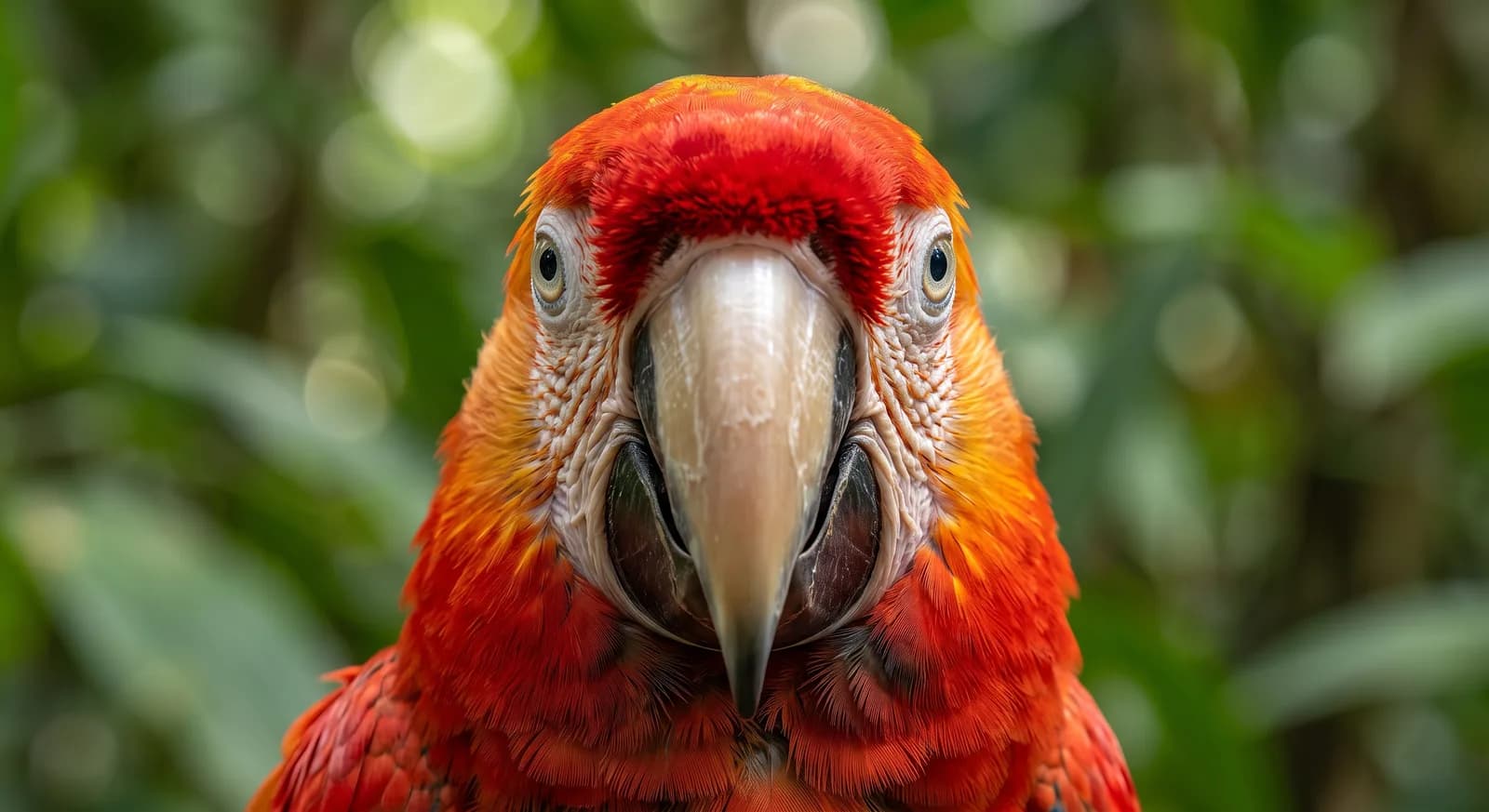 Least Concern
Scarlet Macaw
Ara macao
Collared Trogon
Trogon collaris
Yellow-Crowned Amazon
Amazona ochrocephala
Baltimore Oriole
Icterus galbula
Indigo Bunting
Passerina cyanea
Scarlet-rumped Tanager
Ramphocelus passerinii
Keep exploring
Based on what we already know about amazonian motmot.
Comments
Share an experience, a fun fact or a tip for seeing the amazonian motmot.
Be the first to comment.