Mammals · Artiodactyla · Bovidae
Nilgai
Boselaphus tragocamelus
The species is abundant and widely distributed; it faces no significant short-term risk. See full glossary
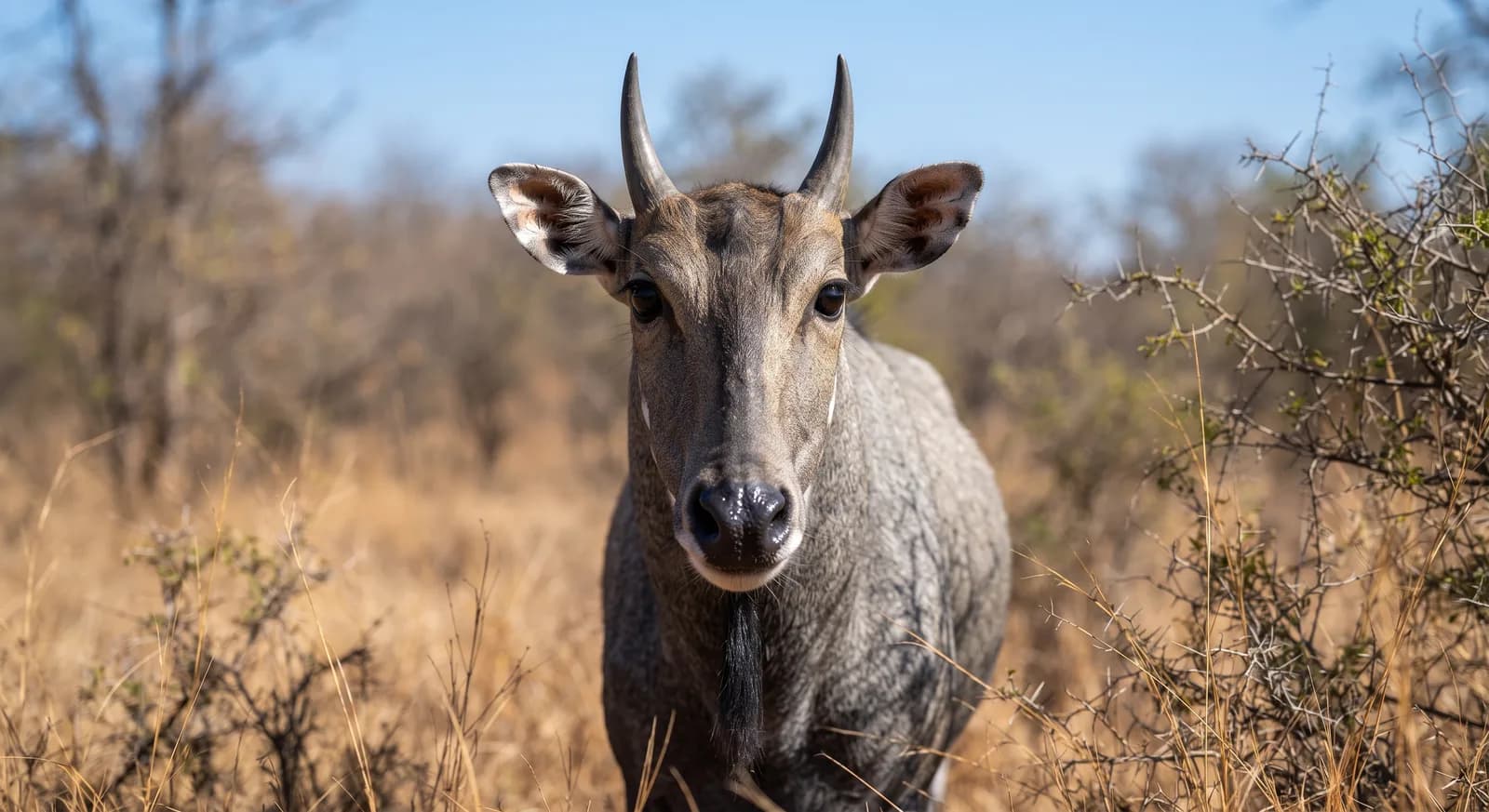
The nilgai is the largest antelope in Asia. It shows striking dimorphism: adult males are blue-grey with white legs and short, straight horns, while females and young animals are tawny and hornless. Its name means blue cow in Hindi and Urdu, and that association with the sacred cow has protected it from hunting in India for centuries. It lives in small groups in open country and eats grasses, leaves and fruit.
Weight
100 kg – 300 kg
Size
1.7 m – 2.1 m
Lifespan
15 years
Diet
Herbivore
Feeds mainly on plants.
Activity
Diurnal
Active mainly during the day.
Sighting difficulty
Easy
Fun facts
- GeneralThe largest wild bovid in Asia; in India it is respected through its association with the sacred cow.
- Its name means blue cow, and that association with the sacred animal of Hinduism has spared it from hunting for centuries, to the point that it is now so abundant in some Indian states that it causes serious conflict with farming.
- The males always defecate in the same places, building communal middens several metres across that work as territorial markers visible from a distance.
Life cycle & biology
- Skeleton type
- Vertebrate - internal bony skeleton (mammal)
- Habitat & environment
- Dry scrub, open woodland, grassland and farmland of the Indian subcontinent
- Sexual maturity
- 2.2 years
- Gestation / incubation
- 8.4 months
- Litter / clutch size
- 1.5 (average)
Sources consulted: https://es.wikipedia.org/wiki/Boselaphus_tragocamelus
Where to find it
See its range on the interactive mapWhere to watch it
Parks and dive sites where this species has been documented.
Related species
Other species in the catalogue with the most in common with Nilgai — same habitat, park, country, tags or family.
Blackbuck
Antilope cervicapra
Four-horned Antelope
Tetracerus quadricornis
 Not Evaluated
Water Buffalo
Bubalus bubalis
 Vulnerable
Gaur
Bos gaurus
Bighorn Sheep
Ovis canadensis
Keep exploring
Based on what we already know about nilgai.
Comments
Share an experience, a fun fact or a tip for seeing the nilgai.
Be the first to comment.