Skip to content
WAnimals
  • Map
  • Species
  • Parks
  • Diving
Log inCreate account
WAnimals

The guide for travellers and animal lovers: discover, plan and share your wild adventures around the world.

Discover wildlife

  • Species
  • Ecosystems
  • Glossary
  • Tags

Explore places

  • Map
  • Countries
  • Parks
  • Diving

Plan experiences

  • Guides

Learn

  • Blog

Resources

  • About us
  • How we build our profiles
  • Help centre
  • Contact
  • Install the app

Follow us

Account

  • Log in
  • Create account

© 2026 WAnimals. All rights reserved.

Terms of servicePrivacyCookiesLegal notice
MapSpeciesParksDiving
  1. Home
  2. Species
  3. Rhinoceros Viper

One of the 12 vipers on WAnimals
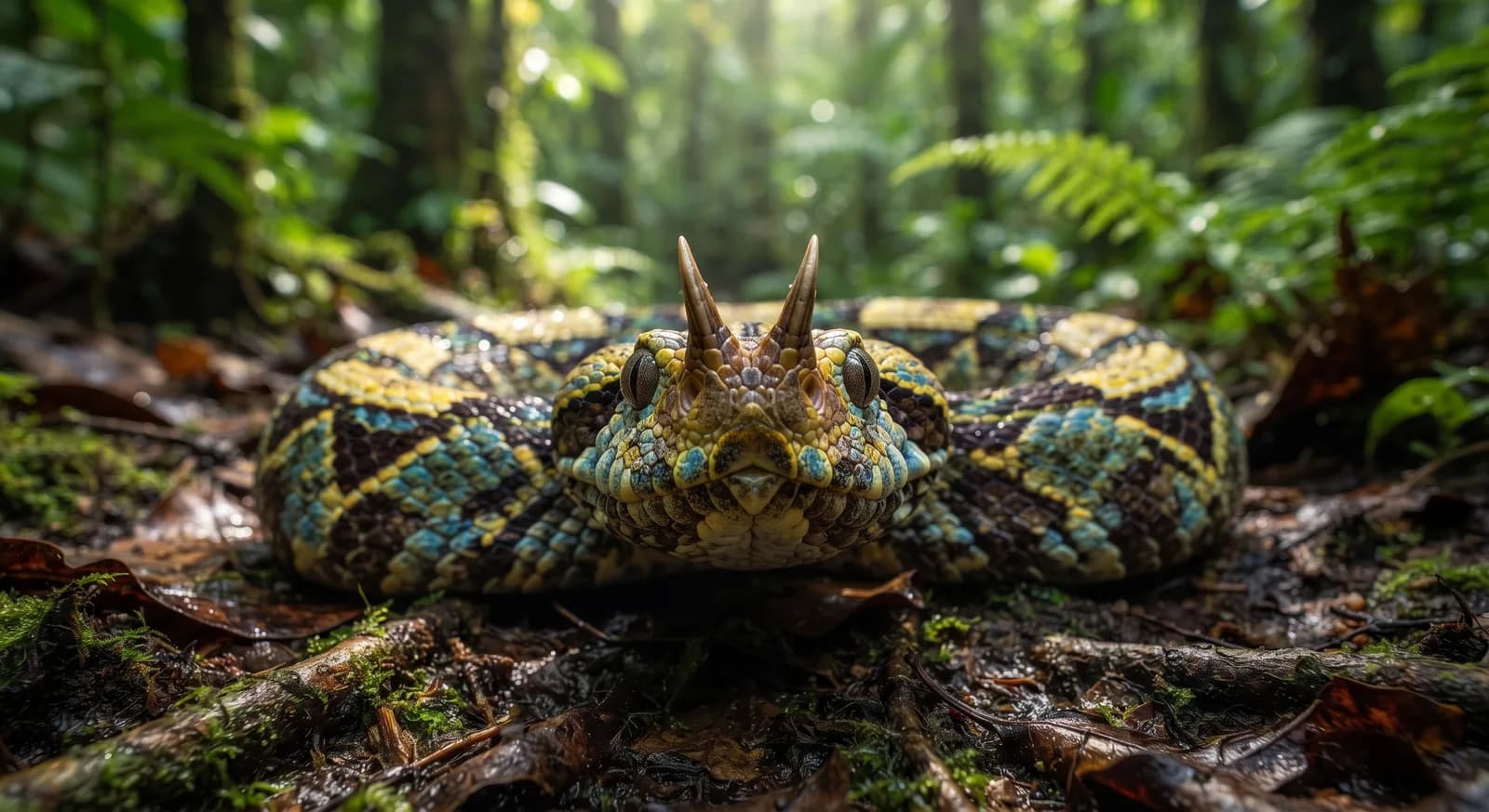
Rhinoceros Viper (Bitis nasicornis)

Reptiles · Squamata · Viperidae

Rhinoceros Viper

Bitis nasicornis

Least Concern

The species is abundant and widely distributed; it faces no significant short-term risk.

Spotted something wrong?

The rhinoceros viper is one of the most spectacular snakes in the world: its skin combines purple, blue, green, red and yellow in a geometric mosaic, and it carries two or three pairs of scaly horns on its snout. Despite those colours it is almost invisible on the leaf litter of the African forest floor, where it hunts by ambush.

Weight

2 kg – 4 kg

Size

70 cm – 1.2 m

Life expectancy

15 years
Diet

Carnivore

Feeds mainly on other animals.

Activity

Nocturnal

Active mainly at night.

Social structure

Solitary

Lives and hunts alone, joining others only to breed.

RainforestFreshwater
12countries19parks22same family

AI-generated images: illustrations, not photographs.

Fun facts

  • GeneralIts skin, patterned in geometric blues and greens, makes it invisible in the leaf litter.
  • It is probably the most colourful snake in Africa: a mosaic of purple, blue, green, red and yellow that, against the damp leaf litter of the forest floor, works as perfect camouflage despite looking impossible in the hand.
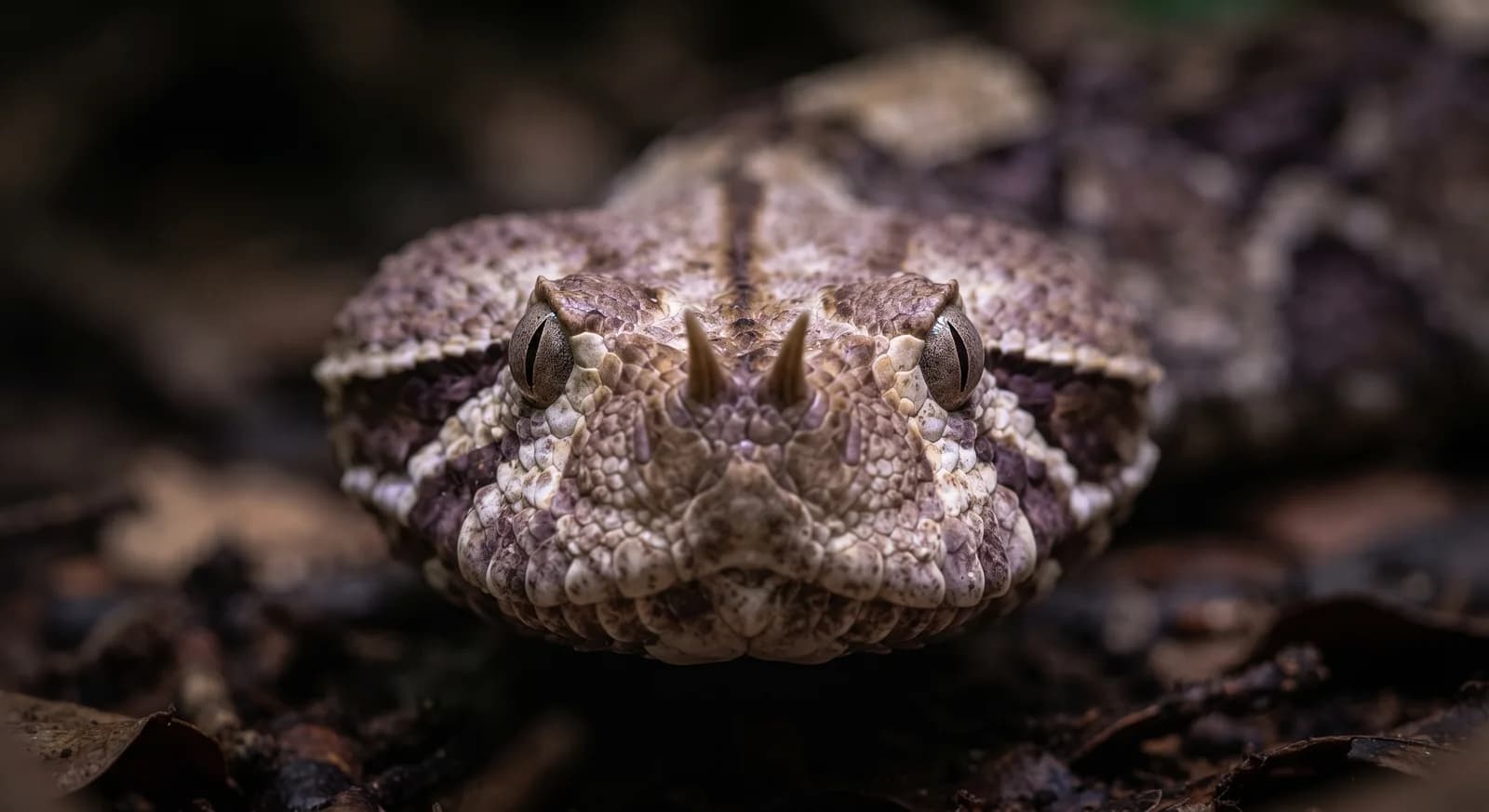
  • The horns on the snout are modified scales and their function is still unclear, although it has been suggested that they break up the outline of the head.
  • It is a patient ambusher: it can stay motionless in the same spot for weeks waiting for a rodent to pass, and strikes with extraordinary speed for such a heavy snake.

Life cycle and biology

Skeleton type
Vertebrate - internal bony skeleton (reptile)
Habitat and environment
Rainforest, swamp forest and waterlogged ground of Central and West Africa
Sexual maturity
3 years
Gestation / incubation
7 months of gestation
Litter / clutch size
20 live young

Sources consulted: Wikipedia (en): Bitis nasicornis

Where to find it

Loading map…

The pins mark the parks where its presence is documented.

Where to see it

Parks and dive sites where this species has been documented — showing 10 of 19.

Related species

Other species in the catalogue with the most in common with Rhinoceros Viper — same habitat, park, country, tags or family.

Same taxonomic family
Shares a park
Shares a park
Shares a park
Shares a park

Keep exploring

Based on what we already know about rhinoceros viper.

Share an experience, a fun fact or a tip for seeing the rhinoceros viper.
See full glossary
This page in other languages: Español · Deutsch · Français · Português · Italiano
See its range on the interactive map→
KakumGhana
TaiCôte d’Ivoire
SalongaDemocratic Republic of the Congo
Dzanga-SanghaCentral African Republic
DjaCameroon
Loango National ParkGabon
Monte Alén National ParkEquatorial Guinea
Sapo National ParkLiberia
SemulikiUganda
KorupCameroon
See all 19 parks
Gaboon ViperNot Evaluated

Gaboon Viper

Bitis gabonica

Puff AdderLeast Concern

Puff Adder

Bitis arietans

Nile CrocodileLeast Concern

Nile Crocodile

Crocodylus niloticus

Least Concern

Helmeted Turtle

Pelomedusa subrufa

Least Concern

Spotted Ctenopoma

Ctenopoma acutirostre

Least Concern

Zaire Dwarf Clawed Frog

Hymenochirus boettgeri

CountriesCameroon
ParksKakumGhana
TagsCarnivore
Carnivore
Nocturnal
Solitary
Reptile
Rainforest
Freshwater
Cameroon
Democratic Republic of the Congo
Gabon
Nigeria
Uganda
Central African Republic
Cameroon
Central African Republic
Côte d’Ivoire
Democratic Republic of the Congo
Equatorial Guinea
Gabon
Ghana
Guinea
Kenya
Liberia
Nigeria
Uganda