Skip to content
WAnimals
  • Map
  • Species
  • Parks
  • Diving
Log inCreate account
WAnimals

The guide for travellers and animal lovers: discover, plan and share your wild adventures around the world.

Discover wildlife

  • Species
  • Ecosystems
  • Glossary
  • Tags

Explore places

  • Map
  • Countries
  • Parks
  • Diving

Plan experiences

  • Guides

Learn

  • Blog

Resources

  • About us
  • How we build our profiles
  • Help centre
  • Contact
  • Install the app

Follow us

Account

  • Log in
  • Create account

© 2026 WAnimals. All rights reserved.

Terms of servicePrivacyCookiesLegal notice
MapSpeciesParksDiving
  1. Home
  2. Species
  3. Small-headed Treefrog

One of the 4 treefrogs on WAnimals
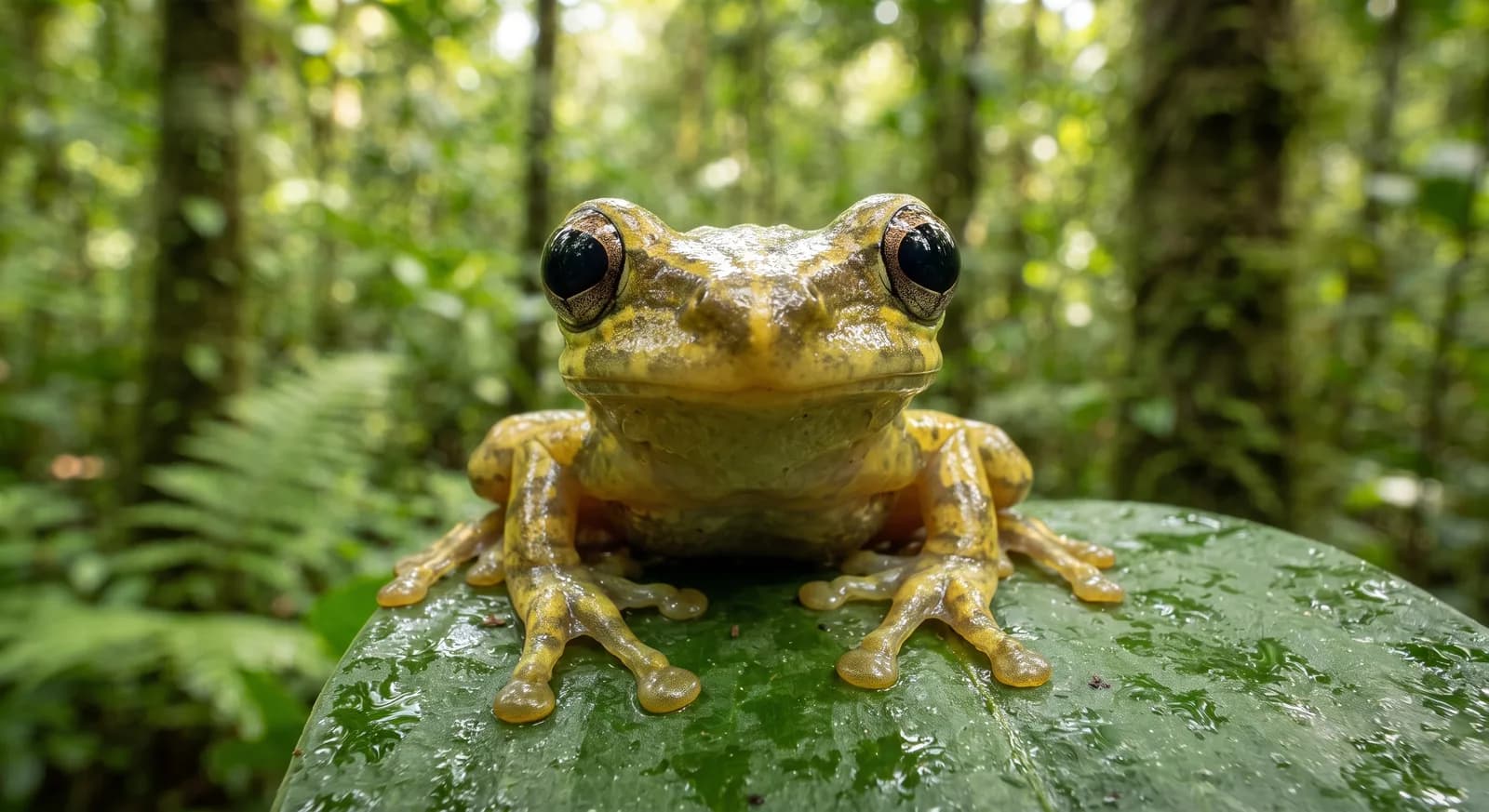
Small-headed Treefrog (Dendropsophus microcephalus)

Amphibians · Anura · Hylidae

Small-headed Treefrog

Dendropsophus microcephalus

Least Concern

The species is abundant and widely distributed; it faces no significant short-term risk.

Spotted something wrong?

The small-headed treefrog is a species of amphibian of the family Hylidae. The head is flat and the snout rounded and short. The eyes have elliptical pupils set horizontally. The nostrils face sideways and the area between them is slightly concave. This species can undergo a change of colour. At night the back is pale yellow with several brown or light brown markings. By day the back is tan, yellow or light brown with darker brown or red blotches. This frog has uniformly yellow thighs with a brown line, often edged by a narrow white line running from the nostril to the vent.

Size

2 cm – 3 cm

Life expectancy

4 years

Diet

Insectivore

Feeds mainly on insects and other invertebrates.

Activity

Nocturnal

Active mainly at night.

Social structure

Colony

Lives in large concentrations, often for breeding reasons.

RainforestFreshwaterGrassland
13countries7same family

AI-generated images: illustrations, not photographs.

Fun facts

  • Its choruses are among the densest in the Neotropics: hundreds of males calling at once from the vegetation over a pool make a noise that makes conversation difficult a few metres away.
  • The males time their calls so as not to overlap with their neighbour, alternating within microseconds so that each is audible separately to the females.
  • It is one of the most abundant frogs in the ditches and pools of tropical America, and it benefits from the waterlogged areas created by roads and clearance.
  • Males call in very large choruses and synchronise their calls: they alternate and overlap following precise rules, so that their call is not masked by the neighbour's.
  • That acoustic competition is a classic model for the study of animal communication in noisy environments.
  • It is tiny, about three centimetres long, and pale yellow with brown lines that camouflage it against dry grass.
  • It breeds in temporary pools and its tadpoles develop quickly before the water disappears.
  • It is abundant and tolerant of disturbed environments, which makes it common in roadside ditches and field margins.

Life cycle and biology

Skeleton type
Vertebrate - internal bony skeleton (amphibian)
Habitat and environment
Vegetation over pools, ditches and wetlands of tropical America
Sexual maturity
10 months
Gestation / incubation
Larval development in pools and flooded ground
Litter / clutch size
200 eggs

Sources consulted: Wikipedia (es): Dendropsophus microcephalus

Where to find it

Loading map…

Related species

Other species in the catalogue with the most in common with Small-headed Treefrog — same habitat, park, country, tags or family.

Same taxonomic family

Keep exploring

Based on what we already know about small-headed treefrog.

Share an experience, a fun fact or a tip for seeing the small-headed treefrog.
See full glossary
This page in other languages: Español · Deutsch · Français · Português · Italiano
See its range on the interactive map→
Least Concern

Mission Golden-eyed Treefrog

Trachycephalus resinifictrix

Least Concern

American Green Treefrog

Dryophytes cinereus

Least Concern

Gray Treefrog

Dryophytes versicolor

Least Concern

Stripeless Treefrog

Hyla meridionalis

Least Concern

White's Tree Frog

Litoria caerulea

Least Concern

Common Tree Frog

Hyla arborea

CountriesBrazil
TagsInsectivore
Insectivore
Nocturnal
Colonial
Amphibian
Rainforest
Freshwater
Grassland

North America7

South America6

Brazil
Colombia
Costa Rica
Ecuador
Guatemala
Guyana
Costa Rica
Guatemala
Honduras
Mexico
Nicaragua
Panama
Trinidad and Tobago
Brazil
Colombia
Ecuador
Guyana
Peru
Venezuela