Skip to content
WAnimals
  • Map
  • Species
  • Parks
  • Diving
Log inCreate account
WAnimals

The guide for travellers and animal lovers: discover, plan and share your wild adventures around the world.

Discover wildlife

  • Species
  • Ecosystems
  • Glossary
  • Tags

Explore places

  • Map
  • Countries
  • Parks
  • Diving

Plan experiences

  • Guides

Learn

  • Blog

Resources

  • Help centre
  • Contact
  • Install the app

Follow us

Account

  • Log in
  • Create account

© 2026 WAnimals. All rights reserved.

About usHow we build our profilesTerms of servicePrivacyLegal notice
MapSpeciesParksDiving
  1. Home
  2. Species
  3. Water Chevrotain

One of the 12 deer on WAnimals

Mammals · Artiodactyla · Tragulidae

Water Chevrotain

Hyemoschus aquaticus

Least Concern

The species is abundant and widely distributed; it faces no significant short-term risk.

Spotted something wrong?

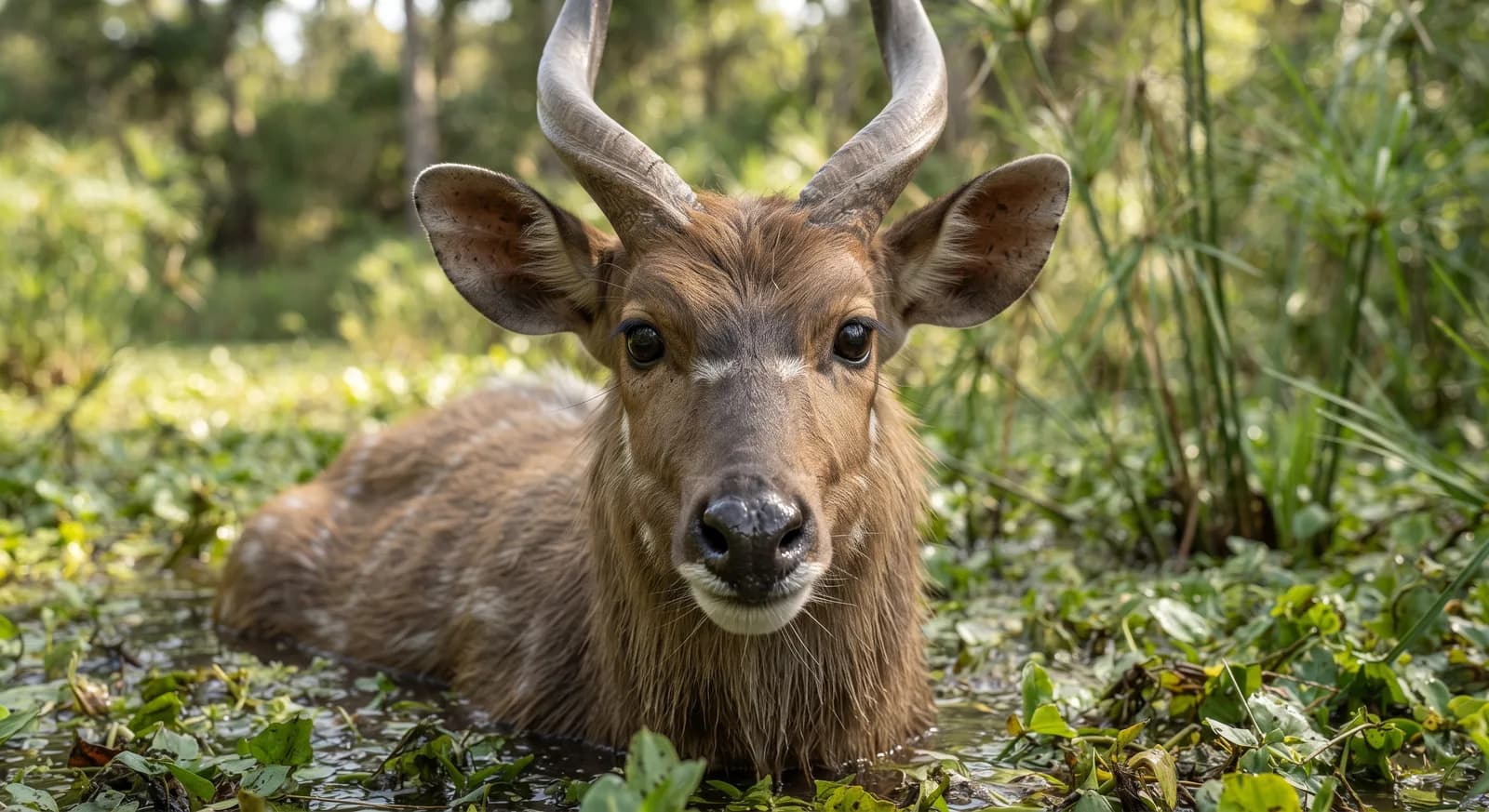
The water chevrotain is the only African tragulid and the largest of the family. It is not a deer: the tragulids are the oldest surviving lineage of ruminants, and they keep very primitive features such as the absence of horns and elongated upper canines in the males. It is nocturnal, solitary and always close to water: when chased it throws itself into the river and can stay submerged for several minutes, moving along the bottom.

Weight

7 kg – 16 kg

Size

75 cm – 85 cm

Life expectancy

13 years

Diet

Herbivore

Feeds mainly on plants.

Activity

Nocturnal

Active mainly at night.

Social structure

Solitary

Lives and hunts alone, joining others only to breed.

Sighting difficulty

Easy

RainforestFreshwater
12countries22parks1same family

Fun facts

  • GeneralIt hides underwater when chased, and represents a very primitive form of hoofed mammal.
  • When chased it submerges and walks along the river bed, breathing with only its snout out of the water: it can stay down for several minutes until the predator leaves.
  • The tragulids are the most primitive living ruminants: their lineage split about 35 million years ago and keeps features that deer and antelopes lost long ago, such as tusks instead of horns.

Life cycle and biology

Skeleton type
Vertebrate - internal bony skeleton (mammal)
Habitat and environment
Moist forest beside rivers and streams, and gallery forest of West and Central Africa
Sexual maturity
13.2 months
Gestation / incubation
5.7 months
Litter / clutch size
1.25 (average)

Sources consulted: https://es.wikipedia.org/wiki/Hyemoschus_aquaticus

Where to find it

Loading map…

The pins mark the parks where its presence is documented.

Where to see it

Parks and dive sites where this species has been documented — showing 10 of 22.

Related species

Other species in the catalogue with the most in common with Water Chevrotain — same habitat, park, country, tags or family.

Shares a park
Shares a park
Shares a park
Shares a park
Shares a park
Shares a park

Keep exploring

Based on what we already know about water chevrotain.

Comments

Share an experience, a fun fact or a tip for seeing the water chevrotain.

Be the first to comment.
See full glossary
This page in other languages: Español · Deutsch · Français · Português · Italiano
See its range on the interactive map→
KakumGhana
TaiCôte d’Ivoire
SalongaDemocratic Republic of the Congo
Dzanga-SanghaCentral African Republic
Odzala-KokouaRepublic of the Congo
DjaCameroon
Loango National ParkGabon
Monte Alén National ParkEquatorial Guinea
Sapo National ParkLiberia
Outamba-Kilimi National ParkSierra Leone
See all 22 parks
Least Concern

Northern Giant Pouched Rat

Cricetomys gambianus

SitatungaLeast Concern

Sitatunga

Tragelaphus spekii

Least Concern

West African Potto

Perodicticus potto

Rhinoceros ViperLeast Concern

Rhinoceros Viper

Bitis nasicornis

Least Concern

Hairy Frog

Trichobatrachus robustus

Least Concern

Royal Antelope

Neotragus pygmaeus

CountriesCameroon
ParksKakumGhana
TagsHerbivore
Herbivore
Nocturnal
Solitary
Rainforest
Freshwater
Mammal
Cameroon
Democratic Republic of the Congo
Gabon
Central African Republic
Nigeria
Republic of the Congo
Cameroon
Central African Republic
Côte d’Ivoire
Democratic Republic of the Congo
Equatorial Guinea
Gabon
Ghana
Guinea
Liberia
Nigeria
Republic of the Congo
Sierra Leone