Birds · Anseriformes · Anatidae
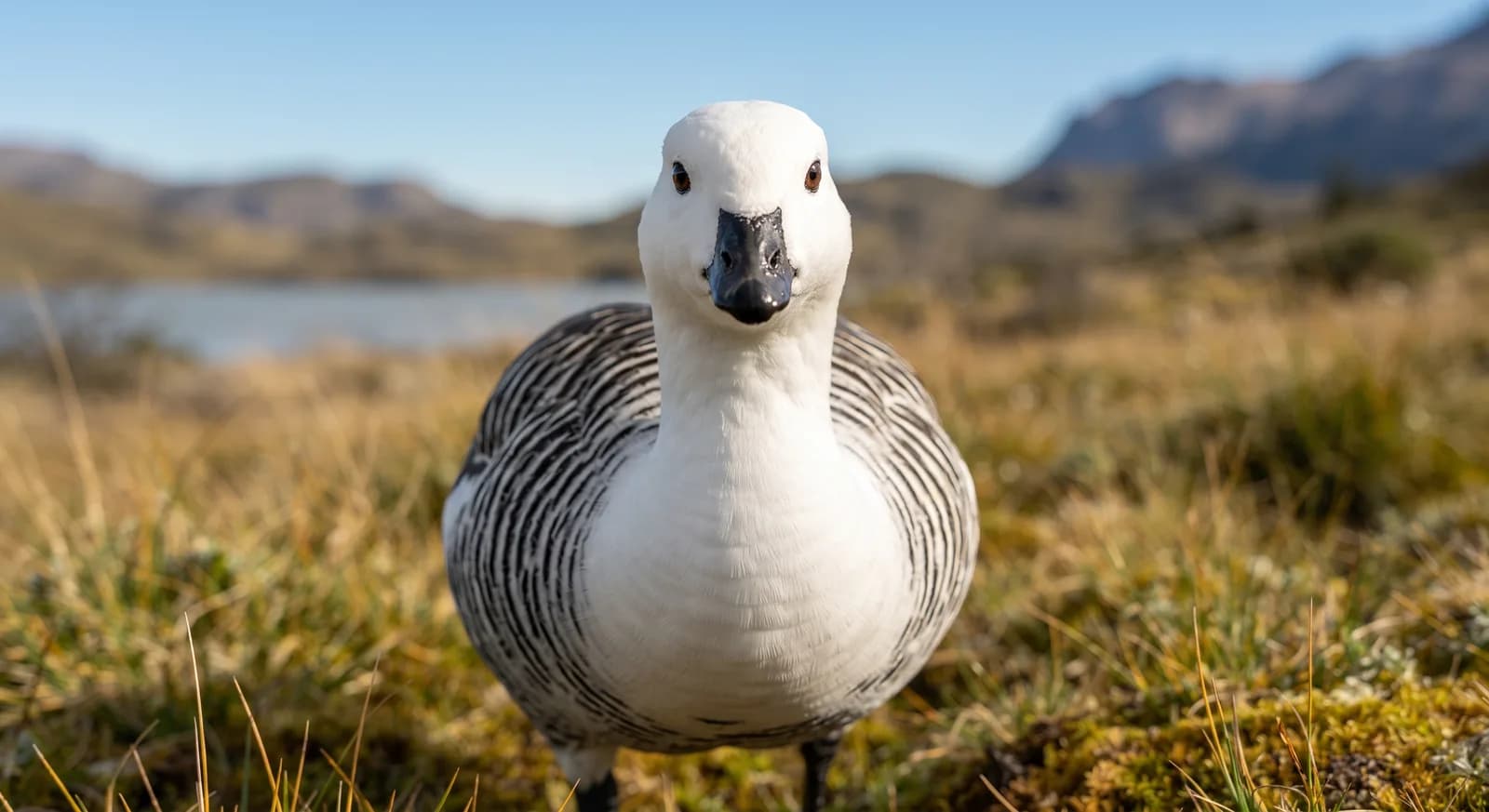
Upland Goose
Chloephaga picta
The species is abundant and widely distributed; it faces no significant short-term risk. See full glossary
A South American goose of upright bearing with a short, conical black bill. Its most visible feature is the wing pattern in flight: blackish primaries and a broad black band with a greenish sheen against a white ground, with a black tail. Males and females differ in plumage.
Weight
23 kg – 35 kg
Size
50 cm – 54 cm
Lifespan
15 years
Diet
Herbivore
Feeds mainly on plants.
Activity
Diurnal
Active mainly during the day.
Social structure
In pairs
Usually lives in pairs, sometimes for life.
Sighting difficulty
Easy
Estimated population
85% of the Chilean population is on the steppes of Aysén and Magallanes
Fun facts
- Its genus, Chloephaga, means 'grass eaters' in Greek, after its diet of tender grass on the Patagonian riverbanks.
- A 2021 study showed that it disperses mosses by endozoochory: 50% of the bryophyte fragments recovered from its droppings regenerated new tissue after 91 days.
- It is the most widespread of the five South American sheldgeese.
Life cycle & biology
- Skeleton type
- Vertebrate - internal bony skeleton (bird)
- Habitat & environment
- Steppe, scrub and parkland, especially water meadows and grassland under 20 cm tall close to water. It lives from the province of Buenos Aires and the Maule Region southwards
- Birth weight
- Precocial: born covered in down and leaves the nest within a few hours
- Size at birth
- Precocial: born covered in down and leaves the nest within a few hours
- Sexual maturity
- 2 years
- Gestation / incubation
- ~30 days of incubation
- Litter / clutch size
- 5-8 eggs per clutch
Sources consulted: IUCN Red List; Ministerio del Medio Ambiente de Chile (RCE, 19.º proceso); SIB - Parques Nacionales de Argentina; Lázaro, Mackenzie y Jiménez 2021, Ecology and Evolution; Schüttler et al. 2009; Rozzi y Sherriffs 2003; Ibarra et al. 2009; Peris et al. 2009; Gmelin 1789
Where to find it
See its range on the interactive mapBest time: All year round in Patagonia; it migrates to the south of Buenos Aires in winter
Where to watch it
Parks and dive sites where this species has been documented.
Related species
Other species in the catalogue with the most in common with Upland Goose — same habitat, park, country, tags or family.
Black-necked Swan
Cygnus melancoryphus
Crested Caracara
Caracara plancus
American Kestrel
Falco sparverius
Burrowing Parrot
Cyanoliseus patagonus
Short-eared Owl
Asio flammeus
Keep exploring
Based on what we already know about upland goose.
Comments
Share an experience, a fun fact or a tip for seeing the upland goose.
Be the first to comment.